
LED Work Lights for Warehouse & Forklift
Forklift OEM lighting for truck builders, dealers and pedestrian-detection system makers: blue spot, red zone, arch and arrow projection lights and amber beacons in 9–32 to 10–110 V DC versions, built to your drawing.

A reach truck turning out of an aisle at the end of a night shift meets a picker who cannot see it coming. The light that prevents that meeting is fitted by the truck builder or the dealer, and it has to run on whatever the truck carries: 12 V on an engine truck, 24 V to 80 V on an electric one. This page is written for the people who specify lighting on material-handling equipment: engineers and buyers at forklift, reach truck, order picker and telehandler builders, the dealers who fit safety packages, and the makers of pedestrian-detection systems who need a light at the end of their signal chain.
The short version: blue spot, red zone, arch and arrow projection lights and amber strobe beacons in four voltage versions (9–32, 10–48, 10–60 and 10–110 V DC), IP69K housings with potted drivers on the projection lights, and brackets, connectors and cable lengths built to your drawing from 60 pieces per model. The full catalogue range is on the forklift safety lights page; this page covers what a truck builder specifies.
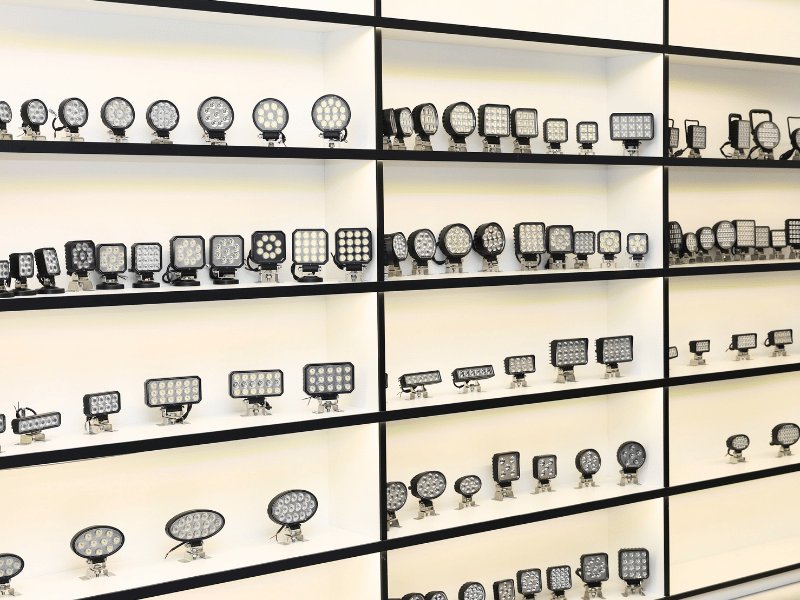
Common Challenges in Warehouse & Forklift
One light, every voltage in the fleet
Engine trucks run 12 V and electrics run 24 V to 80 V, and a light that needs a converter on half the fleet is a light that does not get fitted.
The warning has to land where people look
A projection that lands too close, too far or off to one side warns nobody, so mounting height and angle belong in the specification.
Rack strikes move the aim
A knock against the racking or a hard dock plate can turn a bracket, and a turned bracket moves the warning off the floor where it was set.
What material-handling OEMs ask about first
In the order the questions usually arrive: does it run on the truck's voltage without a converter, does the projection land where pedestrians will see it, will it stay aimed after rack strikes and dock-plate shocks, how does it mount on the overhead guard, and what do the regulations say. Documentation closes the list, and for a pedestrian-detection system maker the interface to the controller sits beside it.
Send the spec sheet and we mark our status against every line
Vibration profile, IP rating, supply voltage, connector, certifications: you get a line-by-line answer, and a test report per model where one exists.
Get RecommendationsReply within 24 hours
| Requirement | What the specification usually calls for | Tough Lighting status |
|---|---|---|
| Truck voltage | 12 V engine trucks, 24 V to 80 V electrics, one light family across the fleet | Four voltage versions of the projection lights and beacons: 9–32, 10–48, 10–60 and 10–110 V DC |
| Pedestrian warning pattern | Blue spot ahead of or behind the truck, red zone lines along the sides, a curve around the rear swing; colour set by the site | Blue spot, red zone line, arch (halo) and arrow projections; blue, red and green versions; projection distance set by mounting height and angle on the truck |
| Rack strikes, dock plates and vibration | A light and bracket that stay aimed after knocks, uneven floors and constant chassis vibration | Potted drivers; vibration run on our own table to your profile, report per model on request; brackets to your drawing |
| Mounting | Overhead guard front, rear and sides; a bracket that holds the aim angle | Compact housings for the overhead guard; bracket, cable length and connector built to your specification |
| Cold stores and washdown | Condensation between freezer and dock; washdown in food and pharma warehouses | IP69K housings with potted drivers on the projection lights |
| Regulations and site rules | Site rules for pedestrian zones and colours; OSHA 1910.178 for powered industrial trucks in the US; UL 583 for electric trucks where the buyer requires it | The light supports the site rule; the truck's own approvals remain the builder's, and we supply the per-model documentation that goes into them |
| Warranty | Years of multi-shift service | 5-year warranty on the projection lights and amber strobe beacons |
| Documentation and interface | EMC evidence next to truck controllers and radios; a switched input for pedestrian-detection systems | Built to CISPR 25, class confirmed per model; EN 12895 testing supported to your specification; connector and cable built to your drawing, so a detection controller can switch the light through its supply |
Light positions on a forklift
A counterbalance or reach truck working in mixed traffic carries lights in six places. The table pairs each position with models often specified there; all of them are available in the voltage versions above unless noted.
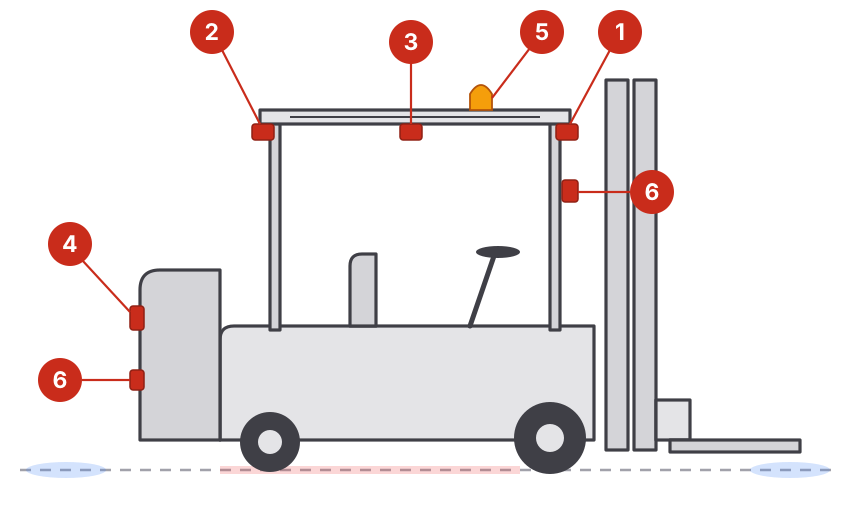
| Position | Job | Pattern | Example models |
|---|---|---|---|
| Overhead guard, front | Warn pedestrians at aisle ends before the truck arrives | Blue spot or arrow projected ahead | 4inch 20W LED Forklift Safety Lights5.5″ 10W LED Arrow Beams Forklift Blue Light |
| Overhead guard, rear | Warn when reversing | Blue spot projected behind, or a blue backup light | 4inch 20W LED Forklift Safety Lights5.5inch 45W Blue Forklift Backup Lights |
| Overhead guard, sides | Mark the keep-out zone along the truck | Red zone line on each side | 4inch 20W Red/Blue Zone Warning Lights |
| Rear swing | Mark the counterweight swing radius | Red or blue arch (halo) | 3inch 20W Arch Beam LED Forklift Safety Lights5inch 20W Arch Beam LED Forklift Safety Lights |
| Roof | Make the truck visible across the floor | Amber strobe beacon | 3-3/4″ Amber LED Strobe Light Beacon5-1/4″ Amber LED Strobe Light Beacon |
| Front and rear lamps | Travel, signal and reversing light, including outdoor yard work | Combination headlight with turn and position functions | 4.5inch 92W LED Combination Headlights |
Recommended Products for Warehouse & Forklift


Not seeing your lamp position or output band? Send the drawing, or a photo and the machine model, and we shortlist models for each position.
Get RecommendationsHow an OEM programme runs
There are two routes, depending on whether your drawing calls for a light we already build or a new part.
Catalogue and private label. Any of the 300-plus lights in the catalogue can be supplied under your brand from 60 pieces per model, with your logo, packaging, connector and cable length. Samples of stock and private-label lights ship first, typically within 1 to 5 days, and production runs in 15 to 25 working days.
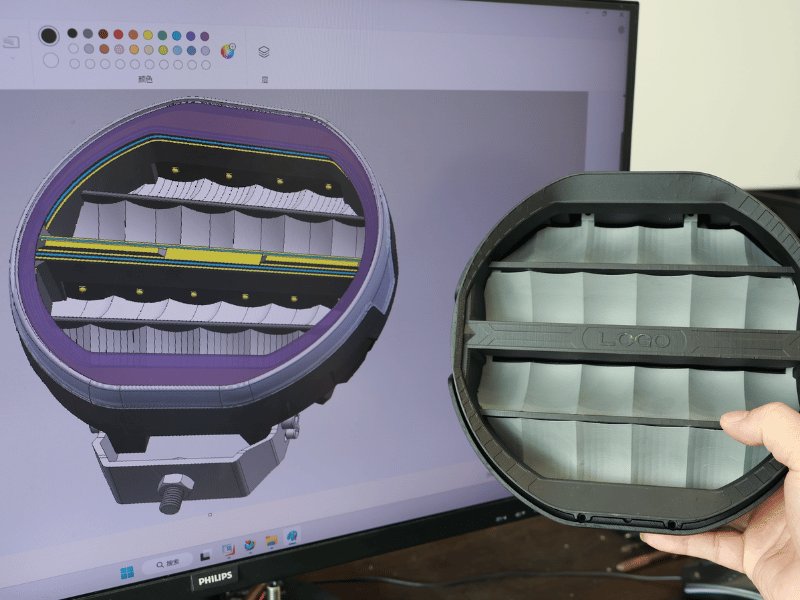
Custom development. Where the mounting position, pattern or housing is new, we develop the light to your requirement: design in 7 to 15 days, a 3D-printed prototype in 5 to 7 working days, production tooling in 30 to 45 days and pre-production samples in 7 to 10 working days, with the first bulk shipment four to five months from design start. Tooling is shared and amortised into the unit price, or funded by you for a lower unit cost, and products developed for you can be covered by an exclusivity agreement.
Send the drawing, or a photo and the truck model, and our engineers will come back within 24 hours with a feasibility assessment and next steps.
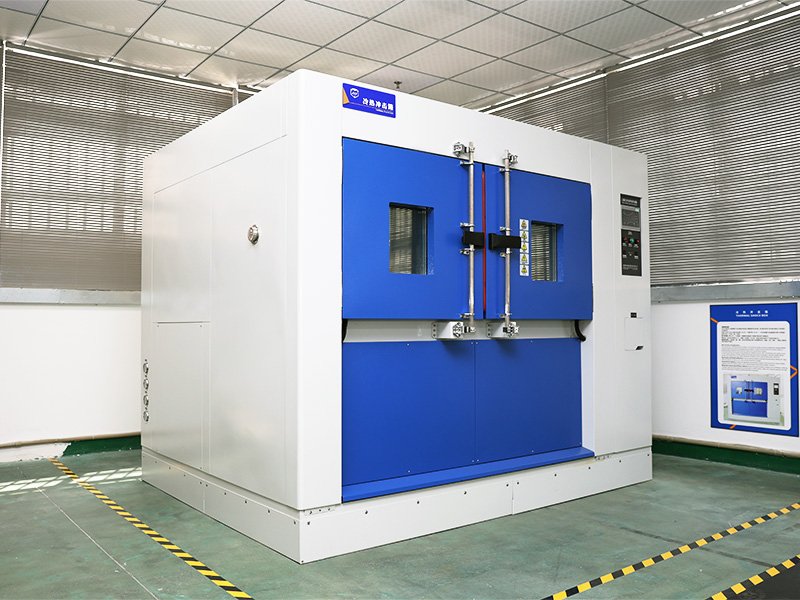
Testing we do in house
The equipment behind the status table sits in our own factory, which is what lets us answer a specification line with a report rather than a promise.
Vibration table for broadband random profiles, run to the profile on your drawing: uneven floors and dock plates set the profile on a forklift, and the report follows it.
Thermal shock chamber for the freezer-to-dock cycle, and salt spray and dust chambers for trucks that also work outdoors.
Photometric darkroom for the projected pattern, so the spot, line or arch on the drawing is measured rather than assumed.
EMC anechoic chamber for radiated emissions to CISPR 25, which matters next to a truck controller and a pedestrian-detection receiver; we confirm the class per model in the documentation pack.
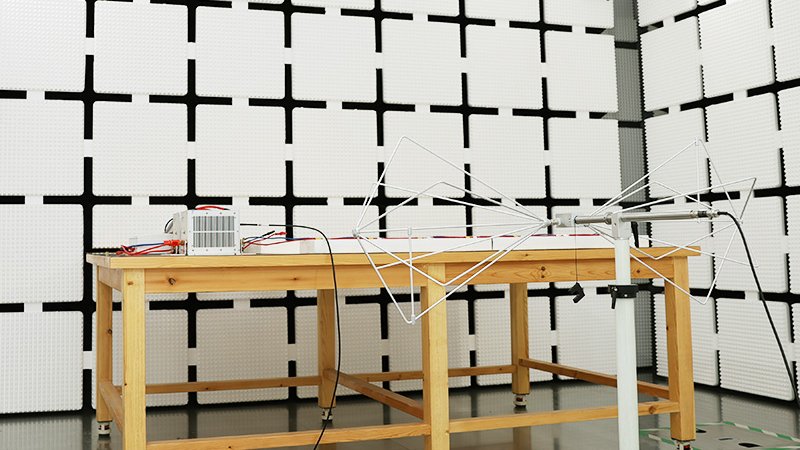
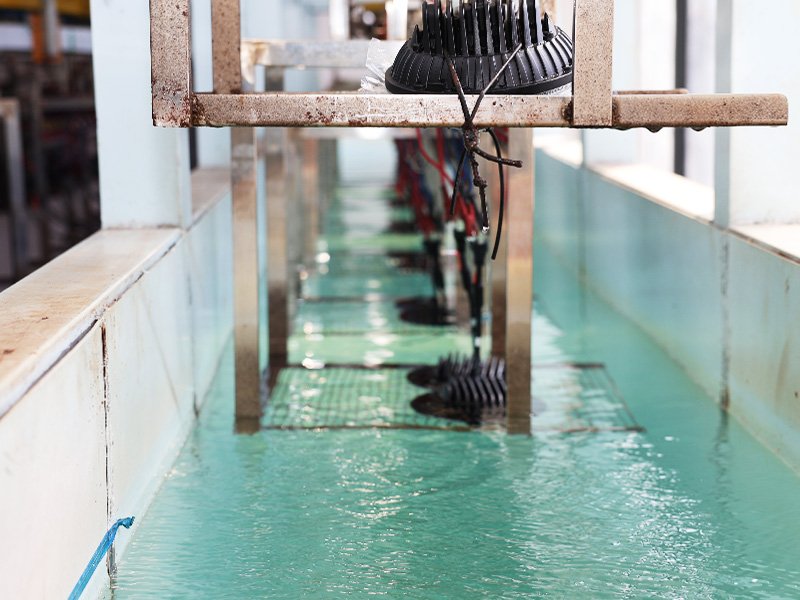
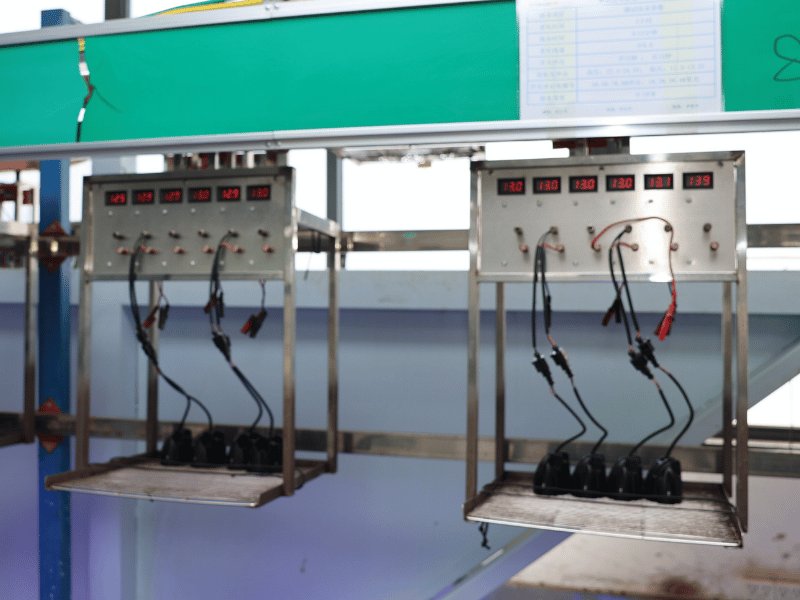
Need the test report for a model? Existing reports are sent on request; where none exists yet, we can run the test to the profile on your drawing.
Request test reportsWant to See the Full Range?
330+ LED lights with full specifications, organised by category, sent straight to your inbox.
Frequently Asked Questions
Which voltage version does a 48 V or 80 V electric forklift need?
Choose the version whose range covers the traction battery with margin: the 10–60 V DC version for a 48 V truck and the 10–110 V DC version for an 80 V truck. The 9–32 V DC version covers 12 V and 24 V engine trucks.
What is the blue light on a forklift for?
It projects a moving blue spot on the floor ahead of or behind the truck, so a pedestrian at an aisle end sees the truck coming before it appears. Red zone lines along the sides mark how close people may stand.
Can your lights be triggered by a pedestrian-detection system?
Yes. The light is switched through its power supply, so your detection controller can switch it directly when the system detects a person; we build the connector and cable length to your drawing.
Do you supply UL 583 or EN 12895 approval?
Those approvals belong to the truck. We supply per-model documentation for the lights, including CISPR 25 emissions reports, and support EN 12895 testing to your specification.
Can you supply lights under our brand for dealer safety packages?
Yes. Catalogue lights can carry your logo and packaging from 60 pieces per model, with the connector and cable length your package uses.
What is the minimum order and lead time for an OEM programme?
Catalogue and private-label lights ship from 60 pieces per model in 15 to 25 working days, after samples that typically ship within 1 to 5 days. A custom-developed light starts with tooling, and reaches first bulk shipment four to five months from design start.
Talk to our engineering team
We'll match the right product to your exact equipment model and operating environment, free of charge.
Get a Free QuoteReply within 24 hours
Need LED Lights for Warehouse & Forklift?
Tell us your equipment model and operating environment and we'll recommend the right solution.