


Forklift safety lights come in four floor-projection patterns: blue spot, red zone line, red arc and arrow. Buyers usually ask two questions: which pattern goes where, and does OSHA require any of them.
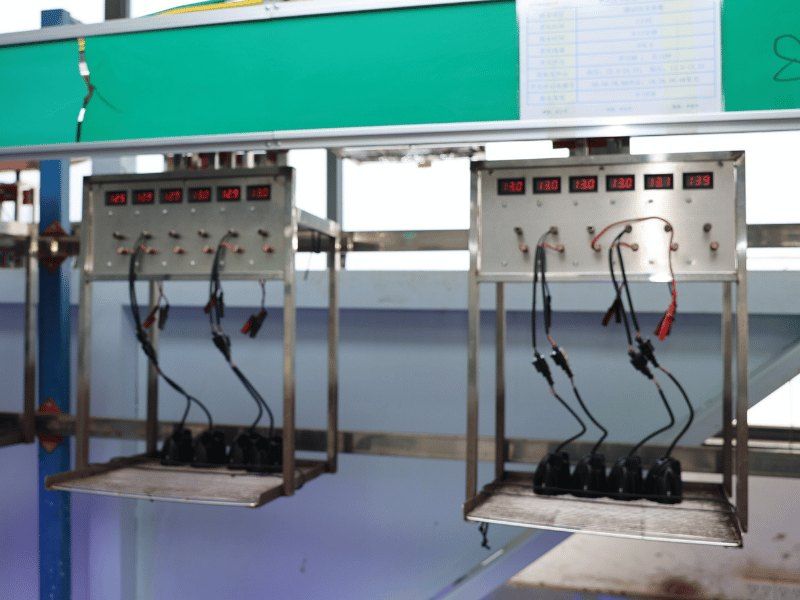
We manufacture all four patterns in-house, ship them to warehouse fleets and forklift dealers on several continents, and burn in every driver on a 12V/24 V alternating-voltage rack before assembly. So we see the same specification mistakes repeat.
This guide separates what the regulation says from what actually reduces pedestrian strikes, gives projection distances and mounting positions for each pattern, and ends with a checklist you can put on a purchase order. Here is the short version first.
The short answer: Blue lights announce that a truck is coming. Red lights mark where people must not stand. OSHA mandates neither, but it does require auxiliary lighting below 2 lumens per square foot and a warning at every blind corner, which is exactly the gap floor-projected lights fill. Fit a blue spot front and rear, add red zone lines or an arc where rear-end swing meets foot traffic, and order the voltage version that matches the truck battery.
What OSHA actually says about forklift warning lights
The powered industrial truck standard, 29 CFR 1910.178, contains no mention of blue spot or red zone lights. Three clauses matter for lighting decisions.
Once the same truck leaves the building, a different rule set applies: which beacon colors a vehicle may run on public roads is state law, covered in our beacon light colors guide.
1910.178(h)(2): "Where general lighting is less than 2 lumens per square foot, auxiliary directional lighting shall be provided on the truck."
1910.178(n)(4): "The driver shall be required to slow down and sound the horn at cross aisles and other locations where vision is obstructed."
1910.178(n)(6): "The driver shall be required to look in the direction of, and keep a clear view of the path of travel."
OSHA's forklift eTool adds one line that applies directly: "When provided, use flashing warning light or backup alarms when traveling in reverse."
Read together, the rule is about visibility and warning, not about colour. That is why a floor-projected light is the cheapest way to go beyond compliance: it works in the exact situations the standard singles out, blind intersections and reverse travel, and it works in noise where a horn does not.
The numbers behind the rule are not small. The Bureau of Labor Statistics counted 614 forklift-related deaths between 2011 and 2017. In 2017 alone there were 74 fatal injuries and 9,050 nonfatal injuries with days away from work. Pedestrian-involved cases carried the longest recovery, a median of 20 days away against 13 for forklift injuries overall.
Blue spot lights: how they work and how far they should project
A blue spot light is a narrow-beam LED lamp mounted high on the overhead guard, angled down so it paints a bright blue disc on the floor 16–24 ft (5–7 m) ahead of the truck. A second unit faces backwards for reverse travel.
The disc moves with the truck. Because people notice movement on the floor before they notice a vehicle at eye level, the disc reaches a pedestrian rounding a rack end several seconds before the truck does.
Three mounting rules decide whether it works:
- Height first. The higher the lamp, the longer the projection at the same angle. Overhead-guard mounting gives the full 16–24 ft range; mast mounting shortens it.
- Angle for the aisle. At a T-junction the disc should land in the cross aisle, not on your own path. Adjust the bracket so the disc arrives where a pedestrian would step out.
- Both directions. Reverse travel is where the eTool's "when provided" clause bites. A front-only installation leaves the blind side uncovered.
Our 4inch 20W spot projects the 16–24 ft disc and is available in blue, red or green optics on the same housing.
Red zone lines and arcs: marking the keep-out boundary
Blue says a truck is coming. Red says do not stand here.
A red zone line light projects a sharp line along one side of the truck. Two of them, one per side, mark the strip where a counterbalance truck's rear-end swing sweeps as it turns. Pedestrians standing outside the line are clear of the swing.
An arc light does the same job in one lamp for the rear. It paints a semicircle behind the truck, sized by mounting height and angle to the swing radius. Arc lights suit narrow-aisle and cold-store trucks where side mounting space is limited.
Used together, blue spots front and rear plus red lines each side close a complete warning boundary around the truck. Sites that colour-code by area can order the same optics in blue or green.
Arrow beams: when direction matters more than presence
In two-way aisles and at dock doors, a disc tells a pedestrian a truck is near but not which way it is moving. An arrow beam projects a directional arrow 14–22 ft (4–7 m) out, so the person can step the right way.
Arrow lights are the usual choice for order pickers and reach trucks that travel forks-first and reverse frequently. Our 5.5″ arrow unit draws 10W and fits the same bracket family as the spot.
Which pattern for which zone
Match the pattern to the hazard at each position, not to the truck as a whole:
| Zone | Pattern and why |
|---|---|
| Main travel aisles | blue spot, front and rear. Movement on the floor is seen before the truck is. |
| Cross-aisle intersections | blue spot angled into the cross aisle. This is the case 1910.178(n)(4) names. |
| Loading docks and two-way lanes | arrow beam, so the pedestrian knows which way to move. |
| Turning bays and pick faces | red zone line each side, or a red arc at the rear, marking the strip the counterweight sweeps. |
| Cold storage and wash bays | any pattern, but IP69K sealed. Unsealed lamps fail first in these zones. |
| Yards and ramps | an amber strobe beacon at 80 flashes per minute. A floor projection is invisible in daylight outdoors; a beacon gives 360° visibility to other vehicles. |
Our 5W and 9W amber beacons flash 80 times per minute with a polycarbonate lens and carry the same IP69K sealing as the projection lights.
Electric forklift voltage: 24 V, 36 V, 48 V and 80 V systems
This is the specification most often written wrong on a purchase order.
Internal-combustion forklifts and most utility vehicles run 12 V or 24 V electrics. A 9–32 V DC lamp covers both without a converter, which is why 9–32 V DC is the standard input on every light we build.
Electric forklifts are different. Traction batteries run at 24 V, 36 V, 48 V or 80 V, and a 9–32 V lamp wired to a 48 V truck is damaged at switch-on. For electric trucks we build three wide-input versions:
- 10–48 V DC for 24 V and 36 V trucks and most 48 V systems
- 10–60 V DC for 48 V systems with charging surges
- 10–110 V DC for 80 V trucks and mixed fleets that want one part number for everything
Whichever version you order, the driver is a constant-current design that holds LED output steady across the whole window, so a low battery does not dim the projection and a charger connected to the truck does not overdrive it.
Tell us the truck's battery voltage when you request a quote. The optics and bracket are the same across versions; only the driver changes.
Cold storage and wash-down: the IP rating that matters
A warehouse truck can pass from freezer condensation to a wash bay to a dusty yard ramp in a single shift. Condensation inside the lens is the first failure mode of a cheap safety light, followed by water ingress at the cable gland after pressure washing.
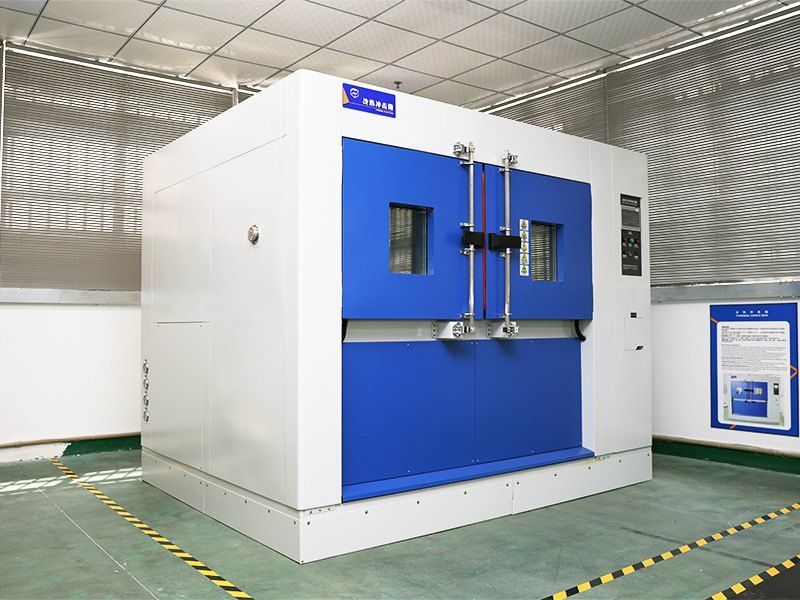
Every Tough Lighting forklift light is sealed to IP69K, the rating that certifies survival under 80°C water jets at close range. That covers cold-store thermal cycling and plant wash bays without a separate cold-store variant.
For what each IP number tests, and why IP68 alone fails under pressure washing, see our guide to IP69K vs IP68.
Spec checklist before you order 60 pieces
- Pattern and colour per position: blue spot front and rear; red line or arc for swing zones; arrow for two-way lanes; amber beacon for yards
- Voltage version: 9–32 V DC for IC trucks; 10–48 V, 10–60 V or 10–110 V DC for electric trucks, matched to battery voltage
- Projection distance: 16–24 ft for spot, 14–22 ft for arrow, checked against your aisle width and mounting height
- Sealing: IP69K, not IP65 or IP67, if trucks see cold storage or wash bays
- Bracket and cable: stainless steel bracket standard; specify cable length and connector for your truck harness
- Documentation: CE and E-Mark documentation available on request for your target market
- Samples and MOQ: samples ship in 1–5 days for on-truck trials; standard MOQ is 60 pieces per model, mixable across patterns
- Warranty: 1 year on beacons and warning lights, 5 years on every other forklift light
Frequently asked questions
Does OSHA require blue lights on forklifts?
No. 29 CFR 1910.178 requires auxiliary lighting where general lighting is below 2 lumens per square foot and a horn at blind intersections, but it does not name blue or red projection lights. Many sites fit them because they satisfy the intent of those clauses in noisy areas where a horn is not heard.
Blue or red: which side of the forklift does each go on?
Blue spots mount front and rear on the overhead guard, angled to project 16–24 ft along the path of travel. Red zone lines mount on each side, or a single red arc mounts at the rear, to mark the strip swept by rear-end swing.
Do blue lights work on 48 V and 80 V electric forklifts?
Yes, with the right driver. Order the 10–48 V DC version for 24 V to 48 V trucks, 10–60 V DC where charging surges are a concern, and 10–110 V DC for 80 V trucks. A standard 9–32 V DC lamp will fail on a 48 V or 80 V system.
Put the plan on the floor
Count your blind intersections, dock doors and turning bays, and you have your light list: a blue spot pair per truck, red lines or an arc where swing meets foot traffic, arrows on two-way lanes.
Browse the forklift safety lights range, or send us your truck list with battery voltages and we will return a per-truck lighting package with pricing within one business day. If cold storage or wash bays are part of the route, our IP69K vs IP68 guide explains what to demand from any supplier's test report.