


A lighting quotation almost never asks which colour temperature you want. The supplier ships whatever the factory is already building, the lamps go on the machine, and the question only surfaces months later: when operators say the new lights are tiring, when a replacement lamp does not match the one beside it, or when a machine that works in dust turns out to be harder to see from than before the upgrade.
This guide is the conversation that should have happened at the quotation stage. It is organised by machine and job rather than by theory: what the working conditions do to the light, which kelvin band answers them, and what to write in the specification so you get it. For the physics and the regulations behind the recommendations, see our colour temperature reference.
The short answer, by job
Most machines are best served by the same band the established OEM brands specify, and only a few conditions justify moving away from it.
Daylight-white 5000–5700 K is the default for general work lighting: field work, loading, yard movement, construction, and any task where the operator needs to read shape and texture at speed. This is where Nordic Lights, Grote, Rigid Industries, J.W. Speaker, Vision X and Baja Designs all sit.
Warm white 2700–3000 K is the exception that earns its place in dust, falling snow and heavy rain, the conditions where cool light comes back at the operator instead of going out to the work.
Cool white 6000–6500 K is a marketing position rather than a performance one on most machines, and it is actively worse in airborne dust or precipitation.
Everything below is the reasoning behind those three lines, machine by machine.
| Colour temperature | Where it belongs | Why |
|---|---|---|
| 2700–3000 K warm | Dust, falling snow, heavy rain; forestry sawdust haze | Cutting the blue end reduces the glare scattered back at the operator |
| 5000–5700 K daylight | General work lighting: field, loading, yard, construction, indoor forklift | Highest apparent contrast on shape and texture; the band the OEM brands specify |
| 6000–6500 K cool | Clear air only, and only if you want it | Measures the same lumens but scatters back harder in anything airborne |
| Not applicable | Amber beacons, blue forklift spots, red zone lines | Signal colours are set by chromaticity coordinates; they have no colour temperature |
What our own order book says
Two things we can add from our own side, and they point the same way as the published specifications above.
About seven in ten of the work lamps we ship go out at 5000–5700 K. That is not a band we impose: it is what buyers settle on once they have told us the machine and the environment, and the proportion has held as the mix of markets changed.
In conversations with farmers running our lamps in the United States, roughly nine in ten told us the same thing in their own words: 5000–5700 K is more comfortable to work under than 6000–6500 K, and the difference shows up on long shifts as less eye fatigue rather than as anything obvious in the first hour. We should be straight about what that is: feedback from operators already running our lamps, not a controlled study. But it matches both the published OEM specifications above and the reason Nordic Lights gives for its own ceiling, and it is the part of this guide we hear most often repeated back to us.
Agricultural machinery: the dust decides
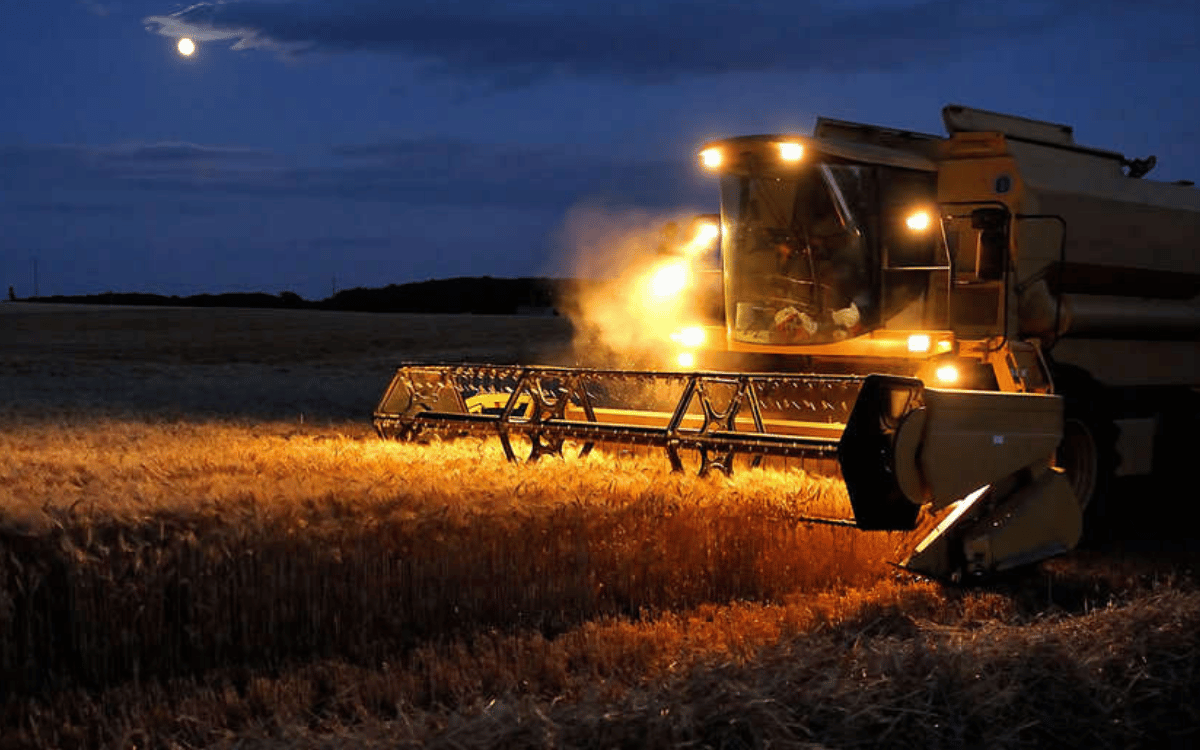
A combine in a dry harvest, a tractor on a cultivated field, a chaser bin working alongside: these machines generate their own dust cloud and then drive into it. The operator is looking through a suspended layer of material that sits directly between the lamp and the work.
What goes wrong with very cool light here is not that it fails to reach the crop. It is that a large share of it comes back. Airborne particles scatter light in all directions including toward the cab, and the shorter, bluer wavelengths produce more veiling glare on the return path. The result is a bright wall in front of the operator, less contrast on the header or the row, and eye fatigue that builds over a long harvest shift.
For a machine that works mostly in clear air, 5000–5700 K is right. For one that spends most of its hours inside its own dust (harvest, cultivation, dry-season haulage) a warm 2700–3000 K lamp on the positions the operator actually watches is the specification that changes the shift. Nordic Lights, whose home market is Nordic agriculture and forestry, sells its warm variant on exactly this argument.
Our agricultural machinery applications page covers the mounting positions; the colour decision sits on top of it.
Forestry and utility vehicles: sawdust haze and long arms
Forestry machines combine the two hardest cases. The head throws a continuous haze of sawdust and chip, and the crane arm puts the lamp a long way from the eye, so any glare on the return path is amplified by the working distance.
This is the clearest case for warm white in the whole range. Operators working through sawdust haze, fog and falling snow consistently report better contrast from a warmer source, and the reason is the same back-scatter mechanism as agriculture, with the added factor that a forestry shift in Northern Europe is largely conducted in darkness for months of the year.
Specify 2700–3000 K for the cab and boom positions that work into the haze. Keep 5000–5700 K for the positions that light clear ground, such as the transport lamps, the rear, the step and handrail lights, because in clear air the daylight-white band still reads shape faster.
Mining and quarry equipment: dust plus glare, in a confined space
An underground or pit face adds a third factor to the dust problem: there is no ambient light at all, so the lamp is the only source and every reflective surface, whether wet rock, steel or water, sends it straight back.
Mining is where the gap between nominal brightness and usable vision is widest. A 6500 K flood on a haul truck in a dusty pit will measure more lumens and deliver less visible detail than a warmer lamp of the same output, because more of those lumens end up in the operator's eyes rather than on the muck pile.
The practical specification for a mine is a mixed set: daylight-white for travel and area lighting where air is clear, warm white on the positions that work into airborne material, and a glare-controlled optic on everything mounted at eye level for ground crew. Colour temperature will not fix a badly aimed lamp; it decides how much a well-aimed one costs the people around it.
Snow clearing: two different lighting jobs on one truck
A plough truck is doing two things at once, and they want opposite specifications.
The road ahead is a headlamp job, and headlamps must be white, not because white performs better in snow, but because the regulation that governs road lighting defines the permitted colours by chromaticity, and white is what a main-beam or dipped-beam headlamp is allowed to emit. On a plough this is also where a heated lens earns its keep, because an LED headlamp runs too cool at the lens to shed the snow that a halogen lamp used to melt off. That is a separate problem from colour, and it is covered in our heated plow lights guide.
The work area, meaning the blade, the wing, the spreader and the reversing path, is a work-lamp job, and here the falling snow behaves exactly like dust. Every flake between the lamp and the blade is a scattering surface, and a cool white flood produces the whiteout effect operators describe as driving into a wall. Warm white on the blade and wing lamps is the single change that most reduces it.
The common mistake is fitting the brightest available cool-white floods to a plough because snow work feels like it needs more light. More light scattered back at you is not more vision.
Warehouse forklifts: no daylight to match
Indoors the calculation changes completely. There is no airborne dust in a clean warehouse, no daylight to match, and the ambient lighting is usually a fixed installation the truck lamp has to work alongside.
Daylight-white 5000–5700 K is right here, and for a reason specific to the environment: a forklift operator spends the whole shift under artificial light with no external reference, and a lamp that is markedly warmer or cooler than the building's own lighting makes the truck's pool of light read as a different space. Matching the building is worth more than any absolute figure.
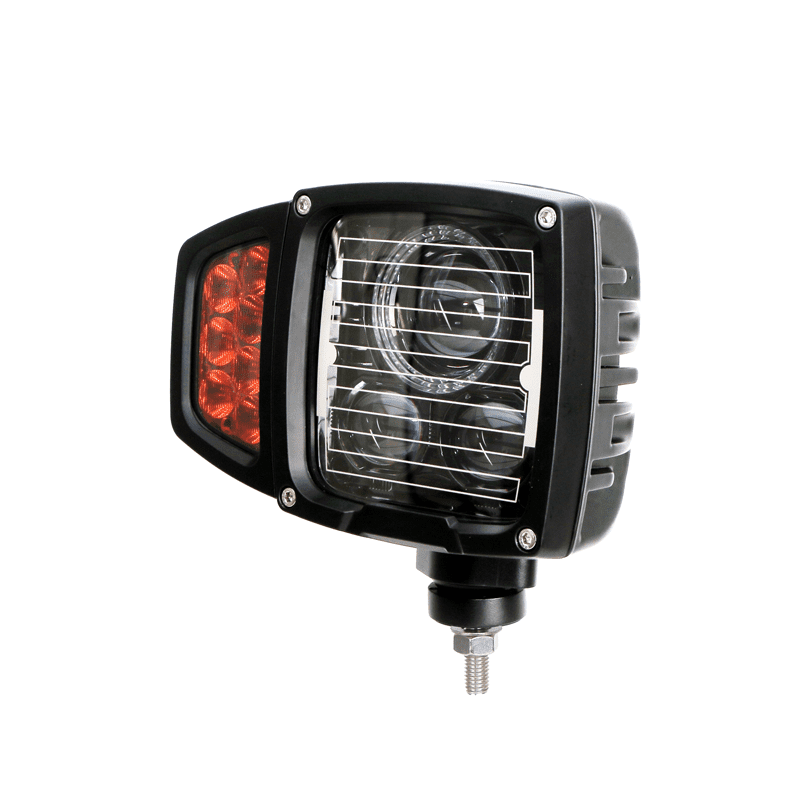
The safety lights are a separate matter entirely. The blue spot, the red zone line and the amber beacon are signal colours, not white light with a tint. They have no colour temperature at all, and asking for a kelvin figure on them is a sign the specification has confused two different things.
Commercial trucks and road transit: the glare you cause
Any machine that travels on a public road has a second audience: the drivers coming the other way. Discomfort glare rises with the blue content of a source, so a 6500 K auxiliary lamp is more objectionable to oncoming traffic than a 4000 K lamp of identical intensity.
For a tractor moving between fields at dusk, a service truck on a verge, or a plough on a highway, the answer is not a compromise colour temperature. It is separation. Keep work lamps on a circuit that cannot be left on in transit, and let the road-legal lamps do the road job. Colour temperature decides how expensive an aiming mistake becomes; it does not excuse one.
Service and maintenance work: the one case where CRI decides
Everything above is about seeing shape and movement. Reading colour is a different task, and colour temperature does not govern it: the colour rendering index does, and the two are independent. Two lamps at the same 5700 K can render a wiring loom's colour codes very differently.
For driving and area lighting, CRI rarely changes a decision. For a technician working under the lamp, reading colour-coded wiring, hydraulic hose bands, coolant condition or oil on a dipstick, it decides whether the job can be finished without reaching for a torch. If the lamp is going on a service body or into a workshop bay, ask for CRI. If it is going on a haul truck, do not pay for it.
| Machine | What decides it | Specify |
|---|---|---|
| Combine, tractor, chaser bin | Works inside its own dust for most of its hours | 5000–5700 K general; 2700–3000 K on the positions the operator watches |
| Forestry harvester, crane | Sawdust haze plus a long arm that amplifies return glare | 2700–3000 K on cab and boom; 5000–5700 K on clear-ground positions |
| Haul truck, loader, drill | Dust, no ambient light, wet rock throwing it back | Mixed set; glare-controlled optics at ground-crew eye level |
| Plough truck | Two jobs at once: road ahead vs blade area | White headlamp (regulated); 2700–3000 K on blade and wing lamps |
| Warehouse forklift | No daylight; must sit alongside the building's own lighting | 5000–5700 K, matched to the building |
| Service body, workshop | Reading colour, not shape | 5000–5700 K plus a CRI figure |
Three specification traps that cost more than the colour choice
“White” is not a specification
A datasheet that says cool white has told you nothing. A specification is a number with a tolerance: 5700 K ±300 K. Without the tolerance you have no basis to reject a delivery that looks wrong, because nothing was agreed.
Two lamps at the same kelvin figure can visibly differ
LEDs come off the wafer with a spread, and manufacturers sort them into bins. The tightness of that sort, expressed as SDCM or MacAdam ellipse steps, decides whether a replacement lamp matches the one next to it. A 3-step bin is a difference most people cannot see; a 7-step bin is obvious on a machine carrying two lamps on the same beam. This matters far more on a fleet than on one machine, because the lamp you fit three years from now will sit beside the original.

Half-converting a machine makes the remaining lamps look broken
Fitting LED lamps to some positions and leaving halogen on others puts 3200 K and 5700 K light on the same work area. The eye adapts to the brighter, cooler source and the halogen pool then reads as a dim yellow patch. Operators routinely report those lamps as failed when they are working exactly as before. If a machine cannot be converted in one pass, convert by work area rather than scattering the new lamps across positions.
What to put in the enquiry
Five lines cover it, and they take less time to write than the email asking why the lamps look wrong.
State the machine and what it works in, because the environment decides more than the machine type does. State the colour temperature with a tolerance rather than a word. Ask for the bin or SDCM figure if fleet consistency matters to you. Ask for CRI only if the task involves reading colour. And if the lamp performs a road function in an ECE market, ask for the measured chromaticity coordinates and the approval mark, because the kelvin figure is not what the regulation tests.
| Write this | Not this | What it prevents |
|---|---|---|
| 5700 K ±300 K | “Cool white” | No agreed figure means no basis to reject a delivery that looks wrong |
| 3-step SDCM (or state the bin) | Nothing | A replacement lamp three years on that visibly differs from the original |
| CRI ≥ 70, only where colour is read | CRI on everything | Paying for a figure that changes nothing on a haul truck |
| Measured chromaticity + approval mark | “6000 K, ECE compliant” | The regulation tests coordinates, not kelvin; the two can disagree |
We build to the band the application needs rather than the one we happen to stock: our standard work lamps ship at 5000–5700 K, and any colour temperature, including 2700–3000 K warm white for dust, snow and rain, is available from 60 pieces per model. Tell us the machine, the environment and the hours it works, and we will propose the band. Browse the LED work light range and the heavy duty range.
Frequently asked questions
Is a higher colour temperature brighter?
No. Colour temperature describes the tint of white light, not its quantity. Two lamps rated 4000 K and 6500 K can emit exactly the same number of lumens. Brightness is the lumen and candela figures; they are a separate line of the specification.
Does yellow light cut through fog and dust better?
Not in the way the claim implies. Fog droplets scatter all visible wavelengths at roughly the same rate, so yellow light does not travel appreciably further than white. What changes is the return path: cutting the blue end reduces the glare scattered back at the operator. The benefit is real, but it is about comfort and contrast, not penetration.
What colour temperature should a beacon or a forklift blue spot be?
Neither has one. Signal lights are specified by colour (amber, red, blue) defined by chromaticity coordinates and, in North America, by SAE colour specifications. Correlated colour temperature only describes light that is nominally white, so the question does not apply.
Can I mix colour temperatures on the same machine?
Across different work areas, yes: a warm lamp working into dust and a daylight-white lamp lighting clear ground is a sensible combination. Within one work area, no, because the eye adapts to the cooler source and the warmer lamp reads as dim or failed.
Our supplier quotes 6500 K. Should we ask them to change it?
Ask what the machine works in first. If it operates in clear air, 6500 K is a defensible if aggressive choice and the difference from 5700 K is small. If it works in dust, falling snow or rain for a significant share of its hours, 6500 K is the wrong end of the range and you should be looking at 5000–5700 K as standard, with warm white on the positions that face the worst of it.