


Fleets that moved plow trucks to LED got more light and a problem the old lamps never had: the headlight that used to melt its own snow now buries itself in it.
We build heated-lens plow headlights and cycle every housing design between -40°C and 65°C (-40°F to 149°F) in a thermal shock chamber and through 240 hours of salt spray before it ships, and the same question arrives with most winter RFQs: do we really need the heated version, and on which lamps?
This guide explains why an LED ices over where a halogen stayed clear, how a heated lens fixes it, what the heater costs in amps, and which positions on a truck earn the premium. The short version comes first.
The short answer: An LED makes plenty of heat, but it sends that heat backwards into the housing, not forwards through the lens. In falling snow the lens sits at air temperature and packs over. A heated lens puts a 15W resistive element on the optic that runs with the lamp and keeps the surface above the point where snow bonds. Fit it on forward-facing lamps that work sustained sub-zero shifts; leave it off sheltered rear work lights.
Why LED plow lights ice up where halogens stayed clear
A halogen sealed beam kept its own lens clear by accident. Incandescent lamps release about 90% of their energy as heat, and most of it left through the front glass along with the light.
An LED produces light up to 90% more efficiently, which is why the same lumen output draws a fraction of the current. The heat it does produce is generated at the chip on the back of the optic, and the lamp is engineered to pull it away from the LED as fast as possible.
That is the purpose of the finned aluminium housing on the back of every LED work light and headlight. Heat management is the single largest factor in LED lifetime, so the design goal is a cool chip and, as a side effect, a cool lens.
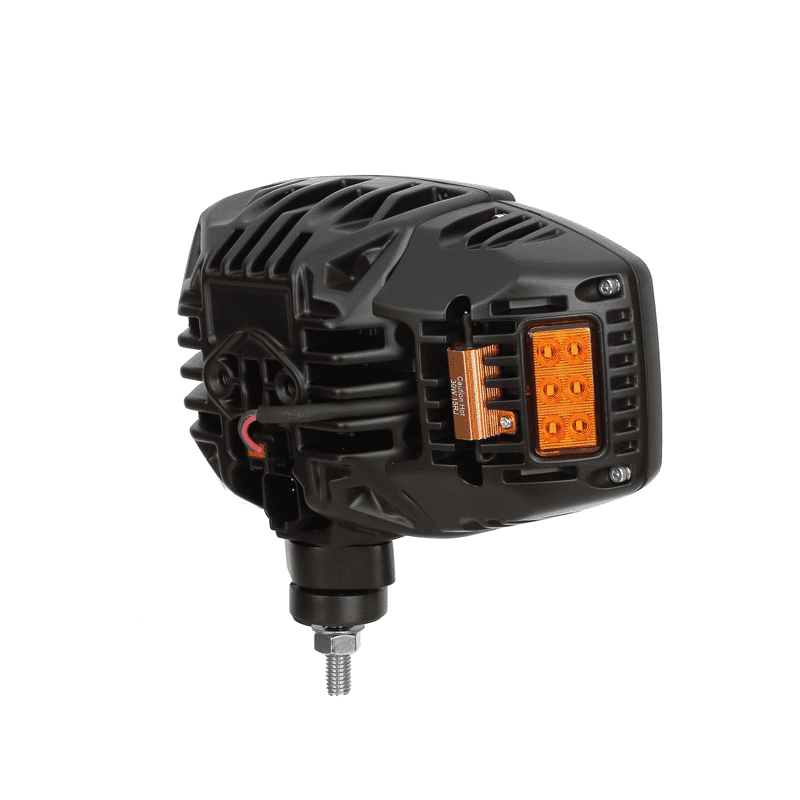
Plow operators on the PlowSite forum describe the result plainly: halogen lamps melted snow on contact and refroze it as a crust, while LED lamps stay cold enough that wet snow simply packs onto the lens until the beam disappears. Grote's own knowledge base gives the same answer: the lens of an LED lamp is not as warm as the housing, and a stationary lamp may never get warm enough to clear itself.
The three conditions that glaze a lens
Dry powder at minus 15°C rarely sticks to anything. Three other conditions do the damage.
- Wet snow near freezing. Snow at 0 to minus 3°C is heavy and wet. It lands on a cold lens, packs under its own weight and freezes into a shell that no amount of driving airflow removes.
- Freezing rain and road slush at speed. Supercooled rain, or slush thrown up by traffic, hits the lens and freezes as clear glaze ice. Military icing tests distinguish this glaze from the opaque rime that forms in mist, and glaze is the harder of the two to shed.
- Slow work and idling. A plow clearing a lot at walking pace has no airflow across the lens and no engine-bay warmth reaching the plow frame. A lamp that stays clear on the highway can be blind after twenty minutes of lot work.
Plow headlamps face all three at once. They sit low on the blade frame, forward of the truck, in the spray zone, and they spend most of the shift below 30 km/h.
How a heated lens works
A heated-lens lamp adds one part to a standard sealed LED headlight: a resistive heating element bonded to the lens, visible as the fine horizontal lines across the optic.
On our combination plow headlight the element is rated at 15W and runs whenever the lamp is switched on. There is no lens thermostat to drift, corrode or fail; if the light is on, the lens is being warmed. The trade-off is that the heater also draws its 15W on a mild day, which is why the lamp belongs on winter-service positions rather than on every lamp of the fleet.
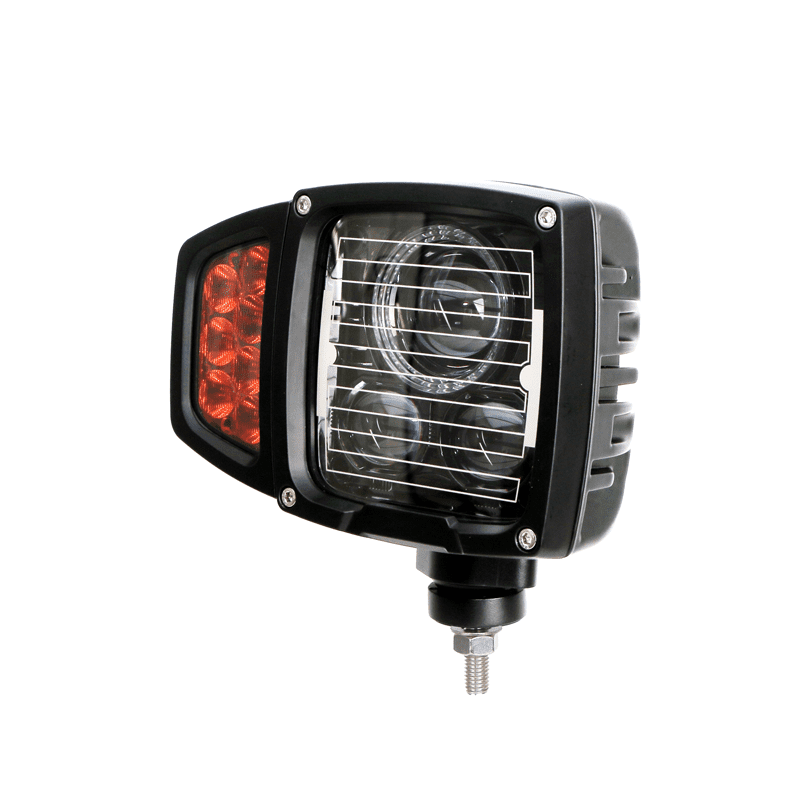
The heater runs from the same input as the lamp, so there is no second cable, relay or control box to install. The whole assembly is sealed to IP66 and IP6K9K, with the driver potted against vibration.
For a one-paragraph definition see our glossary entry on heated lenses. This article is about deciding whether you need one.
What the heater costs in power and wiring
A heated lens costs amps whenever the lamp is on, and a fleet electrician needs the numbers to size the circuit.
Our combination heated plow headlight draws, measured at 12V:
| Function | Power | Current at 12 V | Current at 24 V |
|---|---|---|---|
| Low beam | 30W | 2.5A | 1.25A |
| High beam | 60W | 5A | 2.5A |
| Daytime running light | 12W | 1A | 0.5A |
| Turn signal | 12W | 1A | 0.5A |
| Lens heater | 15W | 1.25A | 0.63A |
Size the fuse and wire for the worst case, high beam plus heater running together, which is 75W or 6.25A at 12 V per lamp. Then check the plow harness connector rating. The lamp ships with a 6-pin DT connector, with AMP or bare cable available for OEM builds.
The lamp accepts 9–32 V DC without a converter, so one part number covers a mixed 12 V and 24 V fleet, and on 24 V trucks every current figure above halves.
When a heated lens pays off, and when it does not
Heated lenses carry a premium over the same lamp without the element. Put them where they earn it.
| Question | Heated lens earns its cost | Standard sealed LED is enough |
|---|---|---|
| Climate | Sustained sub-zero shifts with regular snowfall | Occasional cold snaps, dry cold |
| Machine role | Plows, spreaders, gritters, winter-service trucks that cannot stop mid-route | Machines parked when it snows |
| Mounting position | Forward-facing lamps on the blade frame or front bumper, in the spray zone | Rear work lights, cab-roof lamps sheltered by the cab |
| Duty cycle | Lot and street work at low speed, long idling | Highway transit with airflow across the lens |
| Consequence of a blocked lens | Operator must climb down to scrape it, or drives blind | Lamp is one of several covering the same area |
Two positions are usually enough on a plow truck: the pair of headlights on the plow frame. Rear work lights over the spreader and the amber beacons on the cab see far less driven snow and rarely justify the heated version.
Municipal fleets that run refuse trucks by day and gritters by night are the typical mixed case: heated plow headlights on the winter-service units, standard sealed work lights everywhere else. Our municipal and refuse vehicle page covers the rest of that lighting plan.
Winter kills lamps three other ways
Ice on the lens is the failure the operator sees. Three slower ones decide whether the lamp lasts five winters or one.
- Road salt. Salt spray attacks the housing, the bracket and the connector. We run housings through ISO 9227 salt spray for 240 hours, and the bracket is stainless steel because a painted steel bracket is the first thing to rust through.
- Thermal cycling. A lamp that leaves a heated garage at plus 15°C and goes to work at minus 20°C expands and contracts every shift. Our thermal shock chamber cycles housings between -40°C and 65°C (-40°F to 149°F), far faster than a winter does, and it finds the seal or solder joint that would have failed in February.
- Pressure washing. Plow trucks get washed hard and hot at the end of the shift. IP6K9K covers the high-pressure, high-temperature jet; a potted driver keeps the electronics dry if a gland ever weeps.
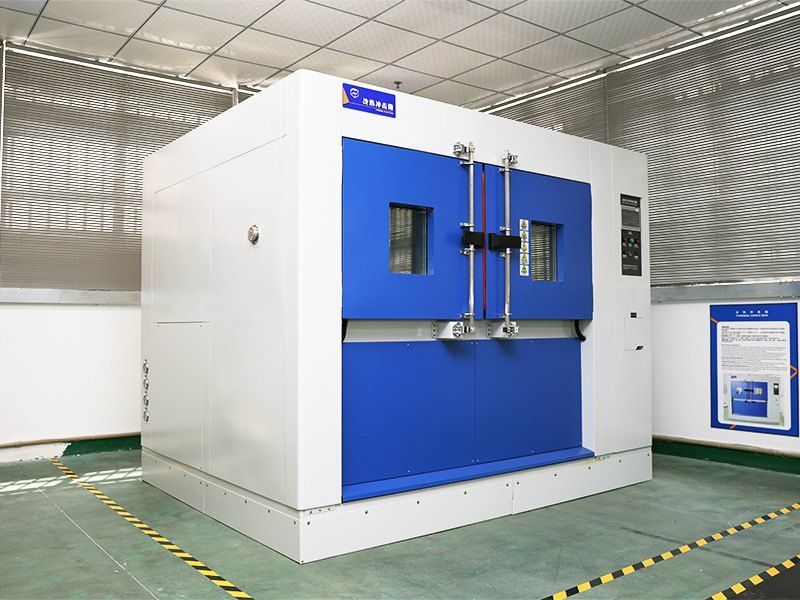
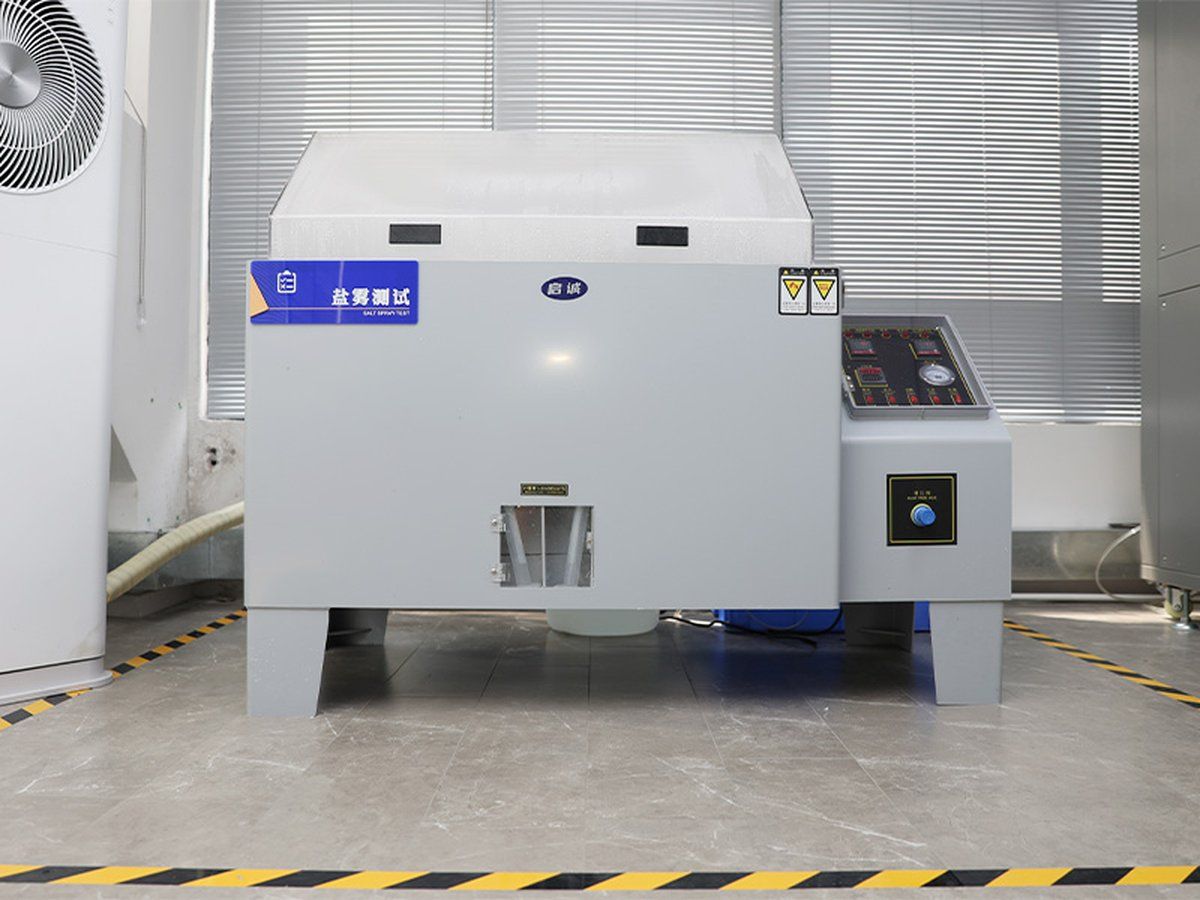
The lens itself is polycarbonate with a hardened surface rather than glass, so a stone thrown by the blade chips the coating rather than cracking the optic. For what the IP numbers actually test, see our guide to IP69K versus IP68.
Road-legal on a plow truck
A raised plow blade blocks the truck's own headlamps, which is why plow headlamps exist at all. Once they replace the vehicle's headlights on the road, they have to do the whole job: low beam, high beam, position and turn signal.
In the United States the requirements for those functions sit in 49 CFR 571.108, the federal lighting standard, and in Europe in the ECE regulations for headlamps and signal lamps. Neither text mentions heated lenses or de-icing; the heater is a durability feature layered on top of a compliant lamp, not a regulated function.
Our combination heated plow headlight integrates low beam, high beam, turn signal, side direction indicator and parking light in one 229 by 173 mm housing. Test documentation for your target market is available on request. Ask for it before the order, not after the first roadside inspection.
Spec checklist before you order
- Position by position: heated lens for the plow-frame headlights; standard sealed LED for rear and cab lamps unless they face driven snow
- Heater: rated power in writing, and whether it is thermostat-controlled or runs with the lamp; ours is 15W, on with the lamp
- Current draw: lamp and heater figures at 12 V and 24 V for fuse and wire sizing; plan for 75W per lamp with high beam and heater together
- Input voltage: 9–32 V DC so one part number covers 12 V and 24 V chassis
- Sealing: IP66 and IP6K9K, driver potted
- Corrosion: ISO 9227 salt spray report, stainless bracket
- Functions and documentation: low, high, turn, position on one lamp; FMVSS 108 or ECE test documentation for your market on request
- Lead time and samples: 1 to 5 samples for a real winter trial, then 60 pieces per model minimum with a 15 to 25 working day lead time
- Warranty: 5 years
Frequently asked questions
Do LED headlights melt snow?
No. Incandescent lamps release about 90% of their energy as heat, much of it through the lens. An LED sends its heat backwards into a finned housing and the lens stays near air temperature, so wet snow packs onto it instead of melting.
Are LED plow lights heated?
Not by default. A standard sealed LED plow headlight has no heater. Heated versions add a resistive element on the optic, either thermostat-controlled or, as on ours, running whenever the lamp is on. Check the spec sheet for a de-icing line rather than assuming.
How much extra power does a heated lens draw?
On our combination plow headlight the heater adds 15W, or 1.25A at 12 V, on top of a 30W low beam and 60W high beam. Size the fuse for high beam plus heater together: 75W, or 6.25A at 12 V, per lamp.
Put it on the build sheet
Count the forward-facing lamps that work in driven snow below freezing, and that is your heated-lens list. Everything else on the truck can stay a standard sealed LED.
Browse the heated LED lights range, or send us your vehicle list and winter route profile and we will return a position-by-position lighting plan with current figures within one business day. If you are specifying the rest of the fleet at the same time, our LED work light buyer's guide covers thermal management, connectors and warranty terms for bulk orders.