


Buying LED work lights for an OEM line or a fleet is not retail purchasing at a larger quantity. A bad specification decision does not cost you one lamp; it multiplies across every unit built, and then again across every hour of downtime the failures cause.
We manufacture for OEM customers and distributors, and the ten questions below are the ones experienced procurement managers actually put to us before a volume order. They are in the order that finds a weak supplier fastest.
Most guides stop at the list. The problem with stopping there is that a list of questions gives you no way to judge the answers, so each section here also says what a real answer contains, and at the end of the commercial section we answer all ten with our own figures.
| # | The question | A reassuring non-answer | What a real answer contains |
|---|---|---|---|
| 1 | Which accredited test reports can you send? | "Our products are fully certified." | Named laboratory, standard number, test date, pass criteria |
| 2 | What is the L70 figure, and what is it based on? | "50,000 hours lifespan." | LM-80 data for the LED package, at a stated drive current and case temperature |
| 3 | How does heat leave the housing? | "Excellent thermal management." | Housing material, thermal path, junction-to-case figure, fin design above a stated wattage |
| 4 | Which EMC standard and class, for which market? | "CE certified." | The standard, the class the vehicle needs, and who holds the report |
| 5 | Which connector, by part number? | "Standard waterproof connector." | Manufacturer part number, wire gauge, cable length, termination type |
| 6 | What voltage window, and what protection? | "Works on 12 V and 24 V." | The window as a range, plus reverse polarity and surge protection named |
| 7 | MOQ, lead time and sample time? | "Very flexible, very fast." | Three separate numbers, in writing, on the quotation |
| 8 | How does it arrive on my line? | "Well packaged." | Polybag per unit, master carton quantity, part number per unit, carton dimensions and weight |
| 9 | What is your failure rate, measured how? | "Very low, almost zero returns." | A number, the population it came from, and what counts as a failure |
| 10 | Will you ship unbranded, and will you sign an NDA? | "No problem." | A signed NDA before drawings move, and a sample carton with your branding |
1. Test Reports, Not Spec Sheets
A specification sheet is a marketing document. A test report from an accredited laboratory is evidence, and the names worth seeing on it are SGS, Bureau Veritas, TÜV and Intertek.
Before approving a supplier, ask for reports covering ingress protection, vibration and shock to SAE J1455 or MIL-STD-810G, EMC, photometrics to IES LM-79, and the operating temperature range.
One trap is specific to ingress. IEC 60529 defines the IP code, but its second digit stops at 8, so the pressure-wash rating that datasheets write as IP69K is not in that document at all; it sits in ISO 20653. A supplier who answers an IP69K question with an IEC 60529 report has sent the wrong standard, which is covered in detail in our note on IP69K and IP68.
2. Lumen Maintenance Over Time
LEDs fade, and the L70 figure says when output reaches 70 percent of new. A quality work light is 50,000 hours or better, and anything below 30,000 hours points at either the LED package or the heat path.
The figure on its own is not evidence. Ask what it is based on, which means the LM-80 measurement for the LED package at a stated drive current and case temperature, because the same package quoted at a gentler current will produce a much better number that the lamp will never see.
Catalogue lumen figures deserve the same scepticism. Unless a report says otherwise, a headline figure is usually raw package output rather than light measured out of the lens, which is the difference between the two numbers in effective lumens.
3. Thermal Management Design
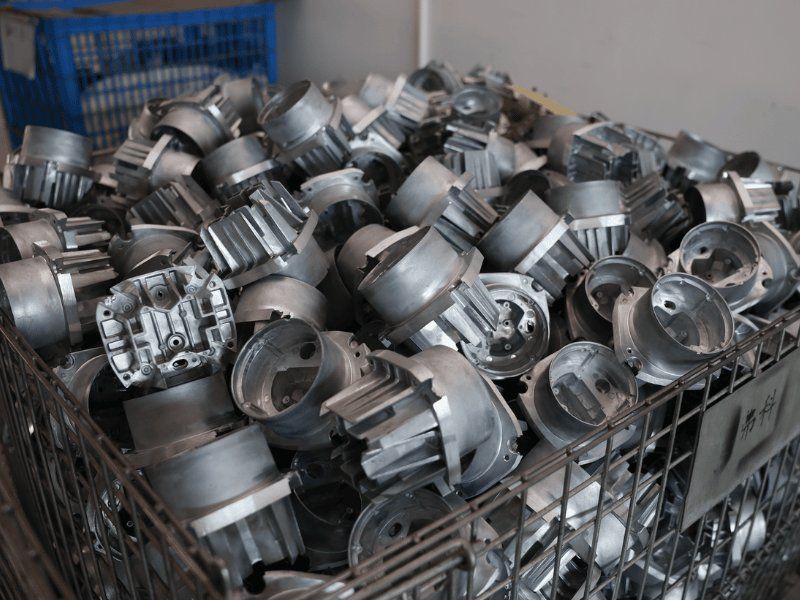
LED junction temperature is the single biggest determinant of service life, and in a sealed housing there is no airflow to help. Every watt of heat leaves through the casting itself, which is why die-cast aluminium is the standard and why fin geometry starts to matter as wattage climbs.
Ask for the housing material, the thermal path from board to casting, the junction-to-case thermal resistance, and what changes in the design above the wattage you are buying.
4. EMC Certification for Your Target Market
If the vehicle runs a CAN bus, a J1939 network or telematics, EMC is not optional. An uncertified lamp couples noise into engine management and GPS, and the symptom is intermittent, which makes it expensive to diagnose in the field.
Name the standard in the RFQ rather than accepting a certificate. For vehicle installations that means CISPR 25 with the class the vehicle actually requires, and ECE R10 for European road use. The class is set by the installation, not by the lamp, so a supplier who quotes one class for every application has not read your requirement.
5. Connector and Wiring Specification
Mismatched connectors discovered after delivery stop assembly lines, and they are the most avoidable failure on this list.
Specify the connector by manufacturer part number rather than by description: Deutsch DT06-2S, Sumitomo HW, Weather Pack. Then add wire gauge, cable length, and whether terminations arrive pre-tinned or bare for your own crimping.
6. Voltage Range and Reverse Polarity Protection
Vehicle electrics are not clean 12 V or 24 V. Cranking transients on a nominal 12 V system reach well above it, and long harness runs add their own.
Specify the window rather than the nominal voltage, and specify reverse polarity and surge protection by name. A multi-volt input covering both systems means a yard running mixed machines holds one part number instead of two, and 308 of the 317 models we list take 9 to 32 V DC for exactly that reason.
Electric forklifts are the exception worth knowing about. Traction batteries from 24 V to 80 V need a driver built for them, and nine models in our forklift safety lights carry 10 to 48 V, 10 to 60 V or 10 to 110 V DC inputs instead.
7. MOQ, Lead Time and Samples
Quoted lead time and actual capacity are different claims, and the three numbers that matter are usually given as one vague reassurance. Ask for them separately and ask for them on the quotation: minimum order at standard pricing, production lead time, and how fast a sample can be in your hands.
Here are ours, so the next quotation you receive has something to sit next to.
| What you are asking | Our figure | The condition attached to it |
|---|---|---|
| Minimum order, catalogue product to your specification | 60 pieces per model | Covers branding, connector, cable length, bracket, colour temperature |
| Minimum order, product developed from scratch | Higher, quoted per project | Depends on the design, the tooling and the unit value |
| Sample in hand | 1 to 5 days | For catalogue models |
| Production lead time | 15 to 25 working days | Standard catalogue production |
| 3D-printed prototype for fit checking | 5 to 7 working days | Before any tooling money is committed |
| Pre-production samples off production tooling | 7 to 10 working days | For your final validation and certification testing |
| Production tooling | 30 to 45 days | Cost shared and amortised, or customer-funded for a lower unit price |
| Design start to first bulk shipment | Four to five months | Includes your confirmation time at each checkpoint |
| Monthly capacity | 120,000 lights | In-house, Foshan |
| Quotation response | One business day | Pricing, lead time and specifications together |
8. Packaging for Assembly Line Integration
Retail packaging on an assembly line is unpacking labour you pay for twice. Specify bulk: polybag per unit, master carton, part number marked on every unit, and no retail inserts.
Then get carton quantity, dimensions and gross weight in writing, because those three decide your inbound freight cost and your line-side storage, and they are the numbers most often missing from a quotation.
9. Warranty Terms and What the Failure Rate Really Means
A warranty period means very little on its own. What matters is the claims process behind it: who decides whether a unit failed from a defect, how long a decision takes, whether you get replacement or credit, and who pays return freight.
Ask for the failure rate as a number, and then ask the question that most suppliers are not ready for: measured against what. A rate counted from formal warranty claims will look far better than one counted from field returns, and better again than one counted from line rejects at your own assembly station. Without the denominator, the number is decoration. A supplier who can tell you the population, the period and what counted as a failure is telling you they measure it.
On warranty period, our own catalogue is not uniform and it would be misleading to quote one figure. Of the 317 models we list, 269 carry a five-year term and 48 carry one year, and the split follows the job the lamp does: work lights carry five years, while road-signalling and marker lamps (indicators, rear and stop lamps, trailer markers, beacons) carry one. Ask per model rather than per supplier, and if a supplier quotes one period across a mixed catalogue, ask which lamps it actually covers.

10. NDA and OEM/ODM Capability
If you are sourcing for a branded line, confirm three things: that the lamp ships with no supplier branding on it, that your labels and cartons are applied at the factory, and that custom colours, beam patterns and wattages are available once volume justifies tooling.
A factory that hesitates to sign an NDA before drawings move is telling you something useful at no cost to you. Sign first, send drawings second.

What to Put in the RFQ
An RFQ that gets accurate and competitive quotes rather than polite ranges contains the exact specification (wattage, ingress rating, beam pattern, connector, voltage window, certifications), the annual volume estimate and a target unit price, payment terms with delivery destination and Incoterms, and a request for pre-production samples before volume is committed.
That level of detail is not bureaucracy. It is the difference between a supplier quoting your actual requirement and a supplier quoting a safe number with margin for everything you did not say.
Frequently Asked Questions
Why is unit price a poor way to compare volume quotes?
Because the three things that set five-year cost are invisible on a price list. Lumen maintenance decides when the fleet starts calling the lamps dim, thermal design decides the lumen maintenance, and the failure rate decides how much of your own labour goes into replacements. A lamp that is 15 percent cheaper and fades twice as fast is the more expensive purchase, and nothing on the quotation says so.
What is a reasonable minimum order for a private-label work light?
For a catalogue product built to your specification, ours starts at 60 pieces per model, and that covers branding, connector, cable length, bracket and colour temperature. A product developed from scratch on new tooling carries a higher minimum because the tooling has to be amortised over the run, so that figure depends on the design and gets confirmed with the quotation rather than published as one number.
How long should a first volume order actually take?
Two different timelines, and suppliers often blur them. A catalogue model to your specification runs 15 to 25 working days in production, with samples in your hands within 1 to 5 days. A product developed from scratch runs four to five months from design start to first bulk shipment, made up of design, a 3D-printed prototype, tooling, pre-production samples and mass production, plus your own confirmation time at each checkpoint.
Can I ask a supplier to hold safety stock for repeat orders?
Yes, and the answer tells you how the supplier is organised. Holding finished stock against a forecast is a commitment of their working capital, so a serious answer comes with conditions: a volume forecast from you, an agreed call-off pattern, and a stated shelf quantity. An unconditional yes usually means stock will exist when it is convenient.
Put the Checklist to Work
Send your current specification through these ten questions before the next volume order, and score the answers against the last column of the table at the top rather than against how confident they sound.
Any supplier who clears all ten in writing has earned a sample order. We answer all ten in writing with every quotation, and the figures in this guide are the ones we quote.