


A new forklift model has a lighting line in its specification before it has a VIN plate. Someone in the engineering room sketches out what the operator will see at night in a reach-truck aisle, how a pedestrian crossing the aisle will know the truck is swinging its counterweight, and which of the four or five safety lights the fleet already runs on older trucks have to be carried over. The order to the lamp supplier follows that sketch, not the other way around.
This article is written for the people who make that order. Forklift builders, upfitters who add a safety package on top of a new truck, and fleet buyers who standardise lighting across a mixed shop. The scope is the integration work on a new model: which lamp types to pick, where they go on the body, how to match their voltage band to the truck's electrical system, and how the sample-and-tooling sequence protects the budget before the mould ships.
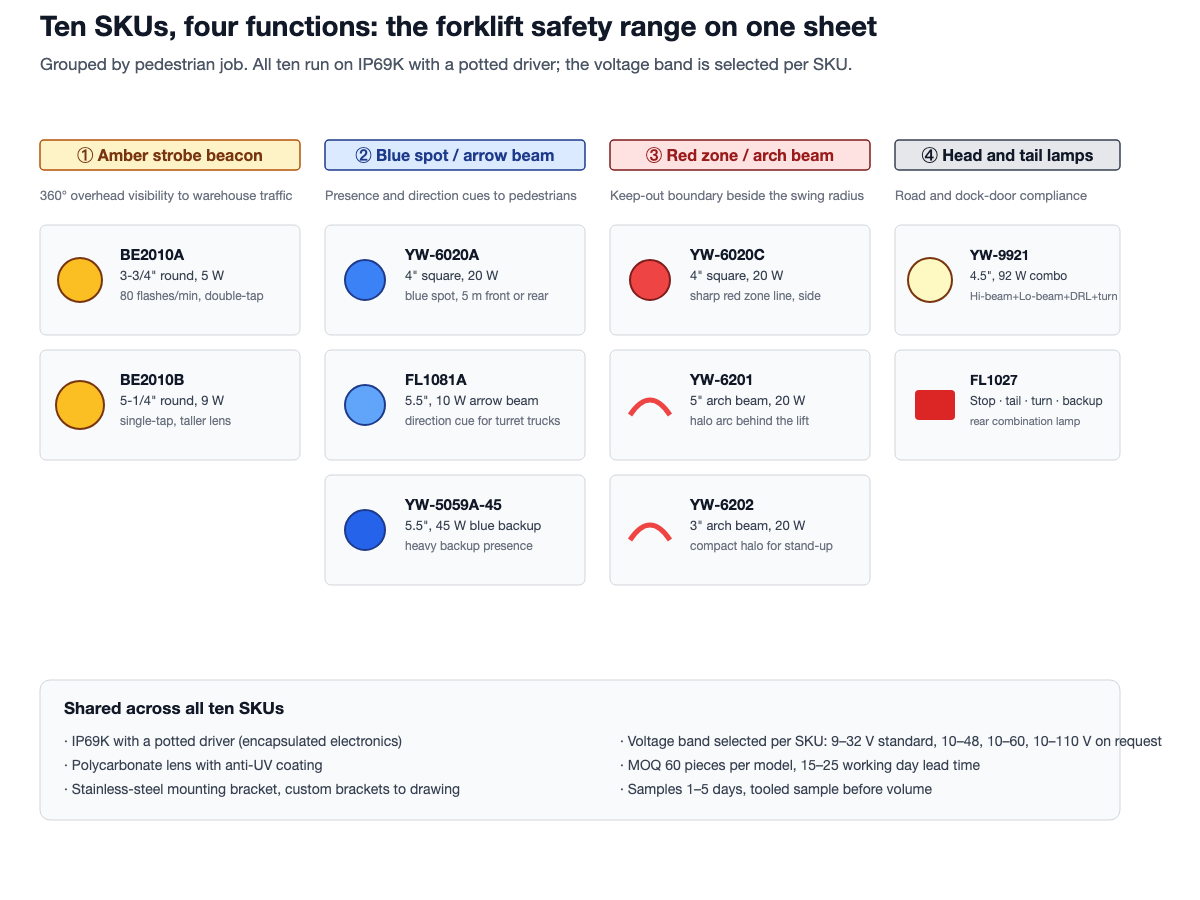
The short answer: pick lamp types by zone and operator task, mount them on the mast guard and the rear overhead, match the lamp voltage band to your electrical platform (9 to 32 V DC standard, 10 to 48, 10 to 60 and 10 to 110 V developed to your fleet), and plan a sample run before tooling starts.
What each lamp type does on a forklift
Before we talk about positions, a quick review for teams coming to this subject fresh. The functions are covered in detail in our separate article on blue light versus red zone light; the summary below is enough to decide which types your new model needs.
A blue spot light throws a round, high-intensity patch 16 to 24 feet in front of or behind the truck. It is a presence signal: a pedestrian turning a blind corner sees the patch before the truck arrives. A red zone line draws a straight boundary on the floor beside the truck, marking the swing radius or a keep-clear strip. An arrow beam shows direction of travel, which matters on three-wheel trucks and reach trucks that can spin on their centres. An amber strobe beacon is the visibility signal to the rest of the warehouse, including other trucks approaching from the overhead crane bay.
Most new programmes carry a blue spot forward and backward, a red zone on at least one side, and an amber beacon on the overhead guard. Arrow beams come in on turret trucks and side-loaders where direction is not obvious from the chassis shape.
Where they go on a new truck
Positioning is where a new forklift programme usually spends its first two meetings. Four positions carry most of the load.
| Truck type | Blue spot | Red zone | Arrow beam | Amber beacon |
|---|---|---|---|---|
| Electric counterbalance, seated | Rear overhead, front mast guard | Both sides, rear corners | Optional | Overhead guard, roof centre |
| Electric stand-up end-rider | Rear overhead | Both sides at operator eye level | Front, under operator step | Overhead guard, above operator head |
| IC counterbalance | Rear overhead, front mast guard | Both sides, rear corners | Not usual | Overhead guard, roof centre |
| Reach truck and order picker | Mast guard, rear of chassis | Narrow zone along wheel base | Front and rear if turret | Top of mast, folded with mast |
| Large-capacity (8 ton and up) | Rear overhead and counterweight corners | Both sides along full length | Not usual | Counterweight top, two amber |
Three constraints decide the final mounts. The lamp needs line of sight to the floor or the pedestrian's eye, not the back of a forklift accessory. The mounting surface has to be flat enough for the gasket to seal without a custom bracket, or we ship the bracket with the lamp. And the cable route has to clear the mast lift chain and the lift cylinder's full travel, including the service position where the chain is slack.
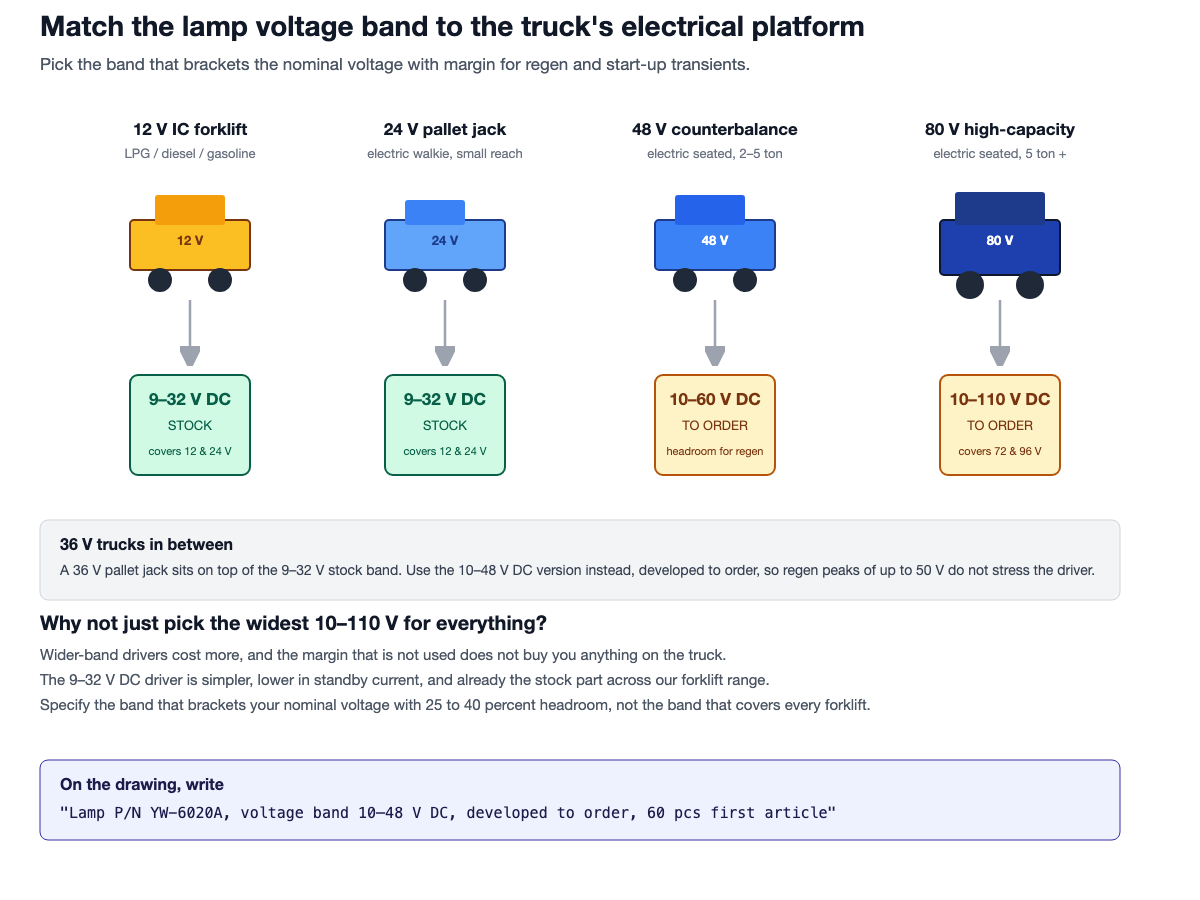
Match the lamp voltage to the truck's electrical platform
| Voltage band | Stock or made to order | Typical truck platforms |
|---|---|---|
| 9–32 V DC | Stock on all ten SKUs | 12 V IC forklifts; 24 V walkies and small reach trucks |
| 10–48 V DC | Made to order | 36 V trucks (margin for regen); some 24 V trucks with heavy inductive loads |
| 10–60 V DC | Made to order | 48 V counterbalance trucks (regen headroom to about 54 V) |
| 10–110 V DC | Made to order | 72 V and 80 V high-capacity trucks |
An electric forklift sold as a "48 V truck" rarely sits exactly at 48 V in operation. A fully charged pack reads above its nominal voltage, a pack under lift stall sags below it, and regen braking can briefly push the bus higher still. The lamp driver has to tolerate that whole band.
Our standard stock range is built for 9 to 32 V DC, which covers 12 V lift trucks, 24 V end-riders, pallet jacks and most 24 V counterbalance trucks. For the higher platforms we build separate variants: 10 to 48 V DC covers a 36 V truck under a full charge, 10 to 60 V DC covers a 48 V truck end-to-end, and 10 to 110 V DC covers an 80 V truck under battery swing. Each lamp model is built for one of these four bands; the specification for a new programme names the band for each position.
Three design points follow from this.
The standard range sits in the warehouse and ships from 60 pieces per model. The three higher bands are developed to your fleet's platform once the integration meeting fixes the band, and pre-production samples arrive before the first production run. If the builder is honest about which band each truck family uses, it keeps one part number per position per model.
Mixing a 9 to 32 V lamp on a 48 V truck will destroy the driver. We write the voltage band into the part number so the warehouse cannot cross-ship by mistake.
A multi-volt driver, like the one described in our glossary entry on multi-volt lamps, makes the lamp tolerant to the normal swing within its band, including regen spikes. It does not stretch the band itself.
The builder's electrical engineer should check two numbers before signing the specification: the maximum bus voltage under regen braking at cold temperature, and the minimum bus voltage under a lift stall at 20 % state of charge. If both fall inside the lamp's band with a reasonable margin, the match is right.
Wiring, interference and the on-board computer
A pallet truck with lithium batteries, fast charging, regen braking, telematics modems and pedestrian detection radars is a noisy electrical environment. The lamp has to survive the transients on the bus and, just as important, has to keep its emissions quiet enough that the radar and the telematics work next to it.
Our forklift safety range is built to CISPR 25 for radiated emissions and uses a potted driver so vibration from the mast and the counterweight cannot shake the electronics loose. The drivers are specified to tolerate the regen spikes expected inside their rated voltage band; order a sample run first so EMC coexistence with your on-board electronics is verified on your actual truck.
The practical wiring note for integrators: route the lamp harness away from the pedestrian detection radar antenna and the telematics modem, use shielded cable where the harness has to cross those lines, and ground the lamp housing at the bracket. Where the truck design puts the bracket on an insulated mast guard, we can ship a lamp with a dedicated ground pigtail; this is a small detail that saves a late-stage EMC retest.
The sample-and-tooling sequence
The step most first-time forklift programmes skip is the fit check before tooling. A 3D-printed version of the housing, shipped in a few days, goes on the real mast guard and the real counterweight. It catches the three things a drawing review will miss: cable routing under the mast chain at full extension, mounting-surface angle versus the body stamping tolerance, and lens-to-operator-eye geometry when the seat is adjusted.
The sequence we run on OEM programmes:
Design, 7 to 15 days: our engineers turn the builder's drawing and electrical-platform spec into a lamp design, confirming mount, cable route and optic choice.
3D-printed prototype, 5 to 7 working days: the builder fits the printed sample on the real truck and confirms the mount and the cable route.
Production tooling, 30 to 45 days: tooling cuts for the custom housing and bracket.
Pre-production samples, 7 to 10 working days from the hard tool: samples go back on the truck for EMC and vibration testing on the actual electrical platform.
First bulk shipment: four to five months from design start, after the pre-production samples pass on the builder's truck.
These figures are the standard programme we run on custom lamps for OEM customers; a catalogue lamp with a standard bracket ships in 15 to 25 working days from 60 pieces.
Frequently asked questions
Where should blue safety lights be mounted on a forklift?
The rear overhead guard is the standard position for the rear-facing blue spot, and the front mast guard for the forward-facing one. Both aim so the spot lands 16 to 24 feet from the truck at operator eye height. On stand-up end-riders, mount the rear spot low enough that the mast crossbeam does not block it when the forks are at lift height.
Can one Tough Lighting safety lamp cover 24, 48 and 80 V trucks?
No. Each lamp model is built for a single voltage band. Our stock range is 9 to 32 V DC, and 10 to 48, 10 to 60 and 10 to 110 V versions are developed to your fleet's platform. The part number records the band, which keeps the builder's warehouse from cross-shipping.
How many samples should I request before a 60-piece order?
Two sample rounds, with one or two pieces each: a 3D-printed prototype (5 to 7 working days after design freeze), then a pre-production sample from the hard tool (7 to 10 working days after tooling). The pre-production sample is the one you test on the truck for EMC and vibration before the first bulk shipment.
A forklift safety lighting package is decided on the drawing: pick the types by zone and operator task, fix the four mounting positions, match each lamp to its truck's voltage band, and plan the sample sequence before tooling starts. Send your truck drawing and the electrical platform spec, and our engineers will come back with a position layout and a lamp-by-position proposal, or browse the forklift safety light range first. For the functional comparison between blue spot, red zone, arrow beam and amber beacon, our forklift blue light versus red zone light article covers the choice in detail; for pedestrian-signal colour rules in different regions, see our beacon light colours article.