
LED Work Lights for Forestry & Utility Vehicles
Forestry lights for harvester, forwarder, skidder and log loader OEMs: floods and spots from 40 to 290 W on one 9–32 V DC range, tested to your vibration profile, with ECE R10 approval on four round work lamp models.

A harvester on a winter night shift works for hours in darkness, under a canopy that throws a shadow across every stem the operator has to judge. Its lamps sit on a cab that swings, on a crane that reaches into the stand, and near a felling head that meets branches at every cut. This page is written for the people who specify forestry lights on those machines: engineers at harvester, forwarder, skidder, feller buncher and log loader builders, and the purchasing teams who hold the drawing.
The short version: one 9–32 V DC range of floods and spots from 40 to 290 W, sealing from IP67 to IP69K with potted drivers, confirmed per model, stainless-steel brackets, vibration run on our own table to your profile, and four round work lamp models with ECE R10 approval.
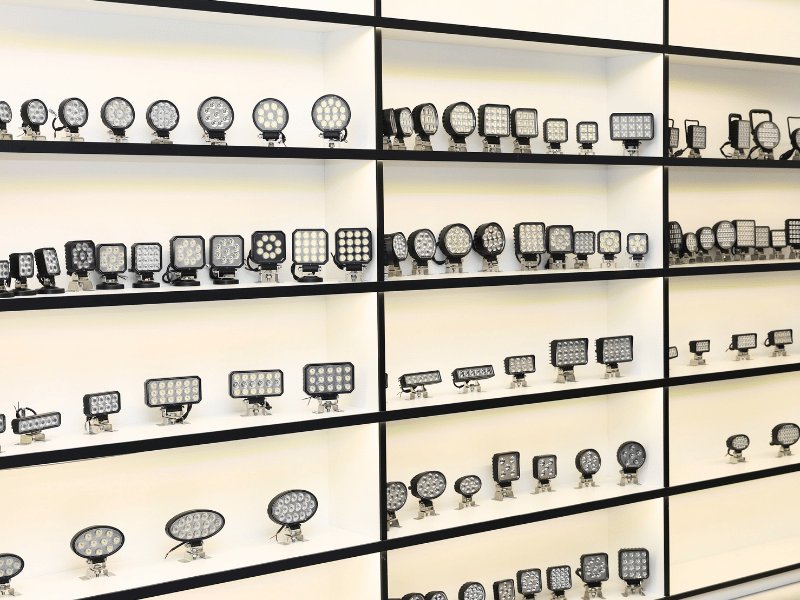
Common Challenges in Forestry & Utility Vehicles
Shadows under the canopy
Stems, stumps and the grapple disappear into the shadow of the tree in front unless the light comes from more than one direction.
The crane and the felling head shake everything
A lamp on the crane or near the head takes the vibration of every cut and the occasional branch, and a weak bracket fails before the lamp does.
Winter shifts in the dark
Long nights, frost on the lens and snow in the air decide whether a lighting plan works in midwinter as well as it did in the drawing.
What forestry OEMs ask about first
In the order the questions usually arrive: can the operator see into the stand without shadows and glare, will the lamp survive the crane, the felling head and the branches, will it hold up through long shifts without straining the alternator, will it keep working in snow, fog and frost, and does one part cover the 12 V and 24 V machines in the range. Documentation closes the list rather than opening it, so it sits at the bottom of the table.
Send the spec sheet and we mark our status against every line
Vibration profile, IP rating, supply voltage, connector, certifications: you get a line-by-line answer, and a test report per model where one exists.
Get RecommendationsReply within 24 hours
| Requirement | What the specification usually calls for | Tough Lighting status |
|---|---|---|
| Seeing into the stand | Wide, even floods around the machine and a longer beam on the crane, so stems, stumps and the grapple stand out from the shadows | Flood and spot beams across the range; 5000–5700 K as standard with other colour temperatures to order; cut-off optics developed to your specification where the beam meets other people |
| Vibration, branch strikes and the crane | Profile from the felling head, crane and rough ground, set by the OEM; a lens and bracket that take branch contact | Run on our in-house vibration table to your profile, report per model on request; polycarbonate outer lenses, UV-stabilised as standard with surface hardening on request; stainless-steel brackets, with 304 recommended as the minimum and 316 where the machine works in wet or salted conditions |
| Long shifts and the power budget | Many lamps running for a full shift without overloading the alternator | LED throughout. The listed wattage is the nominal LED power and a lamp typically draws about 80% of it, so the electrical load of the whole lighting plan can be worked out at 12 V or 24 V; drive power can be set lower to fit the alternator |
| Snow, fog, frost and dust | Cold starts, frost on the lens, dust and bark in the air, pressure washing at the end of the week | Sealing from IP67 to IP69K with potted drivers, confirmed per model; thermal shock, salt spray and dust chambers in house; heated LED headlamps in the range for travel on snow-covered roads |
| Supply voltage | 12 V and 24 V machines on one part number | 9–32 V DC across the work lamp range |
| Connector and harness | Deutsch DT or a flying lead to the harness drawing; routing along the crane | Connector, cable length and bracket built to your specification |
| Warranty and service life | Years of forest work without bulb changes | 5-year warranty on the work lamp range; sealed solid-state build with no bulb to shatter |
| Documentation | ECE R10 or CISPR 25 evidence for the cab electronics, CE for the European market | Four round work lamp models hold ECE R10 approval (40 W, 50 W, 60 W and 90 W); built to CISPR 25, class confirmed per model; CE and E-Mark documentation on request |
Lamp positions on forestry machines
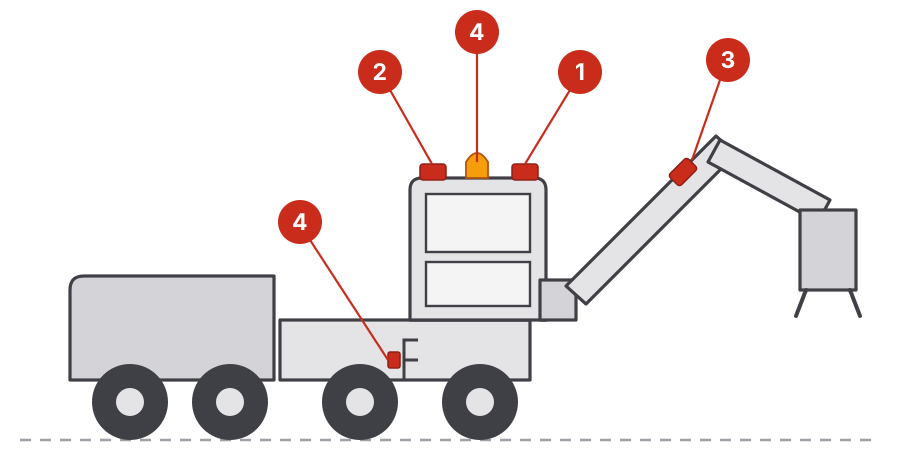
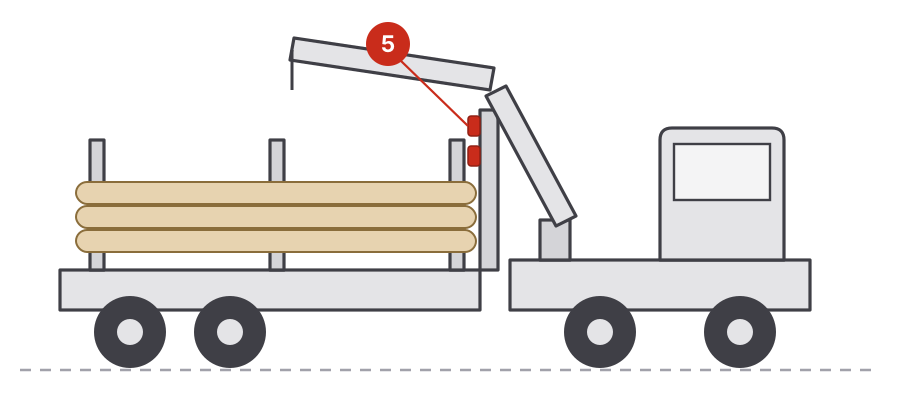
A harvester or forwarder working at night carries lamps in seven places, and each asks for a different output and beam. The table pairs each position with models often specified there; the output bands are a starting point for the lighting plan, not a rule. All run on 9–32 V DC.
| Machine and position | Job | Beam and output band | Example models |
|---|---|---|---|
| Harvester, cab roof front | The felling head and the stem being processed | Flood, 50–90 W | 3.4inch 50W Osram LED Work Light5inch 90W Osram LED Work Light |
| Harvester, cab roof sides and rear | The stand around the machine and the trail behind | Flood, 40–60 W | 3inch 40W Osram LED Work Light4inch 60W Osram LED Work Light |
| Harvester and forwarder, crane | The grapple or the head at full reach | Spot or narrow flood, 50–90 W | 3.5inch Round 50W LED Work Lamp5inch Round 90W LED Work Lamp |
| Roof beacon and service lamps | Being seen in the stand and on the road; light at the steps, engine bay and fuel point | Amber strobe beacon; compact flood, 12–18 W | 3-3/4″ Amber LED Strobe Light Beacon3inch 12W Square LED Work Lights |
| Forwarder, load space | Logs in the bunk and the grapple over it | Flood, 60–120 W | 4inch 60W Square LED Flood Work Light6inch 120W Osram LED Work Light |
| Skidder and log loader, front and rear | The winch, the grapple and the landing | Flood, 40–90 W | 3inch 40W Square LED Flood Work Light6.4inch 90W Heavy Duty LED Work Lights |
| Landing and log yard | The whole deck when loading at night | Flood, 160–290 W | 8.5inch 160W Heavy Duty LED Work Lights12.5inch 290W Heavy Duty LED Work Lights |
Vibration profile, IP rating, supply voltage, connector, certifications: you get a line-by-line answer, and a test report per model where one exists.
Match lamps to my machineRecommended Products for Forestry & Utility Vehicles


Not seeing your lamp position or output band? Send the drawing, or a photo and the machine model, and we shortlist models for each position.
Get RecommendationsHow an OEM programme runs
There are two routes, depending on whether your drawing calls for a lamp we already build or a new part.
Catalogue and private label. Any of the 300-plus lights in the catalogue can be supplied under your brand from 60 pieces per model, with your logo, packaging, connector and cable length. Samples of stock and private-label lamps ship first, typically within 1 to 5 days, and production runs in 15 to 25 working days.
Custom development. Where the mounting position, beam or housing is new, we develop the lamp to your requirement: design in 7 to 15 days, a 3D-printed prototype in 5 to 7 working days, production tooling in 30 to 45 days and pre-production samples in 7 to 10 working days, with the first bulk shipment four to five months from design start. Tooling is shared and amortised into the unit price, or funded by you for a lower unit cost, and products developed for you can be covered by an exclusivity agreement.
Send the drawing, or a photo and the machine model, and our engineers will come back within 24 hours with a feasibility assessment and next steps.
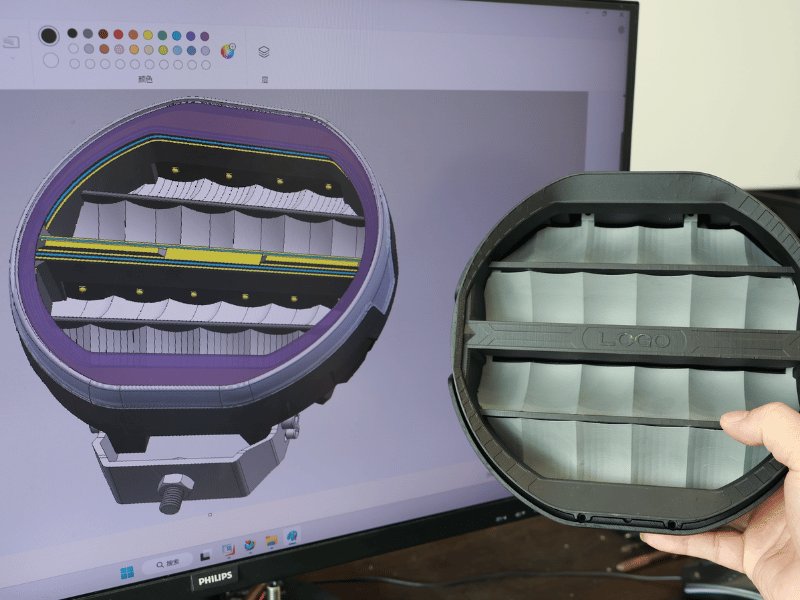
Testing we do in house
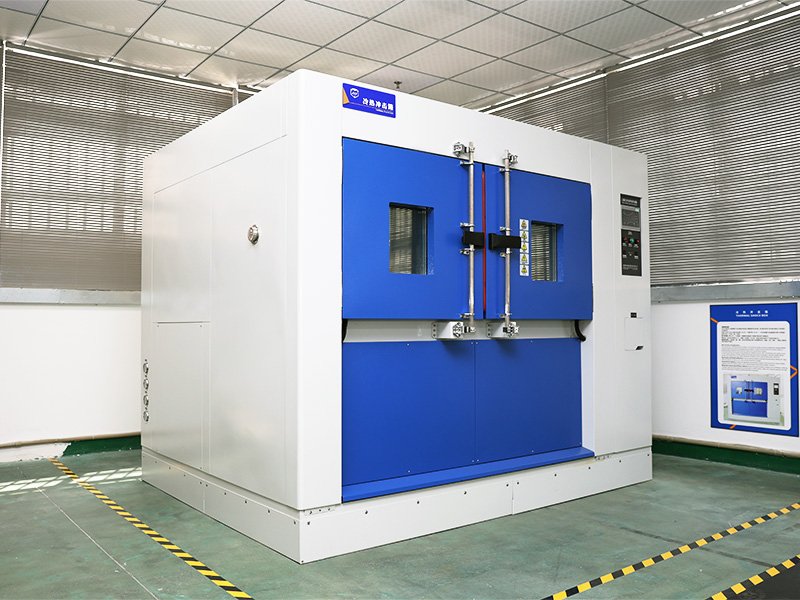
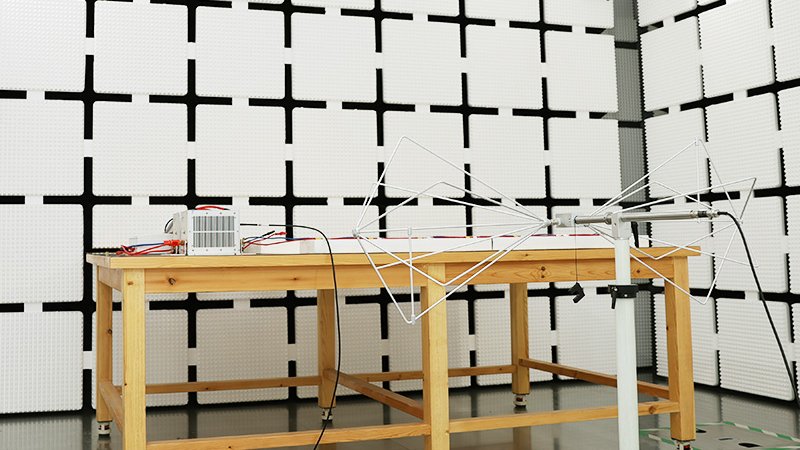
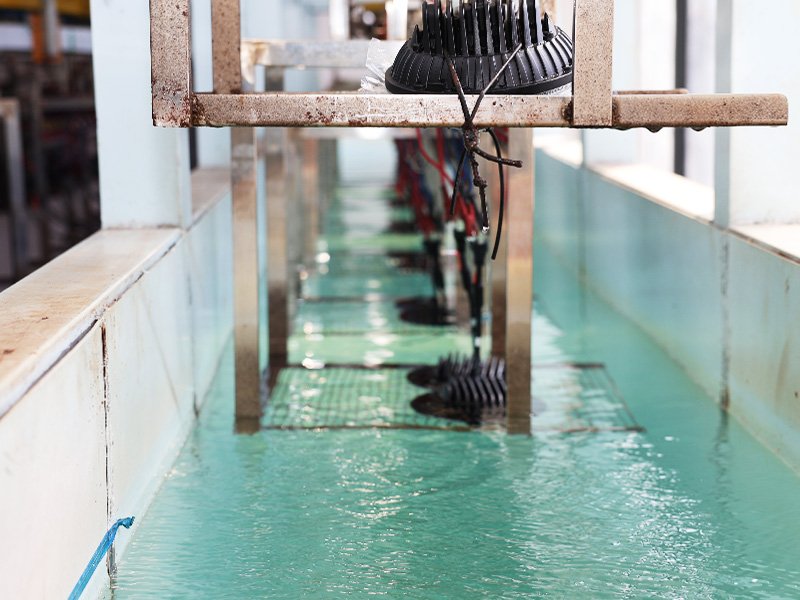
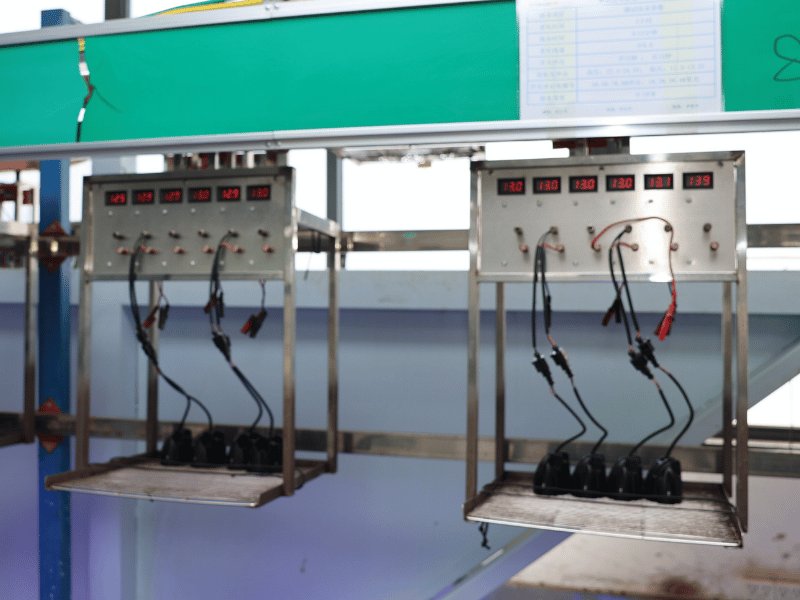
The equipment behind the status table sits in our own factory, which is what lets us answer a specification line with a report rather than a promise.
Vibration table for broadband random profiles, run to the profile on your drawing: the felling head and the crane set the profile on a harvester, and the report follows it.
Thermal shock chamber, salt spray chamber and dust chamber for the environmental lines: frost on a warm lens, road salt on the transfer between sites and bark dust in the air are covered by the tests rather than by a claim.
Photometric darkroom for beam pattern and intensity, so the flood, spot or cut-off on the drawing is measured rather than assumed.
EMC anechoic chamber for radiated emissions to CISPR 25, which matters on a cab carrying a machine controller, a radio and a satellite receiver; we confirm the class per model in the documentation pack.
Need the test report for a model? Existing reports are sent on request; where none exists yet, we can run the test to the profile on your drawing.
Request test reportsColour and glare under the canopy
Shadows are the forestry problem more than darkness: a lamp that is bright but badly aimed leaves the stem the operator is judging in the shade of the one in front. Spread the light across several positions rather than pushing more output from one, and choose a white the operator can work under for a whole shift; see why OEM work lamps are 5000–5700 K. The drivers are potted, so a lamp on the crane behaves the same in its fifth winter as in its first.
Want to See the Full Range?
330+ LED lights with full specifications, organised by category, sent straight to your inbox.
Frequently Asked Questions
How many work lights does a harvester need for winter darkness?
Plan by position rather than by count: the front of the cab roof for the felling head, the sides and rear of the cab roof for the stand and the trail, and the crane for the head at full reach, with the load space added on a forwarder. Spreading the light across these positions removes more shadow than adding output to one of them.
Will the lamps survive branch strikes and crane vibration?
We run the vibration profile on your drawing on our own table and issue the report per model on request. The outer lenses are polycarbonate, UV-stabilised as standard, with surface hardening on request, and we recommend stainless-steel brackets, 304 as the minimum and 316 in wet or salted conditions.
IP68 or IP69K: which matters more in forestry?
IP69K, where the machine is pressure washed. IP68 describes immersion; IP69K describes close-range high-pressure, high-temperature water, which is what a wash bay does to a lamp. Our sealing runs from IP67 to IP69K and is confirmed per model.
Does colour temperature matter when working in fog or snowfall?
It matters, but placement matters more. In fog and falling snow the problem is light reflected back towards the cab, which is worst from lamps mounted close to the operator's line of sight, so move the floods out and up where you can. For the colour, 5000–5700 K is the white operators report working under best over a long shift; we build to it as standard, with other colour temperatures to order.
Can one part number cover our 12 V and 24 V machines?
Yes. The work lamp range runs on 9–32 V DC, so one part number serves 12 V and 24 V machines without a converter.
What is the minimum order and lead time for an OEM programme?
Catalogue and private-label lamps ship from 60 pieces per model in 15 to 25 working days, after samples that typically ship within 1 to 5 days. A custom-developed lamp starts with tooling, and reaches first bulk shipment four to five months from design start.
How much current will a full forestry lighting plan draw?
Work it out from about 80% of the listed wattage, because the wattage we list is the nominal LED power. A lighting plan of fourteen 50 W lamps draws roughly 14 × 40 W = 560 W, which is about 23 A on a 24 V machine or 47 A on 12 V. Compare that with the alternator margin left after the hydraulics and cab electronics, and if it is tight we can set a lower drive power for your programme.
Talk to our engineering team
We'll match the right product to your exact equipment model and operating environment, free of charge.
Get a Free QuoteReply within 24 hours
Need LED Lights for Forestry & Utility Vehicles?
Tell us your equipment model and operating environment and we'll recommend the right solution.