


Walk around a mid-size tracked excavator at the end of a night shift and count the lamps. A typical machine carries between five and nine, spread over six positions: the boom or stick, the front of the cab roof, the rear of the cab roof and the counterweight, the sides of the upper structure and the track frame, a warning beacon on the roof, and on larger machines one or two floodlights for the whole cut.
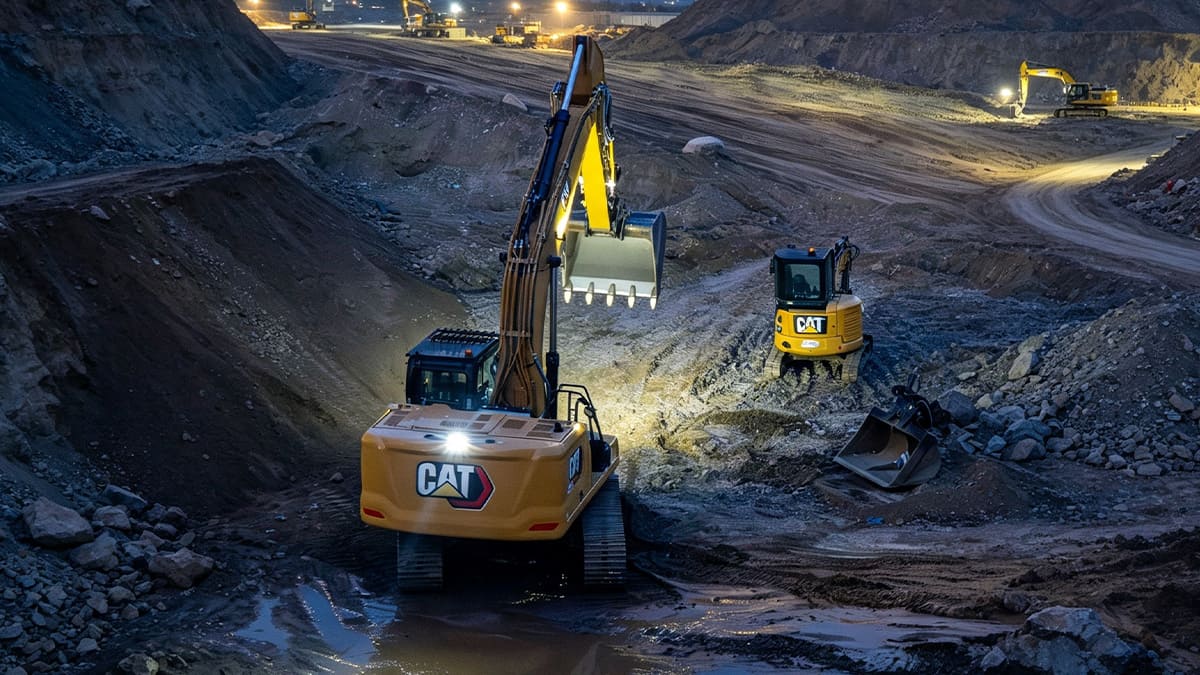
Those six positions are not six copies of the same requirement. Each one has a job, a beam that suits that job, an output band, and a particular way of destroying the lamp that is bolted there. This piece takes them one at a time. It follows the position numbering used on our construction and earthmoving application page, and it is written for the people who write the drawing: fleet engineers, OEM lighting specifiers and the dealers who fit the lamps.
The short answer: specify by position. Name the job, pick the beam and output band for that job, then ask for the test that matches how that position fails.
Six positions at a glance
The table below matches the numbered diagram above. The output bands are the ranges we build and fit most often for each position; a machine at the small or large end of the range will sit at the edge of the band.
| Position | Job | Beam and output band | What breaks a lamp here |
|---|---|---|---|
| 1. Boom or stick | Light that travels with the bucket | Spot or flood, 40–90 W | Vibration and shock at the highest level on the machine; bucket impact through the boom |
| 2. Cab roof, front | Dig face and load area | Flood, 50–144 W | Cab-roof heat and a hot lens after a day in the sun; rain and dust on the lens |
| 3. Cab roof, rear, and counterweight | Swing zone and the reversing path, aimed away from ground workers | Flood with a cut-off, 30–64 W | High-pressure washing, flying rock and rebar; glare complaints if the beam is wrong |
| 4. Side and track | Trench edge and the step up to the cab | Flood, 12–27 W | Mud, stones and the pressure washer, all at close range |
| 5. Cab roof, warning | Site visibility for everyone else | Amber strobe beacon | Vibration and being seen in daylight; the beacon is the one lamp that has to work when the others are off |
| 6. Whole-area lighting on large machines | Floodlighting an entire cut | Flood or spot, 290–580 W | Heat management at high output; mounting mass on a bracket that vibrates |
Position 1: the boom, where vibration is worst
The boom lamp is the one that fails first on most fleets, and the reason is mechanical. It rides the boom through every dig cycle and takes the shock of the bucket hitting rock through the structure. A lamp specified for this position is specified first by its vibration rating and only then by its light.
Ask for the vibration test to be run to the profile on your machine, not to a generic catalogue figure. We run boom lamps on our own vibration table to the OEM's profile and issue the report per model on request. The beam is usually a spot or a narrow flood in the 40–90 W band, so that the light reaches the bucket at full stick extension. Four of our round work lamps in this band (40 W, 50 W, 60 W and 90 W) hold ECE R10 approval, which matters where the lamp shares a harness with radios and telematics.
The bracket is part of the specification here. We recommend 304 stainless steel for the bracket and the fasteners as the minimum for this position, and 316 stainless steel for both where the machine works near the coast or underground, because salt and groundwater attack the fixings before they attack the lamp. That bracket to the boom's mounting face, and a Deutsch DT connector or flying lead to the harness drawing, are what keep the lamp on the boom after the first thousand hours.
Positions 2 and 5: the cab roof, front and warning
The front of the cab roof carries the main working floods, in the 50–144 W band, aimed at the dig face and the load area. The problem at this position is heat rather than shock. The roof is the hottest place on the machine on a summer afternoon, and the lamp has to start cold at dawn and run at full output on a lens that has been in the sun all day. Operating temperature range is the line to check, and the thermal shock test is the one to ask for.
The beacon on the same roof is a different product with a different job. It is there so that everyone else on site can see the machine, in daylight as much as at night, and it is the one lamp that must keep working when the work lights are switched off. Amber strobe beacons are specified by visibility and by supply voltage; our beacon and warning light range runs on 10–48, 10–60 and 10–110 V DC as well as the 9–32 V DC standard.
Positions 3 and 4: counterweight and side, where the washer is aimed
The rear of the cab roof and the counterweight light the swing zone and the reversing path. This is the position where a badly chosen beam causes the most trouble, because the light is pointed at exactly the place where ground workers stand. A flood with a cut-off optic, in the 30–64 W band, puts light on the ground behind the machine and keeps it out of people's eyes. Cut-off optics for this position are developed to the OEM's specification rather than picked from a catalogue.
The side and track lamps are the smallest on the machine, typically 12–27 W, and they get the roughest treatment. They sit at the height where the pressure washer is aimed at the end of the shift, and where mud and stones hit at close range. The specification lines that matter here are ingress protection and lens material: IP69K to ISO 20653 for the washdown, and an impact-resistant polycarbonate lens for the stones. Our construction range uses IP69K housings with potted drivers throughout, and lens guards and reinforced brackets can be built to the drawing.
Position 6: whole-area lighting on large machines
Large excavators and loaders add one or two high-output floods, in the 290–580 W band, to light the whole cut rather than one working zone. OSHA 29 CFR 1926.56 sets the minimum for general construction areas at 5 foot-candles (about 54 lux) and for excavation work at 3 foot-candles (about 32 lux), and on a large machine these floods are what carry the site over that line at the far edge of the work.
At this output, heat management inside the lamp and the mass on the bracket become the specification. A 580 W lamp on a bracket that resonates with the engine will not stay aimed, so the mounting face and the bracket are part of the drawing, not an afterthought.
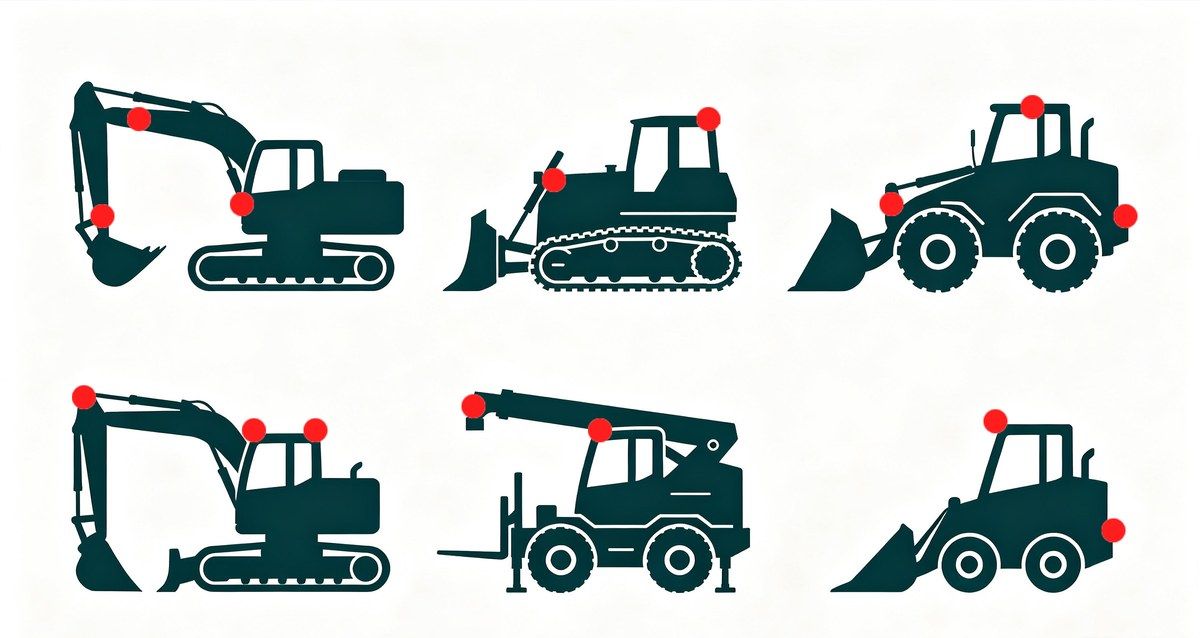
The six positions are an excavator's, but the logic carries over to the rest of the fleet. On a wheel loader the boom lamp becomes a lift-arm lamp, on a dozer the whole-area flood moves to the ROPS. Our guide to which heavy equipment lighting specs are comparable covers the machine-by-machine differences.
One voltage, one connector, six positions
Excavators are built on 12 V and 24 V systems, sometimes both within one fleet, and a lamp family that only runs on one of them doubles the spares list. Our work lights run on 9–32 V DC as standard, so the same part number fits both, and the six positions can share one connector standard. The Deutsch DT family is the usual choice on earthmoving harnesses; a flying lead to the harness drawing is the alternative.
What to put on the drawing for each position
A lamp specification that gets accepted first time names five things per position. The table gives them for the six positions above. Bracket and fastener material belongs on the drawing for every position, not only the boom: 304 stainless steel as the minimum, 316 for coastal sites and underground work.
| Position | Beam and output | Mounting and connector | Test or document to ask for |
|---|---|---|---|
| 1. Boom or stick | Spot or narrow flood, 40–90 W | 304 stainless steel bracket and fasteners to the boom face, 316 near the coast or underground; Deutsch DT or flying lead | Vibration test report to your profile; ECE R10 approval document where required |
| 2. Cab roof, front | Flood, 50–144 W | Roof bracket, cable routed to the roof harness | Operating temperature range; thermal shock test |
| 3. Cab roof, rear, and counterweight | Flood with cut-off, 30–64 W | Counterweight face or rear roof rail | Cut-off beam pattern to your drawing; IP69K to ISO 20653 |
| 4. Side and track | Flood, 12–27 W | Upper structure or track frame; lens guard if specified | IP69K to ISO 20653; polycarbonate lens; salt spray and dust chamber tests |
| 5. Cab roof, warning | Amber strobe beacon | Roof mount; supply voltage to match the machine | Supply voltage range; vibration test |
| 6. Whole-area lighting | Flood or spot, 290–580 W | Bracket sized for the lamp mass; mounting face on the drawing | Photometric data; thermal test at full output |
Where a line calls for a report we already hold, we send it. Where a line calls for a test we have not yet run on that model, we run it to the conditions in your specification and issue the report. Data sheets for the models named on the application page are available on request.
Frequently asked questions
How many work lights does an excavator need?
Most tracked excavators carry between five and nine lamps across six positions: boom, cab roof front, cab roof rear or counterweight, side and track, a warning beacon, and on large machines one or two whole-area floods. Mini excavators sit at the low end of that count, large mining-class machines at the top.
Should excavator work lights be flood or spot?
It depends on the position. The boom takes a spot or narrow flood so the light reaches the bucket at full reach. The cab roof front and the sides take floods. The rear and counterweight take a flood with a cut-off so the beam stays on the ground and out of the eyes of people behind the machine.
Can the same lamp be used on 12 V and 24 V excavators?
Yes, if the lamp is a wide-voltage design. Our work lights run on 9–32 V DC, which covers both systems on one part number. Beacons are offered in 10–48, 10–60 and 10–110 V DC versions as well for machines and carriers with higher system voltages.
Start from the drawing, not from the catalogue
If you have a lighting drawing or a specification for a machine, send it. We answer within 24 hours with a position-by-position response: which of our heavy-duty work lights fit each mount as they are, which need a bracket or connector change, and which need a lamp built to the drawing.