


Two work lamps are quoted at 5,000 lumens. Both are bolted to the same excavator boom. One lets the operator read the trench floor at 12 metres; the other washes the bucket in glare and leaves the cut dark. Nothing on either spec sheet predicted that.
This is not a quality problem. It is a measurement problem, and it exists because no photometric standard covers work lamps at all. Headlamps, fog lamps, spot lamps and tractor headlamps each have one. The lamp that lights the job does not.
The short version: the figures you can compare across suppliers are peak intensity in candela with the beam angle, illuminance in lux at a stated distance, ingress protection with the test named, and a vibration rating with its frequency band. The figures you cannot compare are total lumens, "effective lumens", and any brightness claim without a test condition attached. This guide sets out why, and what to specify instead.
Why "brightest" is not a specification
The gap is easy to verify. SAE publishes J581 for auxiliary high beams, J583 for front fog lamps, J591 for spot lamps, J95 for headlamps on industrial equipment and J975 for agricultural equipment headlamps. None of them covers a work lamp.
SAE J578 is the standard most often cited in work lamp marketing. Its 2020 revision specifies chromaticity requirements, the colour of the light, and contains no photometric requirement whatsoever. Citing it as evidence of output is citing a colour standard for a brightness claim.
The international standards do not fill the gap either. ISO 12509 covers lighting, signalling and marking devices on earth-moving machinery, not work lighting. EN 1837 covers integral lighting of machines and explicitly does not specify lighting systems mounted on the machine to illuminate visual tasks outside it, which is precisely what a work lamp does. EN 12464-2 covers outdoor workplaces as fixed installations, not vehicle-mounted lighting.
That regulatory vacuum is the whole reason unverifiable output claims survive in this category. Nobody has to test to a common method, so nobody does. For the full breakdown of which unit measures what, see lumens vs lux vs candela.
The "effective lumens" trap
One term deserves naming because it looks like a solution and is not. "Effective lumens" appears in neither IEV 845, the CIE international lighting vocabulary, nor ANSI/IES LS-1-25, the nomenclature standard for illuminating engineering. No standards body defines it.
The decisive problem is that vendors measure it differently. Some take the raw figure at start-up and the effective figure after 30 minutes. Others quote 10 and 30 minutes. At least one takes the reading after the lamp has run for two hours. Comparing effective lumens across brands compares different tests, so the ratio between raw and effective, often quoted as roughly 70 %, has no fixed meaning either.
If a supplier offers you an effective lumen figure, the useful follow-up is not "is that number real". It is "after how long, at what ambient temperature, at what test voltage". See raw lumens vs effective lumens for how the figures are derived.
The four figures you can actually compare
| Figure | What it tells you | What to ask the supplier for |
|---|---|---|
| Peak intensity (candela) + beam angle | How much light reaches the target, and how tightly it is concentrated | The photometric plot, or peak cd with the angle at which it was measured |
| Illuminance (lux) at a stated distance | What the operator will actually see on the work surface | Lux at 10 m and 20 m, measured on axis |
| Ingress protection with the test named | Whether it survives wash-down, dust and immersion | The IP code plus which test was run; IP68 and IP69K are different tests, not a ranking |
| Vibration rating with its frequency band | Whether it survives the machine it is bolted to | The Grms figure AND the frequency range and standard it was tested to |
Candela, not lumens
Luminous flux is defined at IEV 845-21-039 with the lumen as its unit; illuminance is defined at IEV 845-21-060 as incident flux per unit area, with the lux as its unit. Both derive from the candela. The practical consequence: a 10,000 lm flood spread across a wide angle can put less light on the target than a 5,000 lm spot, because the flood divides the same flux over a larger area.
Lumens describe the lamp. Lux and candela describe what the operator can see. On a machine, only the second pair decides anything. Which pattern suits which task is set out in beam patterns.
IP68 and IP69K are different tests, not different grades
This is the most common misreading in the category. IP68 covers continuous immersion. IP69K covers high-pressure, high-temperature wash-down, typically 80 °C water at up to 100 bar. A lamp can hold one and fail the other, because they simulate different events. Neither is "higher" than the other in any absolute sense.
For machines that get pressure-washed at the end of a shift, IP69K is the relevant test and IP68 alone does not substitute for it. We cover the distinction in detail in IP69K vs IP68, and the rating system itself in IP ratings.
What to do with this on an RFQ: ask for the IP code and the test standard together. A rating quoted without the test behind it is a marketing number.
A vibration figure without its frequency band is not a figure
Grms values are widely published and almost never comparable, because the same lamp returns very different numbers depending on the frequency range swept and the standard applied. A rating quoted as a bare Grms value tells you a test was run. It does not tell you which one.
On an excavator boom, a dozer blade mount or a fender, this is the specification that decides whether the lamp survives its first season. Ask for the band and the standard alongside the number; see vibration rating. The related question is what happens inside the housing: potting the driver in resin is what keeps a lamp alive through both vibration and thermal cycling, and it is visible on a cutaway but not on a spec sheet. See potted driver.
Three things the spec sheet will not tell you
Where the water actually gets in
An IP rating describes the housing. On machinery the joint that fails is usually the connector, and that sits outside the housing rating entirely. Deutsch connectors, the DT, DTM and DTP series from TE Connectivity, are the default on agricultural and construction harnesses because they seal at both the wire side and the interface.
The detail that belongs on an RFQ: TE specifies IP68 and IP6K9K for inline plug and receptacle pairs with rear protection such as a backshell. PCB-mounted headers and flanged versions are marked "Not Tested" in the same document. A lamp that terminates in a header is therefore not covered by the inline figure, whatever the catalogue implies.
Current ratings carry the same kind of condition. A DT contact is rated 13 A at 14 and 16 AWG, 10 A at 18 AWG and 7.5 A at 20 AWG, per TE product specification 108-151009. Quoting "13 A" without the wire size overstates the rating for thinner cores. The full breakdown by series is in Deutsch connector.
Glare is a specification, just not a published one
Every lamp that lights the work also lights the dust between the lamp and the work. The operator sits inside the beam's near field, so a lamp that measures well on axis can still be unusable if it scatters back off cab glass or a raised bucket.
The variables you control are aiming angle, beam pattern and mounting position, not output. Adding lumens to a glare problem makes it worse. This is why the machine table pairs close-quarters work with wide flood and short throw, and reach work with spot: the mismatch, not the brightness, is what wears an operator down over a twelve-hour shift. See beam patterns.
What a vibration figure covers, and what it does not
A lamp-level Grms rating covers the lamp. The connector has its own, and they are not the same test. The Deutsch DT series is tested to MIL-STD-1344 Method 2005.1: a sinusoidal sweep from 10 to 2000 Hz at up to 20 G, four hours in each of three axes, with the circuit monitored for discontinuity throughout.
That is what a comparable vibration figure looks like: a named method, a stated frequency band, a defined duration and a pass criterion. A bare "20 G" on a lamp datasheet, with no band and no standard behind it, is not comparable to that, or to any other supplier's number.
The one figure the jobsite actually mandates
Everything above is about comparing products. There is exactly one place where a number is legally required, and it is about the site rather than the lamp.
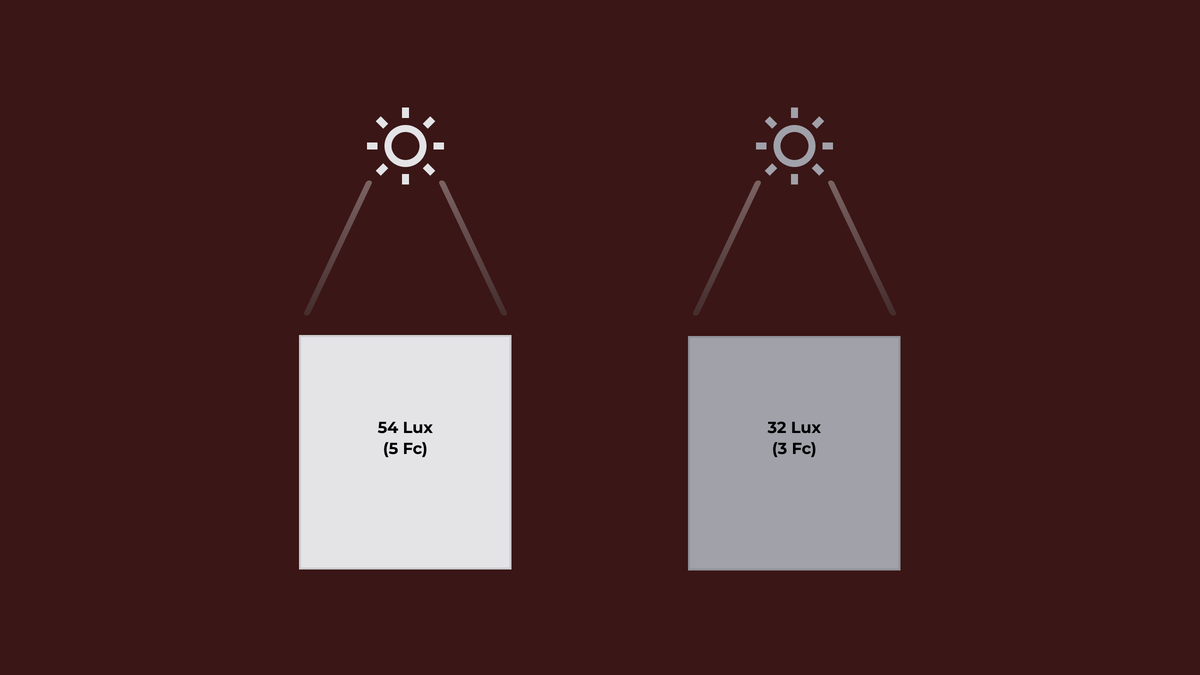
OSHA 1926.56 Table D-3 sets construction minimums: 3 foot-candles, about 32 lux, for general excavation and access areas, and 5 foot-candles, about 54 lux, for general construction areas. These are site-wide illumination requirements on a US construction site, not a specification for any individual lamp.
But they give you something the product standards do not: a target you can calculate backwards from. If you know the required lux on the ground, the mounting height and the beam angle, you can work out how many lamps of what intensity get you there, and you can check the answer with a light meter instead of taking anyone's word for it.
Outside the US the equivalent duty usually sits under the general risk-assessment obligation rather than a fixed table, which is why the site figure is worth carrying into any specification conversation. Our construction and earthmoving lighting page covers how this plays out per machine class.
Machine by machine: what decides the choice
The task at night differs by machine, and the task decides the beam long before the brand does.
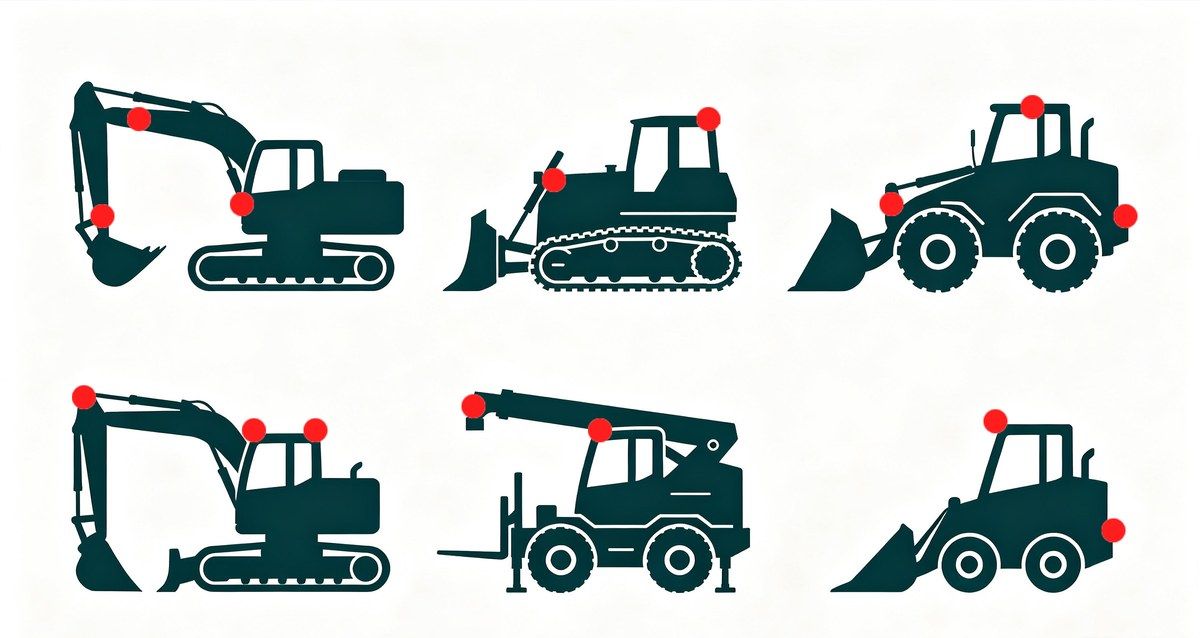
| Machine | What the operator is actually doing | Typical positions | Beam that fits |
|---|---|---|---|
| Excavator | Reading trench depth and bucket edge at reach | Boom, cab roof front, counterweight rear | Spot along the boom, flood at the cab |
| Dozer | Watching blade edge and grade close to the machine | Cab roof front and rear, blade-side corners | Wide flood forward, flood rear |
| Wheel loader | Bucket fill and travel between stockpile and truck | Cab roof, boom, rear grille | Flood at the bucket, combo forward |
| Backhoe | Two work directions from one seat | Cab roof front and rear, boom | Flood both ends, spot on the boom |
| Telehandler | Placing a load at height, away from the cab | Boom head, cab roof | Spot at the boom head, flood at the cab |
| Skid steer | Close-quarters work with high machine movement | Cab front corners, rear | Wide flood, short throw |
One pattern runs through the whole table: the further the work is from the operator, the tighter the beam needs to be, and the more the candela figure matters relative to the lumen figure. Close-quarters machines want spread and low glare; reach machines want intensity down the arm.
Compact machines are the exception worth calling out, because the lamp count is driven by geometry rather than by output: a skid steer works within a couple of metres of its own frame, and a flood that throws 30 metres mostly lights dust. Our skid steer lighting range is built around that constraint.
12 V or 24 V: usually the wrong question
Buyers search for "24 volt LED lights for heavy equipment" because that is what the machine runs. But on a modern work lamp the answer is normally neither: a wide-input driver accepts 9–32 V DC and runs on both systems without a variant. Across our own range, 291 of 317 products are 9–32 V DC. The exceptions are forklift safety lamps, which run 10–48, 10–60 and 10–110 V DC for electric truck systems.
For a fleet or a dealer this is a stocking argument before it is a technical one: one part number covers both 12 V and 24 V machines, which halves the SKUs you hold. See multi-volt input.
What wide input does not fix is the harness. Photometric performance is certified at the lamp terminals (SAE J1383 measures at 12.8 V ± 20 mV there), so whatever the cable loses comes straight out of the beam. Take a 100 W lamp on 5 m of 2.5 mm² copper at 20 °C: at 12 V the drop is about 4.8 %, at 24 V about 1.2 %. Same wire, same power, roughly four times the loss on the lower-voltage system.
This matters most on retrofits. A constant-current LED driver raises current as terminal voltage falls, so replacing halogen lamps on an old harness can expose a voltage-drop problem the filament lamps quietly tolerated. The full arithmetic, including why there is no SAE 3 % rule, is in voltage drop.
The compliance layer most guides skip
Work lamps have no photometric regulation. They are not, however, unregulated, and the part that does apply catches people out.
UN Regulation No. 10 governs electromagnetic compatibility for vehicles and for the electrical sub-assemblies fitted to them, across vehicle categories L, M, N, O, T, R and S. Category T is agricultural tractors, which is why the regulation reaches machinery lighting and not only road cars. It tests two directions: the switching noise of an LED driver must not disturb the radio, GPS or other on-board electronics, and the lamp must keep working inside an external electromagnetic field.
The trap is the E-mark itself. It is a family of approvals, not one certificate. R10 covers EMC; photometric and signalling functions sit under their own regulations. So "this lamp is E-marked" is an incomplete statement; the question is which regulation, and what approval number. See ECE R10.
Practically: if the machine is road-registered or the function faces the road, ask which approvals apply per model and get the documentation. If the lamp only lights the job on private ground, the photometric side is unregulated but the EMC side still applies once it is wired into the vehicle.
So what are the best LED lights for heavy equipment?
There is no single answer, and any supplier who gives you one is selling rather than specifying. What there is, is a checklist that separates a verifiable quote from a marketing one.
- Ask for peak intensity in candela with the beam angle, or the photometric plot.
- Ask for lux at a stated distance: 10 m and 20 m covers most machine work.
- Ask for the IP code with the test named, and check it is the wash-down test if the machine gets pressure-washed.
- Ask for the vibration rating with its frequency band and standard.
- Ask what voltage range the driver accepts, then check the harness rather than the lamp.
- Ask which approvals the model holds and for which market, and expect the documentation, not a logo.
A supplier who answers all six has told you more than any lumen figure could. One who answers none has told you something too. Our heavy duty work lights range is specified on these terms, and documentation is available on request.
Frequently asked questions
What are the best 24 volt LED lights for heavy equipment?
On current products the question usually dissolves: most work lamps built for machinery accept 9–32 V DC, so the same part runs on a 12 V utility vehicle and a 24 V excavator. Rather than filtering for "24 volt", filter for wide input, then compare candela and beam angle for the task. The one place voltage genuinely narrows the field is electric material handling, where 10–48 V, 10–60 V and 10–110 V systems need lamps built for them.
Do work lights on construction equipment need certification?
There is no photometric approval to hold, because no photometric standard covers work lamps. Electromagnetic compatibility is different: once a lamp is wired into a vehicle in the regulated categories, the EMC requirements apply. If the function faces the road, as with headlamps, indicators and markers, then market-specific approvals apply on top. Tell your supplier the destination market and whether the function is road-facing, and ask for documentation per model.
How many work lights does an excavator need?
No standard specifies a lamp count, and any number quoted as a rule is convention rather than requirement. The defensible way to size it is backwards from the site figure: OSHA 1926.56 Table D-3 asks for about 32 lux in general excavation areas, so with a known mounting height and beam angle you can calculate the intensity needed and verify it with a light meter. In practice, a mid-size excavator working nights is commonly lit from the cab front, the boom and the counterweight, because those three positions cover the three things the operator watches.
Why do LED work lights fail on heavy equipment?
Four causes account for most of it: vibration fatigue at the mount and inside the driver, water ingress through gaskets after pressure washing, heat that a housing cannot shed, and voltage drop in a harness that was sized for halogen loads. Notice that only the last one is about the machine rather than the lamp, and it is the one most often diagnosed as a faulty lamp.
What is the difference between a work light and a warning light?
A work light illuminates a task so the operator can see it. A warning light makes the machine visible to everyone else, and it is the one with actual regulation behind it: beacon colour is restricted by jurisdiction rather than left to preference. The two are specified on different terms: a work lamp is chosen on candela, beam and mounting; a beacon is chosen on colour entitlement, flash pattern and mounting height. Fitting a brighter work lamp does not substitute for a beacon, and a beacon aimed at the work does nothing useful.
Can I use tractor work lights on an excavator?
Usually yes, electrically and mechanically: both run 9–32 V systems and share mounting patterns. The difference is the beam and the mount geometry, not the lamp class. A tractor fender flood aimed at an implement is the wrong pattern for a 12 metre trench. Choose by task and throw distance, not by the machine name on the category page.
Specifying rather than shopping
The category rewards buyers who ask measurable questions, because the absence of a photometric standard means nothing else filters the field. Candela with an angle, lux at a distance, an IP code with its test, a vibration figure with its band, a voltage range, and approvals with documentation: six answers, and the quotes on your desk sort themselves.
We manufacture the heavy duty work lights and LED work lights behind this guide, and we answer all six in writing. If you are specifying for a fleet or a machine build, tell us the machine and the task and we will come back with the figures rather than the adjectives.