


At night the fire ground is lit by whatever the first truck brought with it. The crew pulls hose, sets the ladder and works an extrication inside a circle of light that the department chose months earlier, when it signed off the apparatus specification.
This article is for the people who write that part of the specification: apparatus builders, the body and electrical engineers who lay out the lights, and the department members who sit on the truck committee. It covers what the NFPA standard actually asks for, how big a scene light needs to be, where it should go on the body, and the electrical load that comes with it.
The short answer: meet the NFPA light levels around the truck with work lights, add scene lights in the 10,000 lumen class for the incident itself, spread several of them close to the edges of the body, and add up the 12 V current before the package is final.
What NFPA requires, and what it leaves to you
The NFPA apparatus standard does not require scene lights at all. The Fire Apparatus Manufacturers' Association says so plainly in its scene lighting buyer's guide: scene lighting is "an extremely popular choice" but the standard "does not specifically require" it.
What the standard does set is a minimum light level in the places where firefighters step, climb and work around the truck. FAMA's guide summarises the 2016 edition of NFPA 1901 as follows.
| Area | Minimum level |
|---|---|
| Rear of the apparatus, a 10 ft by 10 ft area | Average 30 lux (3 foot-candles) |
| Ground within 30 in of the body where crews get on and off | 20 lux (2 foot-candles) |
| Hose bed, with hose and dividers removed | Average 30 lux (3 foot-candles) |
| Any work surface, step or walkway | 20 lux (2 foot-candles) |
These figures are in lux, the light that lands on a surface, rather than lumens, the light that leaves the lamp. A lumen rating alone cannot show whether a lamp meets them; you need the beam pattern and the mounting position.
Our article on lumens and lux for work lights works through the difference.
The standard has also been renumbered. For apparatus contracted after 1 January 2024, NFPA 1900 replaces NFPA 1901, along with three other apparatus standards, and every chapter number has changed. If your specification still quotes 1901 clause numbers, check them against the edition your contract names.
Scene lights and work lights are two different sizes
A scene light lights the incident. A work light lights the truck. The two jobs need different amounts of light, and mixing them up is the most common reason a new apparatus disappoints at its first night call.
FAMA puts a typical fire truck scene light at "a 10,000 lumen or larger LED fixture", roughly the useful light of the 500 W quartz lamps that departments used for decades. Steps, compartments, the pump panel and the ground beside the body need far less, and a scene-class lamp aimed at them simply dazzles the crew.
| Job on the apparatus | Typical output | Example model | Rated power and output |
|---|---|---|---|
| Ground lighting, steps, rear work area | 4,000 to 5,000 lm | YW-0801-50 | 50 W, 4,000 lm |
| Pump panel side and compartment fronts | about 5,000 lm | YW-0801-60 | 60 W, 4,800 lm |
| Upper body and rear, lighting further out | about 7,000 lm | YW-0801-90 | 90 W, 7,200 lm |
| Scene lighting from the body or brow | 10,000 lm and up | YW-0801-120 | 120 W, 10,200 lm |
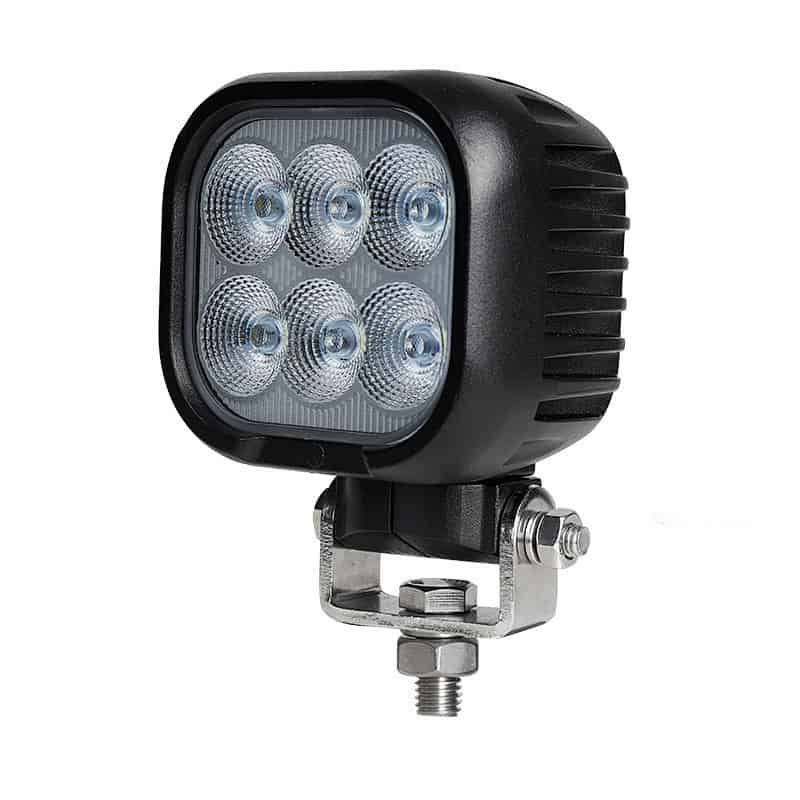
All four models come in a 30 degree spot or a 60 degree flood beam. For scene and ground work the flood is almost always the right choice. The heavy-duty work light range lists the larger fixtures, including 160 W and 290 W models for brow and tower positions.
Place more, smaller fixtures close to the edge of the body
The aim of a scene package is even light. FAMA's guide puts it directly: the fewer "highs and lows" on the fire ground, the better, because bright patches beside dark ones tire the eyes and hide trip hazards. Several medium fixtures spread around the truck usually achieve this better than one very large fixture, and FAMA notes that the cost difference is often negligible.
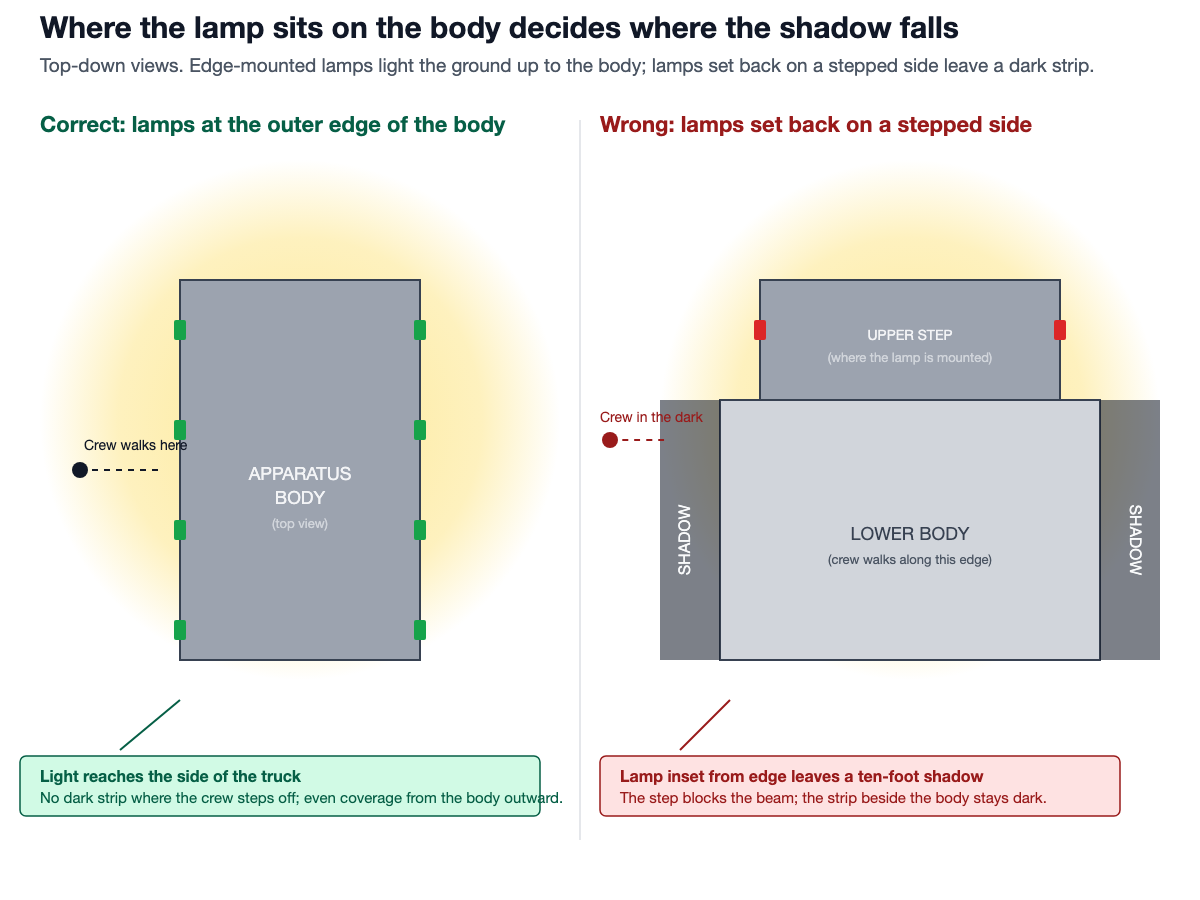
Placement matters as much as the fixture. On a body with stepped sides, a lamp mounted too far in from the edge throws a shadow along the side of the truck, exactly where crews walk; FAMA's guide shows a shadow about ten feet long from that one mistake.
Mount side scene lights as close to the outer edge as the body allows, and on stepped bodies consider a pedestal or bar-style fixture that reaches out past the step.
Two other positions need care:
- Brow lights on the leading edge of the cab give instant light with no setup, but they must not block the FMVSS 108 clearance and identification lamps. Either mount them clear of the marker lamps or use a fixture that integrates them.
- Telescoping poles lift the light up and away from the operators, which is the most effective way to reduce glare at ground level. They need periodic cleaning and lubrication, so plan access to the mechanism.
Recessed fixtures sit almost flush with the body panel, which helps on trucks that work under branches. Surface-mounted fixtures need only mounting holes and a cable entry. Both work; the decision is usually made by the body panel, not the lamp.
Glare is set by aim and optics, not by brightness
A scene light that blinds the crew has made the incident more dangerous. Glare comes from three choices made on the drawing: the beam, the height and the aim.
Use flood optics for scene and ground work, so the light spreads across the area rather than concentrating in a hot spot. Mount high, because light that arrives from above lands on the ground instead of in someone's eyes. Aim below horizontal, so the brightest part of the beam falls on the work area and not across it.
FAMA's guide recommends one more step that no data sheet replaces: look at the candidate fixtures side by side after dark before the specification is finalised. Lumen ratings are measured differently by different manufacturers, so two lamps with the same number on the box can light a scene very differently.
A 12 V scene package is a large electrical load
LED lamps use far less power than halogen for the same light, but FAMA warns against the idea that they hardly draw anything: "watts are watts." A large LED scene package is one of the biggest loads on a 12 V apparatus system.
Our lamps draw about 80% of their rated wattage in operation. The table below adds up a typical package so the current can be checked against the alternator and batteries.
| Position | Quantity | Model | Draw per lamp | Total draw | Current at 12 V |
|---|---|---|---|---|---|
| Scene lights, body sides and rear | 4 | YW-0801-120 | about 96 W | about 384 W | about 32 A |
| Ground and step lights | 6 | YW-0801-50 | about 40 W | about 240 W | about 20 A |
| Package total | 10 | about 624 W | about 52 A |
Fifty amps for lighting alone is the kind of figure that changes alternator sizing and load management decisions on the truck. Hand it to the apparatus builder's electrical engineer early. Where the budget is tight, we can set a lower drive power for a programme, trading some output for current.
Line voltage is a separate decision. Fire apparatus often carry a 120/240 V AC generator system as well as the 12 V chassis system, and FAMA advises that portable and tripod lights should usually be AC versions because long low-voltage cable runs lose too much voltage. Our fixtures are 9–32 V DC lamps for body-mounted positions on the chassis system.
Washdown, vibration and the radios on board
A fire apparatus is washed after calls, vibrates with the pump and the road, and carries radios, cameras and telematics that a noisy lamp can disturb. Each of these is a line in the specification.
The models in the table above are sealed to IP69K, the rating written for close-range high-pressure washing, and their drivers are potted, so vibration and moisture have nothing to work on. Our range is built to CISPR 25 for radiated emissions, and four of our round work lamp models hold ECE R10 approval. Ask for the test report by model and check it against the profile on your drawing.
We have co-developed dedicated lights with fire apparatus and ambulance builders, from design and 3D-printed prototypes through tooling to series production. The emergency vehicle application page describes how those programmes run.
Frequently asked questions
Does NFPA require scene lights on a fire truck?
No. FAMA's buyer's guide states that the NFPA apparatus standard does not require scene lighting. It does set minimum light levels around the truck, such as 30 lux behind the apparatus and 20 lux at steps and walkways, which work lights usually provide.
How many lumens should a fire truck scene light have?
FAMA describes a typical fire truck scene light as a 10,000 lumen or larger LED fixture. Lumens alone do not decide how well a scene is lit, so compare the beam pattern and look at the fixtures after dark before choosing.
What is the difference between scene lights and warning lights?
Scene lights illuminate the work area so the crew can see. Warning lights make the vehicle visible to traffic, and their colours and flash patterns are regulated separately. Our article on beacon light colours covers who may use which colour.
A scene lighting package is decided on the drawing: meet the NFPA levels around the truck, add scene-class lights for the incident, mount them at the edges of the body and add up the current before the order is signed. Send your apparatus drawing and the positions you have in mind, and our engineers will come back with a fixture and load proposal for each one, or browse the LED work light range first.