


Two lamps, same price, one says 2,000 lumens and the other says 3,000. The 3,000 looks like the safer buy.
We build work lamps for agricultural and construction machinery, and the lumen figure is the number our own customers ask about first. It is also the number that answers their question least. Our own catalogue makes the point against us: 55 of our lamps are rated 40 W, and their published output runs from 2,400 to 4,800 lumens.
This piece covers what the lumen figure can and cannot tell you, the illuminance numbers a US jobsite is actually held to, and the arithmetic that connects the two. By the end you should be able to take any lamp's published figures and work out whether it clears the minimum for the job you are lighting.
The short answer: 3,000 lumens is enough to light a small working area and nowhere near enough to light a large one, and the lumen figure alone cannot tell you which case you are in. What you need is lux, meaning light per square metre on the surface you are working on, and lux depends on the beam and the distance as much as on the lumen output. A 3,000-lumen lamp on a tight spot beam at three metres can easily exceed OSHA's minimum; the same 3,000 lumens flooded across a machine's whole working radius may not.
Neither number on the box settles it
A lumen is the total light leaving the lamp in every direction it emits. It says nothing about where the light goes.
Start with what the two numbers on the box do to each other. Here is what one rated wattage at a time looks like across our own range:
| Rated wattage | Published lumens, lowest to highest | Ratio |
|---|---|---|
| 24 W | 1,920 · 2,040 · 2,200 · 2,450 | 1.3× |
| 30 W | 1,100 · 1,200 · 2,000 · 2,100 · 2,400 · 2,500 · 3,000 | 2.7× |
| 40 W | 2,400 · 3,200 · 3,500 · 3,600 · 4,800 | 2.0× |
| 60 W | 3,500 · 4,800 | 1.4× |
The spread is not uniform: at 24 W and 60 W it is narrow, at 30 W two lamps differ by a factor of 2.7. But at no wattage is the lumen figure fixed by the wattage. Efficacy across the range runs from about 37 lumens per watt (a 30 W sealed replacement lamp, YW-3301, at 1,100 lm) to 160 (a 20 W compact flood, YW-0601-20, at 3,200 lm; 20 W is not one of the four wattages in the table above), because a lamp built to drop into a specific fitting and a lamp built for reach are not the same kind of object. The figures here come from single-lamp entries where the wattage and the lumen figure describe the same thing: one lamp, one light output. Two kinds of entry are left out. Conversion kits quote one combined figure for a pair of lamps. Multi-colour lamps quote the output of a single channel against the wattage of the whole unit. In both cases the two numbers are not measuring the same object. So wattage does not settle lumens.
But lumens do not settle the question either, and that is the part buyers get wrong. A lumen is a total, and a total says nothing about direction.
What does differ between two lamps of the same wattage and the same lumen figure is the optic: whether the light leaves as a flood, a spot, a trapezoid or a driving beam. That decision changes the illuminance on your working surface by a factor of several, at the same lumen figure. It is covered in our beam pattern glossary entry, and it is the specification that should be doing the work the lumen figure is currently being asked to do.
The lighting numbers a US jobsite is held to
There is a federal requirement, and it is not written in lumens. Some states run their own OSHA-approved plans and other subparts of Part 1926 carry their own lighting duties, so check what applies to your site, but the federal floor is where the argument starts.
29 CFR 1926.56 requires that "Construction areas, ramps, runways, corridors, offices, shops, and storage areas shall be lighted to not less than the minimum illumination intensities listed in Table D-3 while any work is in progress." Table D-3 reads:
| Foot-candles | Lux (approx.) | Area |
|---|---|---|
| 5 | 54 | General construction area lighting |
| 3 | 32 | General construction areas, concrete placement, excavation and waste areas, accessways, active storage areas, loading platforms, refueling, and field maintenance areas |
| 5 | 54 | Indoors: warehouses, corridors, hallways, and exitways |
| 5 | 54 | Tunnels, shafts, and general underground work areas (10 fc at tunnel and shaft heading during drilling, mucking and scaling) |
| 10 | 108 | General construction plant and shops |
| 30 | 323 | First aid stations, infirmaries, and offices |
Read the first two rows together before going further. The regulation uses closely similar wording in both: "general construction area lighting" is held to 5 foot-candles, while "general construction areas" appears again in the 3 foot-candle row alongside excavation, accessways, loading platforms and field maintenance. That is the regulation's own phrasing, not a contradiction in this article, and it is why quoting a single figure for "a construction site" is unsafe.
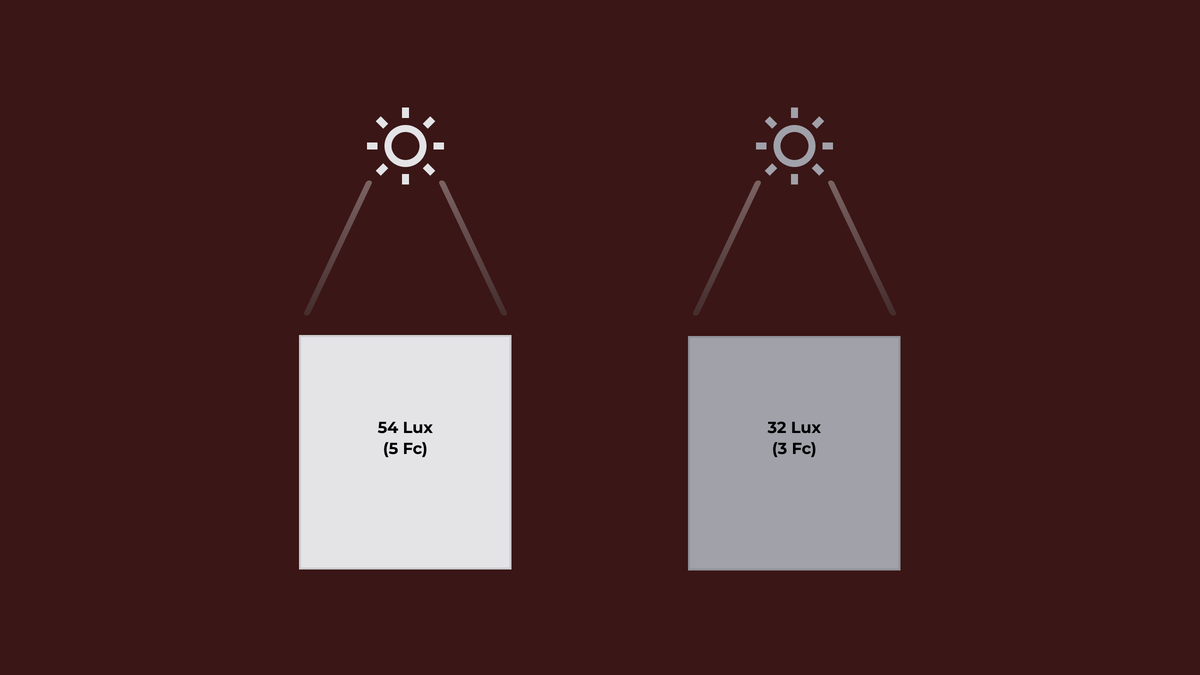
One foot-candle is one lumen per square foot; the lux column is the same quantity in lumens per square metre, at 10.764 lux to the foot-candle.
Read the table twice. Every value describes light arriving on an area. Not one of them describes light leaving a lamp. A regulation written by people who had to enforce something measurable chose the quantity you can put a meter on at the work surface.
This is the gap that every buying guide on this topic leaves open. Recommending "3,000 to 10,000 lumens for construction" is not wrong exactly, but it is unfalsifiable: there is no area attached, so there is no way to check it against the one number an inspector can actually measure.
The arithmetic between the two
Illuminance is luminous flux per unit area:
lux = lumens ÷ area in square metres
Use it as a ceiling for the average, not a prediction. It assumes every lumen the lamp emits lands inside the area you specified, spread evenly, with nothing lost to the optic, the lens or the angle of incidence. The average across that area will come out below this figure; a tight beam can of course exceed it on the patch it actually covers, which is the same point about direction from a different side. A ceiling is useful precisely because a lamp that fails it cannot meet the average in practice.
Worked through, with our own lamps:
| Lamp | Rated watts | Lumens | Lit area | Ceiling illuminance | Against OSHA 3 fc (32 lux) |
|---|---|---|---|---|---|
| YW-3301 | 30 W | 1,100 | 100 m² | 11 lux | 0.34× (short) |
| WL8620 | 30 W | 3,000 | 100 m² | 30 lux | 0.94× (just short) |
| YW-0602-18 | 18 W | 1,440 | 25 m² | 58 lux | 1.8× (clears) |
| YW-0401-60 | 60 W | 4,800 | 100 m² | 48 lux | 1.5× (clears) |
| YW-0607-580 | 580 W | 46,400 | 1,000 m² | 46 lux | 1.4× (clears) |
Look at the first two rows before anything else. Both lamps are rated 30 W. Over the same 100 square metres one reaches 11 lux and the other 30. Neither clears the minimum, but they are not remotely the same lamp, and the wattage on the box is identical. Further down, the 18 W lamp is generous over the 25 square metres in its own row; spread the same 1,440 lumens over the 100 square metres in the rows above it and the ceiling falls to 14 lux, well under the minimum. The 580 W lamp in the last row is the mirror case: generous over the 1,000 square metres it is listed against, and wasteful over the 25 square metres above it, where its 46,400 lumens would put a ceiling of about 1,856 lux on a surface that needs 32. None of that is visible until you attach an area to the figure.
This is also why the question changes shape once you ask it properly. "How many lumens do I need" has no answer. "How many square metres do I need to hold at 3 foot-candles" has one, and it leads directly to a lamp count.
What this changes when you compare two quotes
Three practical consequences.
Same wattage, same lumens, different lamp. If two suppliers quote the same wattage and the same lumen figure, you still have not learned which lamp performs better. Ask for the beam pattern and, if they have a photometric file, the candela distribution. That is the number that differs.
A bigger lumen figure can be the worse buy. Putting that 580 W lamp over a 25 m² work area, as the arithmetic above shows, is delivering far more light than the task requires, drawing current you have to fuse and generating heat the housing has to shed. Matching the lamp to the area is cheaper than over-specifying it.
"Effective lumens" is a different number from raw lumens. Some suppliers publish the sum of the LED manufacturers' bare-chip ratings; others publish the output measured from the finished lamp after optical and thermal losses. The two can differ by a third or more. We explain the distinction in our raw versus effective lumens entry. If a quote does not say which one it is, that is the first question to ask.
What to ask for instead
A specification that can be checked has three parts, not one:
The area and the target. "Hold 54 lux across the 30 m by 20 m yard" is checkable with a light meter. "Bright enough" is not.
The beam pattern per position. Flood for close work around the machine, spot or driving for reach, trapezoid where a rectangular patch suits the task better than a circle.
The evidence. A photometric file if the supplier has one, or at minimum a statement of whether the lumen figure is raw or measured from the finished lamp.
Our work lamps are listed at 9–32 V DC, so one lamp covers both 12 V and 24 V systems and the specification conversation stays on optics rather than on electrical variants.
Frequently asked questions
Is 3,000 lumens bright for a work light?
For a single machine-mounted lamp it is a mid-range figure, but notice that the question cannot be answered in the units it was asked in. Whether 3,000 lumens is bright enough depends on the area you are lighting. Spread over 25 square metres it comfortably exceeds OSHA's 3 foot-candle minimum; spread over 100 square metres it cannot reach it even before optical losses.
How many lumens do I need for a work light?
There is no lumen answer to this question without an area. Decide the area you need to light and the illuminance you must hold. Under 29 CFR 1926.56 that is 5 foot-candles for general construction area lighting, and 3 for excavation, accessways, loading platforms and field maintenance areas. Then divide. The result tells you the total lumens all the lamps together must deliver, which usually means a lamp count rather than a single bigger lamp.
Is 2,000 lumens bright enough for a work light?
Over a small working area, yes. A 2,000-lumen lamp spread over 25 square metres gives a ceiling of 80 lux, well clear of the 32 lux that 3 foot-candles represents. Over a 100 square metre area the same lamp gives a ceiling of 20 lux, which is below the minimum.
Does a higher lumen figure mean a brighter working area?
Not reliably. Two lamps with the same lumen figure but different beam patterns put very different illuminance on the same surface, because one concentrates its output and the other spreads it. Higher lumens with a wider beam can leave you with less light on the task than lower lumens with a beam matched to the distance.
Put an area on it
Before the next quote, write down two numbers: the working area in square metres, and the illuminance you need to hold on it. Everything else, from lamp count and wattage to beam pattern and whether 3,000 lumens is enough, follows from those two and can be checked afterwards with a meter.
If you want the arithmetic run against your own machines, send the positions and working distances with your enquiry and we will come back with a lamp count rather than a lumen figure. Start from the LED work light range, or the heavy duty range if the lamps will see pressure washing and sustained vibration.
Next: LED Lights for Heavy Equipment: Which Specs Are Comparable covers the other figures on a spec sheet and which of them can be compared between suppliers at all.
---