


Two scratches of the same depth, on the same lamp, on the same day. One of them will still be nothing in three years. The other can perforate the housing.
What separates them is not the damage. It is what metal happens to be bolted alongside, and how much of it there is. Our housings are die-cast aluminium and our brackets are stainless steel, so this is a question we have had to answer about our own products rather than in the abstract.
This article explains the mechanism, the one variable that sets its speed, and what actually holds it back on a lamp that lives outdoors.
The short answer: aluminium and stainless steel in contact, with salt water bridging them, form a galvanic cell in which the aluminium is the one that dissolves. How quickly depends overwhelmingly on how much bare aluminium is exposed compared with the stainless steel facing it. A small breach next to a large bracket is the worst case, and it is also the most common one.
What galvanic corrosion is, in one paragraph
It is a battery you did not mean to build.
Put two dissimilar metals in electrical contact, then bridge them with an electrolyte, and current flows between them. One metal gives up material into the solution and the other is protected. The metal that loses is the anode. All three conditions have to be present at the same time: remove any one of them and the cell stops.
That last point is the whole basis of corrosion control, and it is worth holding onto. Nothing practical changes which metal is the anode. What you can change is whether the electrolyte ever reaches the metals at all.
Sea water is a far better electrolyte than rain, which is why a lamp that lives happily on a tractor for years can behave quite differently on a boat. The metals did not change. The bridge did.
It is worth separating two things that are easy to conflate. Everything in this article happens on the outside of the housing, where the two metals meet. Whether water gets inside the enclosure is a different question with its own rating system, and a lamp can be entirely sound on one count and exposed on the other.
In a lamp, the aluminium is the anode
Ranked against stainless steel in sea water, aluminium is the more active of the two, so the aluminium is the side that gives way.
This is not a defect in either metal and it is not a reason to avoid stainless brackets. Stainless steel is used for fixings precisely because it holds up in wet service, and a mild steel bracket would have its own, more visible problems. The pairing is normal engineering. What matters is understanding which side is exposed by it.
| Pairing | Which side corrodes | Where it shows up |
|---|---|---|
| Aluminium housing and stainless bracket | The aluminium | At the contact face and around fixing holes |
| Aluminium housing and stainless bolt | The aluminium | The bore of the hole, often unseen until it leaks |
| Stainless bracket and stainless bolt | Neither, they are alike | Not a galvanic pair, though crevices still trap salt |
| Aluminium bolt into a stainless bracket | The aluminium bolt, severely | The fastener itself, which is why this is not done |
The area ratio sets the speed
This is the variable that decides whether the mechanism is a curiosity or a failure, and it is the one most often left out.
Corrosion current has to leave through whatever anode is available. If the exposed aluminium is generous, that current spreads across a wide area and the loss at any one point is slight. If the exposed aluminium is a pinprick while the stainless facing it is a whole bracket, the same current is forced through that pinprick. The metal there is consumed at a rate out of all proportion to the size of the original damage.
Marine engineering has understood this for a long time, which is why the rule of thumb in boatbuilding is to never let the active metal be the small one. A large aluminium plate with a few stainless fixings is a well-behaved arrangement. A few small aluminium fittings on a large stainless structure is not.
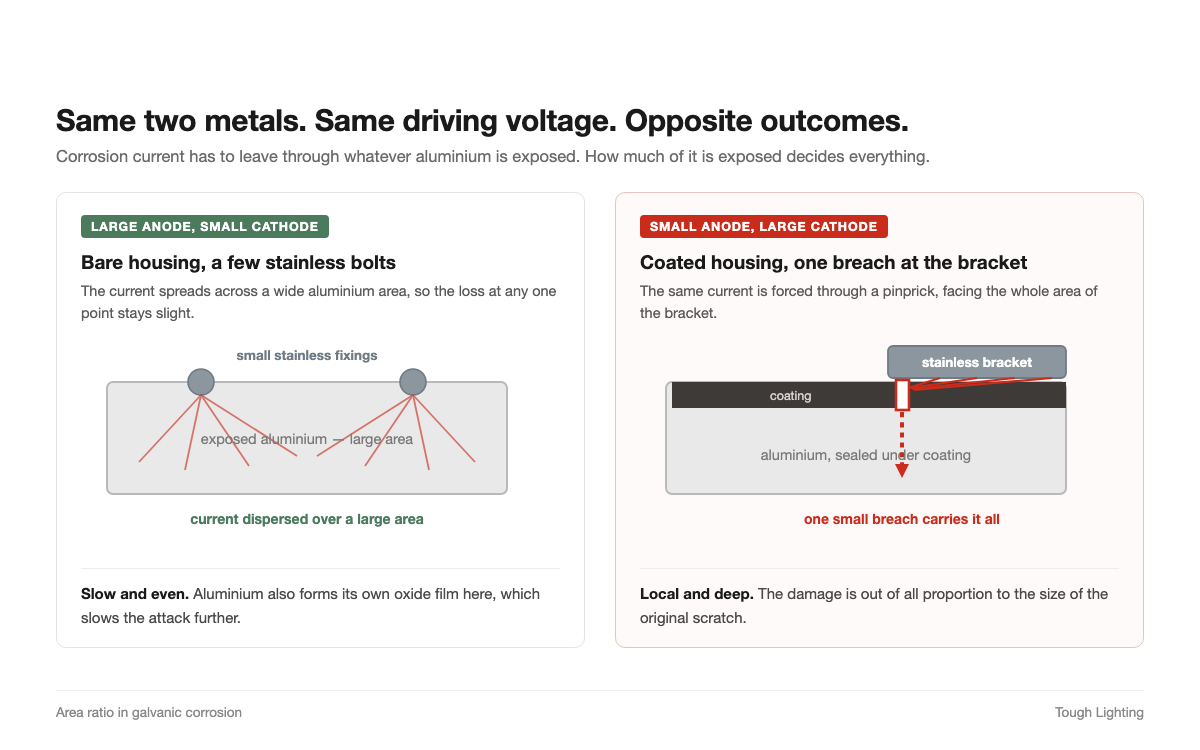
| Geometry | Exposed aluminium | Stainless facing it | Result |
|---|---|---|---|
| Coated housing, scratch in open ground | Small | None nearby | Ordinary aluminium weathering, self-limiting |
| Bare housing, a few stainless bolts | Large | Small | Attack spread thinly, slow and even |
| Coated housing, breach at the bracket face | Very small | Large | Current concentrated into one point, local and deep |
Which is why location beats depth
A scratch is not a quantity of damage. It is a geometry, and the geometry is set by what is next to it.
Aluminium left in open air does something helpful on its own: it forms a thin oxide film that slows further attack. A coating breach in the middle of a housing panel, far from any other metal, tends to sit there and dull rather than progress. It is untidy and it is not urgent.
The same breach where the bracket clamps against the housing is a different event. It is small, it is wet for longer because the joint holds water by capillary action, and it is facing a large area of stainless steel. Every condition that makes galvanic attack fast is present in that one spot.
This is also why mechanical robustness and corrosion resistance are not separate subjects. Most coating breaches are not manufacturing faults. They are created later by impact during fitting, or by a lamp working against its mount for a season.
What actually holds it back
Only one thing does the real work: keeping the electrolyte away from the metal. Everything below is a version of that.
| Control | What it does | Where it stops working |
|---|---|---|
| Intact coating on the housing | Denies the electrolyte contact with the aluminium | At any breach, which is why edges and fixing points matter most |
| Insulating washer or sleeve at the joint | Breaks the electrical path between the two metals | Only if it fully separates them, including inside the bore |
| Sealant at the interface | Keeps standing water out of the joint itself | Degrades over time and is disturbed whenever the joint is opened |
| Drainage in the mounting design | Stops the joint holding salt water for days | Cannot help a joint that is clamped flat against a horizontal surface |
Two of those are specification decisions you make when ordering. The other two are installation decisions made by whoever fits the lamp, which is why a well-built light can still fail early if it is mounted into a pocket that never drains.
Why aluminium fasteners are not the answer
Because they invert the area ratio into its most damaging arrangement.
It is a reasonable instinct: if dissimilar metals are the problem, use the same metal throughout. But an aluminium bolt clamping a stainless bracket is a small anode facing a large cathode, which is precisely the geometry described above. The bolt is consumed, and it is the one component whose failure releases the lamp entirely.
Fastener strength points the same way. The sensible arrangement keeps the small parts noble and the large part active, which for a lamp means stainless fixings into a stainless bracket, and a coated aluminium housing whose exposed area stays at zero.
How we build against it
Our die-cast housings are powder coated and our brackets are stainless steel, so our whole approach rests on keeping the coating unbroken where it matters most.
Coverage at edges and fixing points gets the attention rather than coverage on the flat faces, because the flat faces were never the risk. We verify the finish in neutral salt spray to ISO 9227 for 240 hours, which ranks a finish against others rather than predicting its service life.
For marine and coastal buyers the most frequent custom request we receive is a white powder coat rather than the standard dark finish. That is largely a matter of matching vessel colour schemes, though a light finish also runs cooler in direct sun. It is a finish colour change rather than a different protection system, and it is worth saying so plainly: the protection comes from an unbroken film, not from its colour.
What we do not claim: that any coating makes a housing immune, that stainless fixings can be left unbedded in a marine installation, or that a salt spray result predicts years of service. The mechanism described here does not switch off. It is held back, and it resumes wherever the film is broken.
Frequently asked questions
Does a stainless steel bracket cause corrosion on an aluminium light?
Only where both metals are exposed to the same electrolyte at once. With the coating intact there is no exposed aluminium and therefore no galvanic cell, which is the normal condition for a lamp in service. The bracket is not the hazard. A breach in the coating next to the bracket is.
Can paint alone stop galvanic corrosion?
A continuous film stops it while the film is continuous, which is a real but conditional protection. It is also worth coating the cathode rather than only the anode where you can, since reducing the stainless area facing a breach reduces the current that breach has to carry. Coating only the aluminium and leaving a large bare stainless surface is the less effective of the two options.
Is anodising better than powder coating for marine service?
Neither is universally better, and for most lamp housings the choice is narrower than it looks because the casting alloy largely decides it. Anodising is grown into the metal so it has no film edge to lift, while powder coating is a thicker barrier that can be breached but is also easier to apply in colour. Both fail in the same place, which is wherever the surface is discontinuous.
What to do with this
The decision this settles is where to spend attention: not on the coating specification in general, but on the joint. Ask how the bracket is bedded, whether the fixings are isolated, and whether the mounting position drains.
If you are selecting lamps for salt exposure, the next thing worth reading is how the finish itself is verified, because that is the number suppliers will quote at you and it needs interpreting before it means anything.