


Cameras are taking over jobs on machines that used to belong to the operator's eyes: proximity detection on excavators, pedestrian detection on forklifts, the multi-camera view on a remotely operated loader. At night every one of them needs light, and the light does not have to be visible.
We build sealed work lamps for these machines, and an enquiry this month from a vehicle-lighting distributor asked for an 850 nm headlamp. Working through that request exposed a gap that every white-light specification shares: the number the whole industry compares lamps by does not exist for an infrared one.
This piece sets out why that is, what to check on the camera before spending anything on a lamp, how to choose between 850 nm and 940 nm, and which figures to ask a supplier for instead of lumens.
The short answer: the lumen is defined against the response of the human eye, and infrared light falls outside that curve, so an infrared lamp is specified by radiant power and irradiance at a distance rather than by lumens. Before comparing lamps at all, confirm that the camera removes or lacks its IR-cut filter at night, because a camera with a fixed filter does not see infrared light. Choose 850 nm for range and 940 nm only when the faint red glow at the source is itself a problem.
Why the camera needs light the operator cannot see
A camera-based detection system fails in the dark for the same reason an operator does: no light reaches the sensor. The difference is that the camera can be fed light that lights up nothing else.
Collision warning on earth-moving machinery is now a standardised function. ISO 21815-1:2022 sets general requirements for detecting objects and warning the operator. It is written around the function rather than around any one sensor, and camera-based systems are among those built to meet it. A forklift pedestrian-detection camera, a rear-view camera on a haul truck and the camera array on a remotely operated machine all share one need: enough light on the scene to form a usable image, every hour the machine runs.
White work lamps meet that need at a cost. They light the whole site, they cause glare to anyone facing the machine, and they are aimed for the operator's field of view rather than the camera's. An infrared emitter puts light exactly where the camera looks, at a wavelength the sensor can use and a person barely notices. That is why infrared illumination is standard on fixed security cameras, and why it is beginning to follow the camera onto the machine.
The same enquiry that prompted this piece arrived with a full specification drawing. It listed voltage, dimensions, mounting and connector. What it could not list, because the figure does not exist, was lumens.
A lamp the lumen figure cannot describe
Luminous flux, the quantity behind every lumen figure, is defined by weighting the lamp's radiant power against the spectral sensitivity of the human eye. That weighting function, known as V(λ), is set out in ISO/CIE 23539, the CIE system of physical photometry, and the CIE publishes its values from 360 nm to 830 nm. Beyond 830 nm the published table simply stops, and any radiation there contributes nothing to the lumen figure.
Both common infrared illumination wavelengths sit beyond that edge. An emitter at 850 nm or 940 nm can radiate several watts of optical power and still have a luminous flux of zero, because the eye that the lumen is defined for does not respond at those wavelengths. The figure is zero by definition.
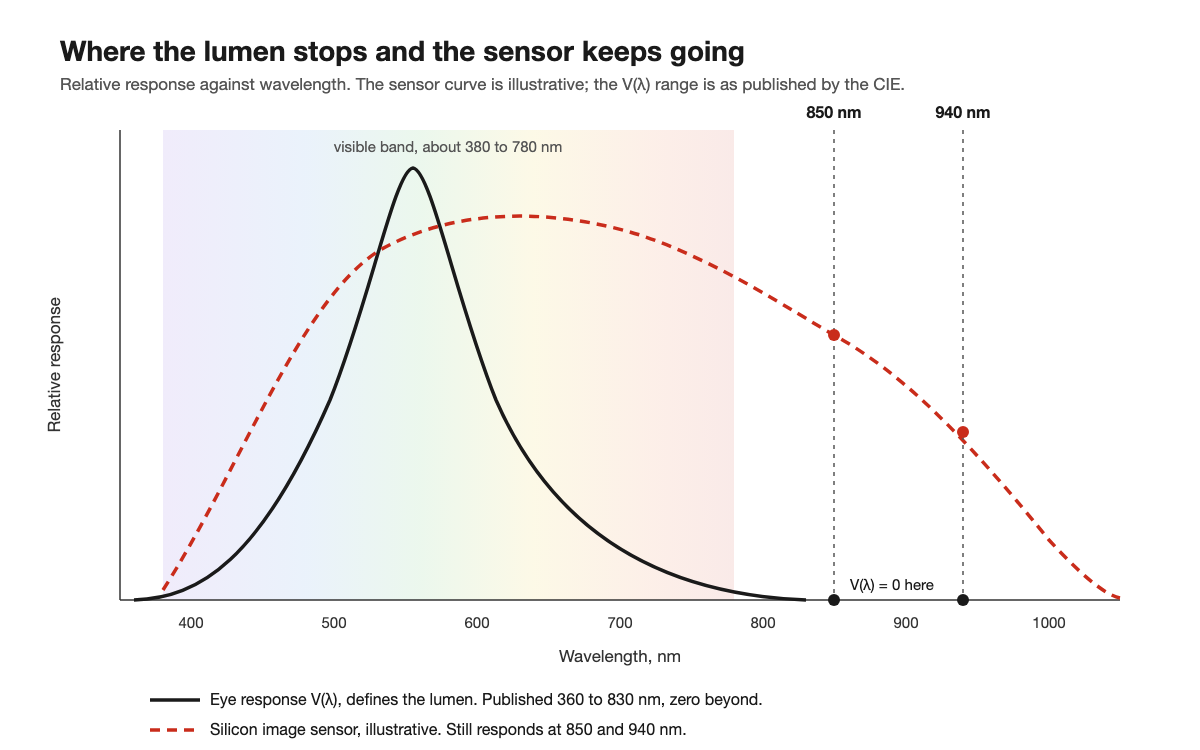
This changes what a specification sheet has to say. The whole vocabulary of white-light comparison, covered in our lumens, lux and candela glossary entry, has a radiometric twin that describes the same geometry without the eye in the way.
| What you want to know | White lamp (photometric) | Infrared lamp (radiometric) |
|---|---|---|
| Total light leaving the lamp | Luminous flux, lumens (lm) | Radiant flux, watts (W) or milliwatts (mW) |
| Light in one direction | Luminous intensity, candela (cd) | Radiant intensity, watts per steradian (W/sr) |
| Light arriving on the scene | Illuminance, lux (lx) | Irradiance, watts per square metre (W/m²) or mW/cm² |
| Where the energy is | Colour temperature, kelvin (K) | Peak wavelength and spectral half-width, nanometres (nm) |
| How wide the beam is | Beam angle, degrees | Beam angle, degrees (unchanged) |
The figure that decides whether the camera gets a usable image is irradiance at the working distance, exactly as illuminance on the working surface is the figure that decides for a person. Our piece on why 3,000 lumens is not a specification makes that argument for white light. For infrared, the lumen figure is not merely unhelpful. It is absent.
A supplier who quotes an infrared lamp in lumens has either converted from electrical watts, which says nothing about optical output, or is quoting the faint visible tail of an 850 nm emitter. Neither number describes what reaches the camera.
850 nm or 940 nm: range against glow
The choice between the two standard wavelengths is a trade between how far the camera can see and whether anyone can see the lamp.
Axis Communications, which builds infrared illumination into its own cameras, states the trade plainly in its published white paper on infrared in surveillance: 850 nm emitters produce a faint red glow visible at the source, while 940 nm emitters do not, but the image sensor is less sensitive at 940 nm, so an 850 nm lamp of the same power reaches further. Axis chose 850 nm for its own products on that basis.
| 850 nm | 940 nm | |
|---|---|---|
| Visible to a person | Faint red glow at the emitter when looked at directly; the beam itself is not seen | No visible glow |
| Image sensor sensitivity | Higher | Lower, so more emitter power is needed for the same range |
| Range for the same emitter power | Longer | Shorter |
| Typical reason to choose it | Detection range, lower power for a given distance | The glow itself must not be seen |
| On a machine at night | The glow doubles as an "on" indicator for the operator | The lamp gives no sign it is working |
On a machine the 850 nm glow is usually an advantage rather than a problem. It is the only way an operator walking around the machine can tell the emitter is powered, and it costs nothing in range. Choose 940 nm when the application genuinely requires that the source shows no light at all, and budget for more emitter power or shorter detection range when you do.
Check the IR-cut filter before you buy any lamp
The most expensive mistake in this category is buying an infrared lamp for a camera that cannot see infrared light. It is common, and it is invisible on the spec sheet.
Colour image sensors are sensitive well into the near infrared. That sensitivity ruins daytime colour, so almost every colour camera carries an IR-cut filter in front of the sensor. On a fixed-filter camera, the filter stays in place at all times, and 850 nm light is blocked before it reaches the sensor. On a day-and-night camera, the filter is mechanically removed when light falls below a threshold, and the sensor then uses infrared light. Axis describes this switching behaviour in the same white paper. Monochrome cameras used for machine vision often have no filter at all.
The consequence is that the camera, not the lamp, decides whether infrared illumination works. Three questions settle it:
Is the camera a day-and-night type with a removable IR-cut filter, or a fixed-filter colour camera? The vendor's data sheet will say. If it does not, ask.
At what light level does it switch, and can that be forced? Some systems allow the night mode to be set manually, which matters on a machine that moves between lit and unlit areas.
Does the detection software run on the same image stream? A detection system that uses a separate sensor from the operator's view camera may need its own illumination.
There is also a five-second check that needs no data sheet. Most infrared remote controls use a near-infrared emitter. Point one at the camera in the dark and press a button. If the camera's image shows the emitter flashing, the sensor is receiving near-infrared light through whatever filter is in front of it. If the image shows nothing, an infrared lamp will show nothing either.
Invisible light still flickers
An infrared LED driven by pulse-width modulation switches on and off many times a second, and a camera that samples the scene sees that switching as banding or as frames that are darker than their neighbours. No person sees the flicker, because no person sees the light, which is precisely why it goes undiagnosed.
Automotive camera systems have already had to standardise this. IEEE 2020-2024, the IEEE standard for automotive system image quality, lists LED flicker among the image-quality attributes it specifies methods to measure. A detection algorithm working on a flickering image stream has less usable information in some frames than in others, and the frames it loses are not the ones a person would notice.
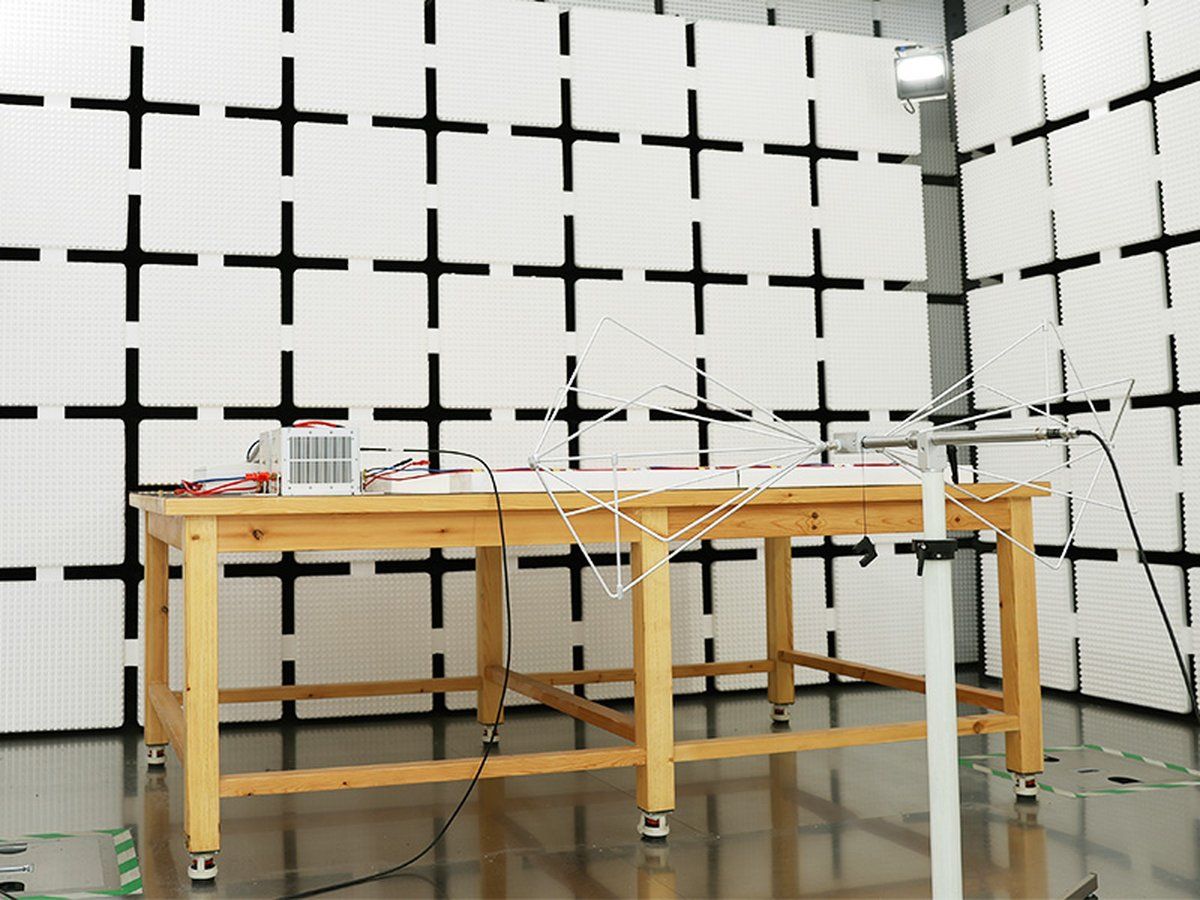
For an infrared lamp on a machine, the practical questions are whether the driver is constant-current rather than pulsed, and, if it is pulsed for dimming, at what frequency. Ask for the driver type in writing. The same driver electronics also sit next to the camera's cabling, which is the nearest thing to a victim if the driver is noisy, and that is a CISPR 25 question we have covered from the radio's side in why E-marked lamps still interfere with radios and GPS. The camera is the next receiver in that list.
Invisible light needs its own safety line
The eye's normal defence against a bright lamp is to look away, blink and let the pupil close. Every one of those reactions depends on seeing the light. Infrared light triggers none of them.
IEC 62471, the photobiological safety standard for lamps and lamp systems, covers optical radiation from 200 nm to 3,000 nm, which includes both infrared illumination wavelengths, and it assesses infrared hazards to the cornea, the lens and the retina separately from the visible-light hazards. Products are classified into risk groups from RG0, exempt, to RG3, high risk. An infrared lamp is not exempt from that classification because it is invisible. If anything, the absence of any warning to the person looking at it is the reason the classification exists.
Ask the supplier for the IEC 62471 risk group and the distance at which it was assessed. We are not reproducing the exposure limits here, because a limit copied out of context is how a safety table becomes a hazard of its own. A risk group on a data sheet, with a test distance, is the figure to compare.
Two practical points follow from invisibility. First, an infrared emitter should be mounted and aimed using the camera's own image, because nobody can see where the beam is going. Second, a lamp that gives no visible sign of operation needs some other indication that it is powered, whether that is the 850 nm glow, a status LED or a fault signal to the machine's controller.
What to put in the enquiry
A supplier can only specify an infrared lamp against the camera it serves. The enquiry that gets a useful answer carries the camera's details first and the lamp's second.
| Item | Why it matters |
|---|---|
| Camera make and model, and whether its IR-cut filter is fixed or removable | Decides whether any infrared lamp will work |
| Distance at which detection must work, and the field of view | Sets the irradiance and beam angle required |
| Preferred wavelength, 850 nm or 940 nm, or "no preference" | Range against glow, and the power budget that follows |
| Machine electrical system, 12 V or 24 V, and the supply available at the mounting point | Driver design; sealed lamps for these machines are typically rated across a 9–32 V DC range |
| Mounting position and environment: washdown, vibration, temperature | Same sealing and vibration requirements as the white work lamps on the same machine |
| Driver type required, constant-current or pulsed, and any flicker limit from the camera vendor | Image quality for the detection algorithm |
| IEC 62471 risk group required by the site or the machine OEM | Photobiological safety of an invisible source |
The white lamps on the same machine are specified in the same terms of sealing and vibration, and the heavy duty work lights range shows what those figures look like on a data sheet. The forklift safety lights range is where camera-based pedestrian detection most often meets a lighting question first.
Frequently asked questions
Can a camera see 850 nm infrared light?
Only if nothing blocks it. An image sensor is sensitive at 850 nm, but a colour camera with a fixed IR-cut filter blocks that light before it reaches the sensor. A day-and-night camera removes the filter in low light and then sees 850 nm well. Check the camera type before buying any infrared lamp.
Is 850 nm or 940 nm better for a machine camera?
850 nm, in most cases. Image sensors are more sensitive to it, so it gives more range for the same emitter power, and its faint red glow at the source lets people tell the lamp is on. Choose 940 nm only when the source must show no visible light at all, and expect to pay for that in emitter power or range.
Do infrared lights have a lumen rating?
No. Lumens are defined against the human eye's response curve, and infrared wavelengths fall outside it, so the luminous flux of an infrared lamp is zero by definition. Compare infrared lamps by radiant flux in watts and by irradiance at the working distance instead.
Are infrared LED lamps safe to look at?
Not automatically. Infrared lamps are classified under IEC 62471 into the same risk groups as visible lamps, and the eye's usual reaction to a bright source, looking away and closing the pupil, does not happen with light it cannot see. Ask the supplier for the risk group and the distance at which it was assessed.
Start with the camera
The decision this piece settles is what to ask for. Confirm that the camera sees infrared at night, decide between 850 nm and 940 nm on range against glow, and specify the lamp by irradiance at the working distance, driver type and IEC 62471 risk group rather than by lumens.
Infrared emitters for machine cameras are a product line we are evaluating rather than one we list today. If you run cameras on machines at night, tell us the camera and the distance it has to cover, and we will tell you what a sealed emitter for that machine would need to be. In the meantime, the white lamps on the same machine are specified in the heavy duty work lights range, and the argument that started this piece is made for white light in is 3,000 lumens enough for a work light.