


The question usually arrives in a binary form. Is it illegal to run deck lights while under way, yes or no.
The rule does not answer in that form, and the shape of its actual answer is more useful than either yes or no would have been. It sets three conditions, and none of them is a limit on how bright the light may be.
We make deck and task lighting rather than navigation lights, so this is a boundary we have to be clear about rather than one we benefit from blurring.
The short answer: under the US Inland Navigation Rules, between sunset and sunrise no other lights may be exhibited except those which cannot be mistaken for the lights specified in the Rules, do not impair their visibility or distinctive character, and do not interfere with the keeping of a proper lookout. Deck lighting is therefore permitted within those limits. Whether a particular installation stays inside them depends on where it is aimed, what it is visible from, and when it is switched on.
What the Rule actually says
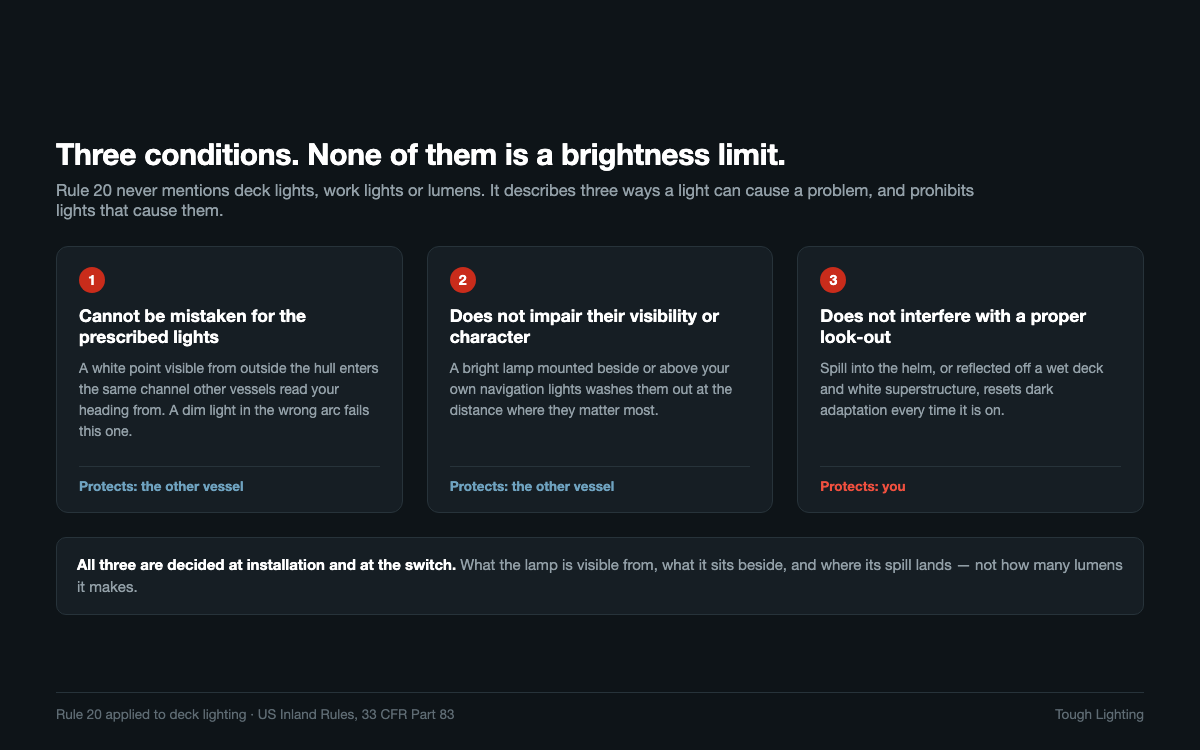
It restricts other lights by their effect, not by their type or their output.
Rule 20 governs when the lighting rules apply and what else may be shown alongside them. Its wording is that the Rules concerning lights shall be complied with from sunset to sunrise, and that during such times no other lights shall be exhibited, except such lights as cannot be mistaken for the lights specified in these Rules or do not impair their visibility or distinctive character, or interfere with the keeping of a proper lookout.
Read it slowly and it is a test of consequences. The rule never mentions deck lights, work lights, spotlights or lumens. It describes three ways a light can cause a problem and prohibits lights that cause them. The sentence is drafted with "or" rather than "and", which is a long-standing awkwardness in the wording; it is applied as three conditions that all have to be satisfied, and that is how the rest of this article treats it.
| Condition | What it is protecting | How a deck light fails it |
|---|---|---|
| Cannot be mistaken for the prescribed lights | Another skipper's reading of your heading and status | White light visible from outside the vessel, in an arc where a navigation light would be |
| Does not impair their visibility or distinctive character | That your own navigation lights stay legible | A bright deck light beside or above them, washing them out at distance |
| Does not interfere with keeping a proper lookout | The watch, which usually means your own | Any light in the helm's field of view that destroys dark adaptation |
Three tests, and brightness is not one of them
This is why the yes-or-no framing misleads people into optimising the wrong variable.
A modest light in the wrong position, visible aft as a white point, can be read as a stern light by a vessel that is overtaking you. It is dim, and it fails the first condition. A powerful flood aimed down at a working deck, screened from outside the vessel and switched off when the job is done, may fail none of them.
So the useful questions are geometric and operational rather than photometric. What is this light visible from, outside the vessel? Does it sit in the same sightline as a navigation light? And who is looking into it?
The condition that catches people out
The third one, because it is the only one whose victim is the vessel showing the light.
Dark adaptation takes a long time to build and a moment to lose. A deck light that spills into the helm, or reflects off a wet white deck or superstructure into the helm, resets the watch's night vision every time it is on. The other two conditions protect other people. This one protects the person who chose to switch it on.
Reflection is the part that surprises people, and it is specific to vessels. On a field there is nothing to bounce a beam back. On a boat the deck is wet, the superstructure is often white, and both sit directly between the lamp and the person steering.
Why white is the colour that causes trouble
Because the prescribed lights use white in defined arcs, and a white point of light outside the vessel is ambiguous by default.
Navigation lighting communicates through a combination of colour and arc of visibility. Someone at a distance sees points of light and infers a heading, a size and a status from them. Any additional white light visible from outside the hull enters that same channel, and the person reading it has no way to know it was meant as a work light.
Coloured deck lighting avoids some of that ambiguity but introduces its own, since colours carry specific meanings in the rules. The safer route is not a different colour but a different geometry: keep the working light where it cannot be seen from outside the vessel at all.
How this changes the way you fit them
Every one of the three conditions is decided at installation rather than at purchase.
| Decision | What to do | Which condition it addresses |
|---|---|---|
| Mounting height and aim | Mount low and aim downward rather than high and level | Mistaken identity, by removing outside visibility |
| Separation from navigation lights | Keep working lamps out of the same sightline | Impairing visibility of the prescribed lights |
| Screening and spill | Check what the beam hits, not just what it illuminates | Lookout, since reflection reaches the helm |
| Switching | Separate circuit from navigation lights, off when not working | All three, because none of them applies when it is off |
| Beam pattern | A wide, short-throw pattern over the work area | Lookout, by reducing spill and reflected glare |
The switching row is the one worth arguing for hardest. A deck light on its own circuit, that nobody can leave on by accident when the vessel gets under way, resolves the whole question operationally rather than by argument.
Which rules apply to you
The wording quoted here is from the US Inland Navigation Rules, published in 33 CFR Part 83.
International waters are governed by the COLREGs, and other countries implement those through their own national instruments. The provision on other lights is closely comparable across them, but the details, the enforcement and the vessel classes covered are not ours to summarise. Confirm the rule set that applies where the vessel operates, and treat commercial and recreational vessels as separate questions.
One boundary does hold everywhere. Navigation lights are a defined, approved product class with requirements on arcs, colours and visibility distances. A work light is not one, and no specification improves it into one.
Frequently asked questions
Is it illegal to run docking or deck lights while under way?
Not as a blanket prohibition. Under the US Inland Rules other lights may be shown between sunset and sunrise provided they cannot be mistaken for the prescribed lights, do not impair them, and do not interfere with keeping a proper lookout. In practice a light aimed down at a working deck and switched off when not needed is far easier to defend than one left on while making way.
Can I use a work light as a navigation light?
No. Navigation lights are specified by colour, arc of visibility and visibility distance and are subject to approval regimes. A work light meets none of those requirements by design, and fitting one in place of a navigation light removes information other vessels rely on to judge your heading.
Does a red deck light solve the night vision problem?
It helps with dark adaptation, which is why red is common for instrument and cabin lighting. It does not help with the first condition, because colours carry defined meanings in the rules and a red light visible from outside the vessel is its own ambiguity. Controlling where the light goes is the more reliable approach than changing its colour.
What to do with this
Decide the three questions at the mounting stage: what the lamp is visible from outside the hull, whether it shares a sightline with a navigation light, and where its spill lands. Then put it on its own switch.
If you are choosing lamps for a vessel rather than for machinery, the mounting interface deserves at least as much attention as the beam, because that is where marine service does its damage.