


This question usually arrives with an apology attached, as though fitting a machinery work light to a boat were a compromise the buyer already knows they should not be making.
It is worth saying up front that this is already happening. We see work lights ordered for duck boats, for small commercial craft and for dock and quayside work. That is an observation about the orders we receive rather than a survey, but it does tell you something: if the basic construction were the obstacle, the practice would have stopped on its own.
What follows is what sea service genuinely changes, what is worth changing when you order, and where the limit actually falls.
The short answer: a sealed die-cast work light is usually adequate as deck and task lighting afloat, and the housing is rarely the part that fails first. What sea service attacks is the interface. The bracket bedding, the fasteners, the cable entry and whether the mounting position drains will decide the outcome long before the lamp itself is tested.
What sea service actually changes
Four things, and only one of them is about water getting in.
| Change | What it does | What it attacks first |
|---|---|---|
| Salt water instead of rain | A far more conductive electrolyte | Any joint where two dissimilar metals meet |
| Surfaces stay wet longer | Spray and humidity rather than intermittent showers | Crevices and clamped faces that hold water |
| Salt crystals remain after drying | The electrolyte reactivates with the next dew | Everything above, but on a continuous cycle |
| More ultraviolet exposure, unshaded and all day | Accelerates polymer ageing | Lenses, gaskets and cable sheathing |
Notice that none of these begin with water getting inside the housing. Ingress is a solved problem on a properly sealed lamp, and it is the one thing buyers ask about most. The conductivity of the electrolyte outside the housing is the change that matters, and it is the one nobody asks about.
The lamp is rarely what fails
The failure sequence in marine service runs through the interface, which is why buying a better lamp does not necessarily buy you a better outcome.
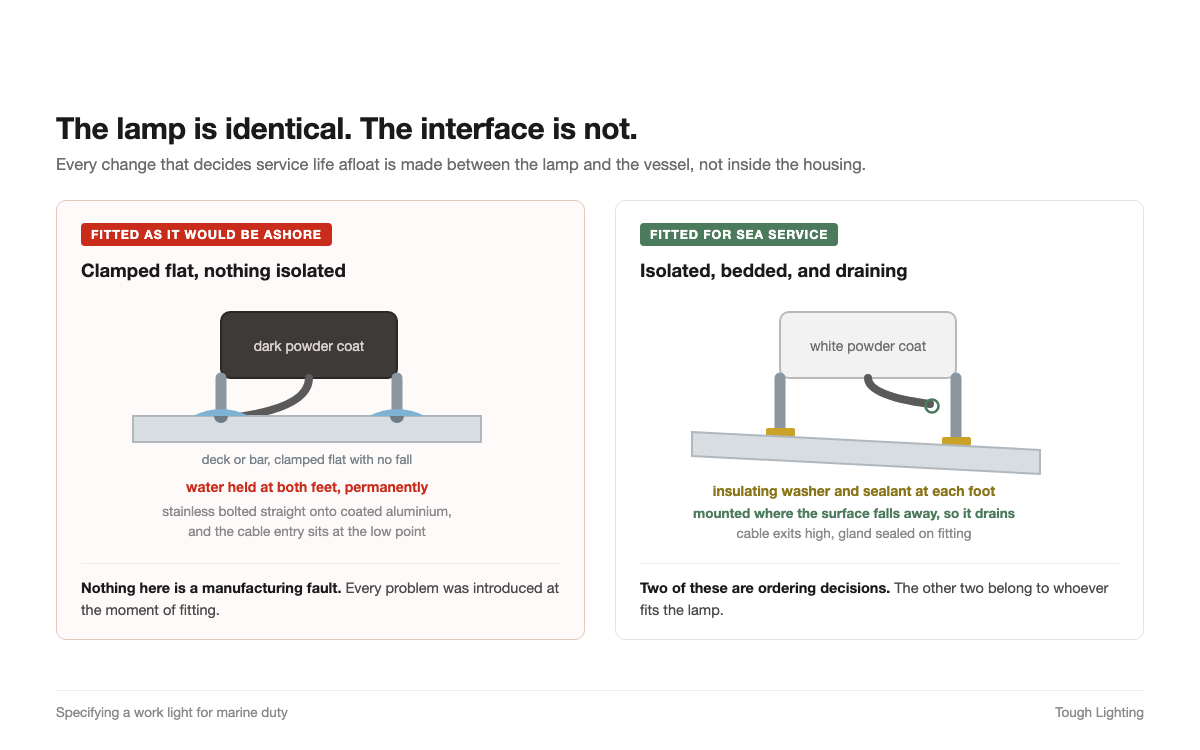
A coated die-cast housing bolted to a stainless bracket is a galvanic pair waiting for an electrolyte, and sea water supplies an excellent one. As long as the coating is unbroken there is no exposed aluminium and nothing happens. The trouble starts at the first breach, and a breach at the bracket face is the one that counts, because a small area of exposed aluminium facing a large stainless surface is the worst possible geometry.
That is also why installation quality matters more afloat than ashore. A lamp torqued down onto an unbedded bracket, in a pocket that holds spray for days, will fail early no matter what its specification sheet says.
The three duties we are asked for most
They are not interchangeable, and each one stresses a different part of the lamp.
Hunting and small craft conversions are the most visible of the three. These are owner-fitted, often on aluminium hulls, and the lamp usually ends up on a bar or a frame rather than on a machined surface. That combination is worth pausing on: an aluminium hull, a stainless bar and a coated aluminium lamp is three components but only two metals, and whichever piece of aluminium has the smallest exposed area is the one that suffers.
Small commercial craft are the least forgiving, because the lamp is on for hours every working night rather than occasionally. Heat management and driver life matter more here than corrosion does in the first year, and the lamp is usually wired into a vessel system rather than a battery clip, so the connector and the cable entry carry the risk.
Dock, quayside and yard work is the gentlest duty of the three in terms of movement, but it has the longest exposure. The lamp is fixed, salt-laden air is constant, and nothing ever gets washed off. This is where an unbedded bracket shows up soonest, because the joint never dries out and never moves.
Those are observations from what we are asked to supply rather than a study of the market, and the pattern in them is consistent: the duty changes which part is under the most stress, but in all three the lamp body is not the part being asked the hardest question.
What to change when you order
Five things, and none of them are the lamp itself.
| Item | Typical machinery default | Worth changing afloat | Why |
|---|---|---|---|
| Finish colour | Dark powder coat | White powder coat | Matches vessel colour schemes and runs cooler in direct sun |
| Bracket and fasteners | Stainless steel | Stainless, plus isolation at the joint | Removes the electrical path rather than relying on coating alone |
| Cable and entry | Standard sheathing | Marine-rated sheath, gland sealed on fitting | Ultraviolet and constant damp age the entry before the housing |
| Mounting position | Wherever the beam is needed | Somewhere that drains | A flat clamped face that holds water runs the reaction continuously |
| Connector | Whatever the harness uses | Sealed, and mounted so it cannot sit in standing water | Connectors are the most common entry point for salt |
The white powder coat is the request we receive most often from coastal and marine buyers. It is worth being plain about what it is: a finish colour, chosen mostly to match the vessel. It is not a different protection system, and the protection still comes from the film being unbroken rather than from what colour it is.
Beam pattern matters more on a deck than in a field
Because the surfaces around you are reflective, close, and occupied by people trying to keep their night vision.
A flood pattern that is ideal across an open field will bounce off a wet deck and a white superstructure straight back into the helm. The working area is also much smaller than a field, so a tight spot beam mostly wastes itself over the side. What works on deck is usually a wide pattern mounted low and aimed down, rather than the high, far-throwing arrangement that suits machinery.
Where a work light is not the right answer
There are three duties it should not be bought for, and confusing them with deck lighting causes real problems.
| Duty | Why a work light does not cover it | What is actually required |
|---|---|---|
| Navigation lights | Defined arcs, colours and visibility distances, subject to approval regimes | Purpose-built, approved navigation lighting |
| Underwater lighting | Continuous immersion and pressure, not an ingress rating question | Purpose-built submersible fittings |
| Lighting in hazardous areas | Fuel vapour zones need an explosion protection concept | Equipment certified for the zone in question |
The first of those is not just a performance limit. Under the US Inland Navigation Rules, which are published in 33 CFR Part 83, Rule 20 requires that between sunset and sunrise no other lights be exhibited except ones that cannot be mistaken for the lights specified in the Rules, do not impair their visibility or distinctive character, and do not interfere with keeping a proper lookout. Deck lighting is permitted within those limits, which is a real constraint on when you switch it on rather than on whether you may fit it.
That wording is from the US Inland Rules. International waters are governed by the COLREGs and other countries have their own implementations, so confirm the rule set that applies where the vessel operates.
Frequently asked questions
Can I use a normal LED work light on a boat?
As deck or task lighting, generally yes, and it is already common practice. The changes worth making are at the mounting interface rather than in the lamp: bed and isolate the bracket, seal the cable entry, and choose a position that drains. What you cannot do is use it in place of navigation lighting.
Does a work light need a marine certification?
For deck and task lighting there is generally no approval requirement in the way there is for navigation lights, which are subject to approval regimes. Requirements do vary by flag state and by vessel class, and commercial vessels are treated differently from recreational ones, so confirm against the rules your vessel operates under.
Is white powder coating better for marine use?
It is the most requested option for coastal work, chiefly to match vessel colour schemes, and a light finish does run cooler in direct sun. As corrosion protection it is the same system as any other colour of powder coat. What protects the housing is an unbroken film, and that depends on coverage at edges and fixings rather than on the pigment.
What to do with this
If you are fitting work lights afloat, spend the specification effort on the joint and the cable entry, and spend the installation effort on drainage. Those three decide the service life far more than the lamp you pick.
If a standard catalogue lamp does not fit the vessel, the finish, bracket and cable are the parts we change most often for marine buyers, and they are worth raising at the enquiry stage rather than after the first order.