


Every supplier quotation that mentions corrosion leads with a number of hours. 240, 500, 1000. That number is being asked to carry a great deal of meaning, and most of it is meaning the number cannot carry.
We run ISO 9227 neutral salt spray to 240 hours on our die-cast housings, which are powder coated. Working out exactly what that sentence entitles us to claim, and what it does not, is the reason this article exists.
What follows is how a salt spray report is actually structured, why two identical hour counts can describe very different products, and the four questions that make supplier reports comparable.
The short answer: a salt spray test measures how a finish behaves in one specific artificial fog, relative to other finishes in the same chamber. Hours describe how long the part stayed in that fog. They do not describe how long it will survive outdoors, and on their own they do not even describe how badly it corroded. That verdict comes from a separate rating standard, which many reports never mention.
What a salt spray test actually measures
It measures the condition of a test piece after a fixed time in a controlled corrosive fog. Nothing more, and deliberately so.
The chamber holds a continuous atomised salt fog at a controlled temperature, fed by a sodium chloride solution held within a narrow pH band. The point of that control is repeatability: any laboratory running the same practice should produce the same environment, so that results from different places can be set beside each other.
The scope of ASTM B117 states the purpose plainly. The practice provides a controlled corrosive environment used to produce relative corrosion resistance information. Relative is the operative word, and it is in the standard's own description of itself. The test ranks finishes against each other under identical artificial conditions. It does not model any real location.
That single word explains most of the confusion that follows in this article. An hour count is a position in a ranking, not a duration of service.
Producing the fog and judging the damage are two different standards
This is the part most reports leave out, and it is the part that decides whether the report means anything.
Read the full titles of the standards involved and the division is obvious. ASTM B117 is titled Standard Practice for Operating Salt Spray (Fog) Apparatus. It is about running the equipment. ISO 9227 covers the salt spray tests themselves in the same way: apparatus, reagents, procedure.
Neither of them tells you whether the part passed. That judgement belongs to a different family of standards written specifically for rating corrosion damage.
| Job | Standard | What its title tells you |
|---|---|---|
| Produce and maintain the fog | ASTM B117 | Standard Practice for Operating Salt Spray (Fog) Apparatus |
| Produce and maintain the fog | ISO 9227 | Corrosion tests in artificial atmospheres: Salt spray tests |
| Rate the resulting damage | ASTM D1654 | Standard Test Method for Evaluation of Painted or Coated Specimens Subjected to Corrosive Environments |
| Rate the resulting damage | ISO 4628-8 | Paints and varnishes: assessment of delamination and corrosion around a scribe |
The rating standards work by measurement rather than opinion. ASTM D1654 has the specimen scribed through the coating, then measures how far corrosion has crept sideways from that scribe line, and converts the mean creep width into a number on a fixed scale. ISO 4628-8 does the same job on the ISO side, and its title states what it assesses: the degree of delamination and corrosion around a scribe. Which one applies depends on the finish: the ISO 4628 series covers paints and varnishes, which includes powder coating, while metallic and inorganic coatings such as anodizing are rated under ISO 10289 instead.
So a line reading ISO 9227, 240 h, pass has told you the chamber and the clock. It has not told you the rating standard, the rating achieved, or where on the part it was measured.
Why two 240-hour reports can describe different products
Because the hour count says nothing about what went into the chamber.
A flat coated coupon is the easiest possible test piece. It is uniform, it has no fasteners, no threads, no joints and no dissimilar metals touching it. Powder coating covers a flat panel evenly and reliably, so a coupon flatters the finish.
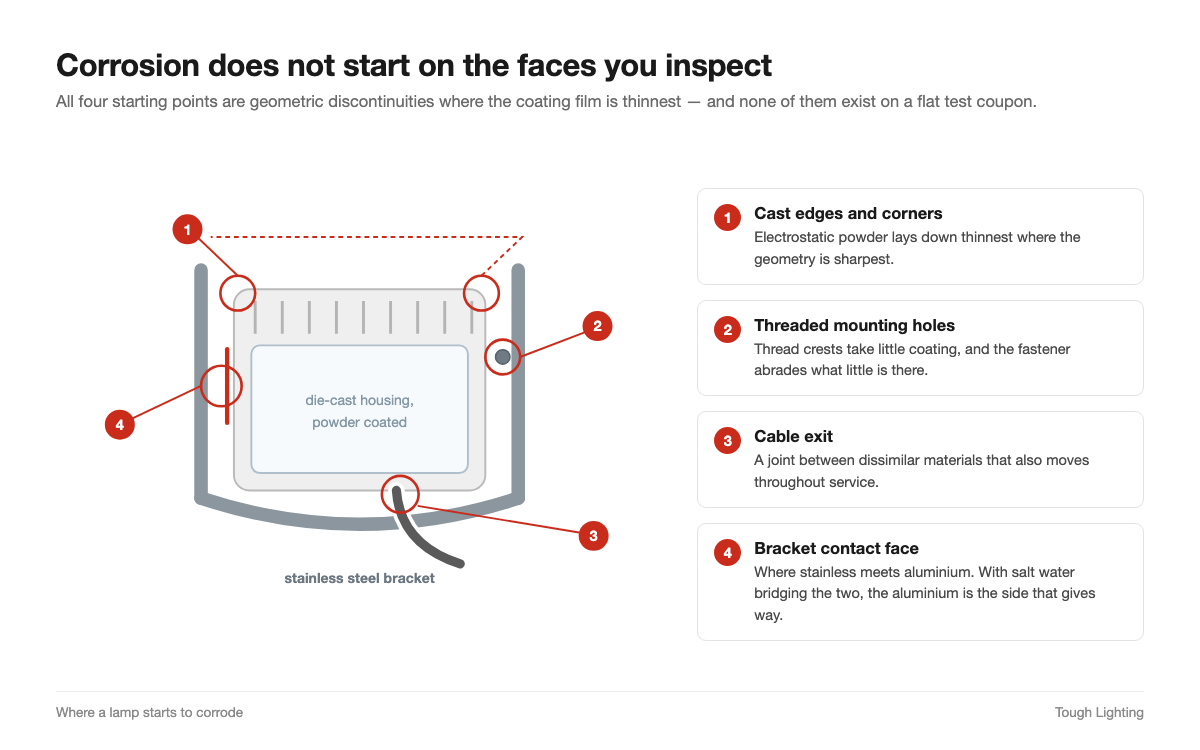
An assembled lamp is a much harder test piece. It has sharp cast edges where coating thins, threaded mounting holes, a cable exit, a lens-to-housing joint, and a stainless steel bracket bolted against the aluminium. Every one of those is a place the fog can find a way in that a coupon simply does not have.
Both can honestly be reported as 240 hours. They are not the same claim, and nothing in the hour count distinguishes them.
| Ask this | Why it changes the answer | A usable answer looks like |
|---|---|---|
| What exactly was in the chamber? | A flat coupon and a fully assembled lamp are different difficulties entirely | A complete lamp, assembled, with its bracket fitted |
| Which rating standard was applied? | The hour count is not a verdict; the rating standard supplies the verdict | Rated to ASTM D1654 or ISO 4628-8, named in the report |
| What rating did it reach? | Pass is not a rating. A scale position is | A specific rating on the named scale, not the word pass |
| Where was the rating measured? | Flat faces behave far better than edges, threads and joints | Named locations, including at least one edge or fastening point |
None of these are unreasonable questions, and a supplier who has genuinely had a lamp tested can answer all four from the report in front of them. A supplier who cannot is quoting a number someone else generated.
Hours do not convert into years
There is no conversion factor, and anyone offering you one is selling certainty the test cannot produce.
The limitation is not a secret and it is not a fringe view. The relationship between accelerated salt fog hours and real outdoor service is a long-running argument inside the coatings industry itself, and major coatings manufacturers publish their own material on where B117 falls short. The fog is constant, wet and at one temperature. Real coastal exposure is intermittent, includes drying cycles, ultraviolet light, temperature swings, abrasion and pollutants. Those cycles matter, and the chamber does not have them.
This does not make the test worthless. It makes it a comparator. Within one chamber, one test piece design and one rating standard, a finish that survives longer than another really is the more corrosion resistant of the two. That is a genuinely useful thing to know when choosing between two suppliers or two processes.
What it cannot do is tell you how many seasons a lamp will last on a boat. If a supplier offers that conversion, the number is invented, however confidently it is presented.
Where a lamp actually starts to corrode
Almost never on the large flat surfaces everyone inspects first.
Powder coating is applied electrostatically, and the way charge distributes across a part means the film is thinnest exactly where the geometry is sharpest. Cast edges, the crests of threads and the lips around openings all end up with less coating than the broad faces beside them. Those are the places a breach begins.
Mechanical damage then does the rest. A lamp that is knocked during fitting, or that vibrates against a mount for a season, will have its coating broken somewhere long before the coating itself degrades. This is why corrosion performance and mechanical robustness are not separate subjects. Those four locations, and the question that settles whether a supplier has tested each of them, are set out below.
| Location | Why it starts here | What to ask |
|---|---|---|
| Cast edges and corners | Electrostatic coating is thinnest where geometry is sharpest | Was the rating measured at an edge as well as a face? |
| Threaded mounting holes | Thread crests take little coating; fasteners abrade what is there | Were fasteners fitted during the test? |
| Cable exit | A joint between dissimilar materials that also moves in service | Was the cable and its seal present on the test piece? |
| Bracket contact face | Stainless steel against aluminium, with an electrolyte present | Was the bracket fitted and torqued for the test? |
That last row is a different mechanism from the others and it deserves care. Stainless steel and aluminium in contact, with salt water bridging them, form a galvanic pair in which the aluminium is the one that gives way. The coating is what keeps them apart, which is why a scratch at a bracket face matters more than a scratch in open ground.
How we test, and what we claim from it
We run neutral salt spray to ISO 9227 for 240 hours in our own chamber, on powder coated die-cast housings.

Running it ourselves changes what we are able to tell you, rather than changing the number. We can say what the test piece was, whether the bracket was fitted, and which surfaces were examined afterwards. Those are the answers that make the 240 hours mean something when you set our report beside someone else's.
What we do not claim: that 240 hours corresponds to any number of years in service, that a salt spray result makes a lamp suitable for permanent immersion, or that a finish which passes cannot be breached by impact. All three would be claims the test is not built to support.
Surface finish is only half the picture, and which finish is even available to you is decided earlier than most buyers realise. The alloy your housing is made from narrows the choice before anyone specifies a coating.
Frequently asked questions
How many hours of salt spray testing are needed?
There is no universal figure, because the hour count is set by the product specification rather than by the salt spray standard itself. What matters more than the target is that the same hour count, test piece and rating standard are used when comparing suppliers. A 240-hour result on a complete assembled lamp is a stronger claim than a 500-hour result on a flat coupon.
Does passing a salt spray test mean a light is saltwater proof?
No. The test exposes a part to salt fog, not to immersion, and it addresses the finish rather than the sealing. Resistance to water entering the housing is a separate question answered by ingress protection testing, and those procedures specify the temperature of the water without setting any requirement for its salinity.
Can I compare a 500-hour claim against a 240-hour claim?
Only if both reports describe the same test piece and the same rating standard. If one tested a coated coupon and the other tested a complete lamp with its bracket fitted, the higher number may well be describing the easier test. Establish what went into the chamber first, then compare hours.
What to do with this
The decision this article is meant to settle is narrow: whether a corrosion claim in front of you is comparable with another one. Ask what was tested, under which rating standard, to what rating, measured where.
If you are specifying lamps for a corrosive environment, the more useful next step is to look at how the housing is made and finished rather than at the hour count alone, because that is what the hours are measuring.