


Every comparison of these two finishes is written as though you get to pick one. You read the columns, weigh hardness against colour range, and choose. For a lighting housing that framing is usually wrong, and it is wrong before you reach the comparison table.
The alloy that suits how your housing is made has already narrowed the answer, often to one. Understanding why takes one paragraph about what these two processes actually are.
They are not the same kind of thing
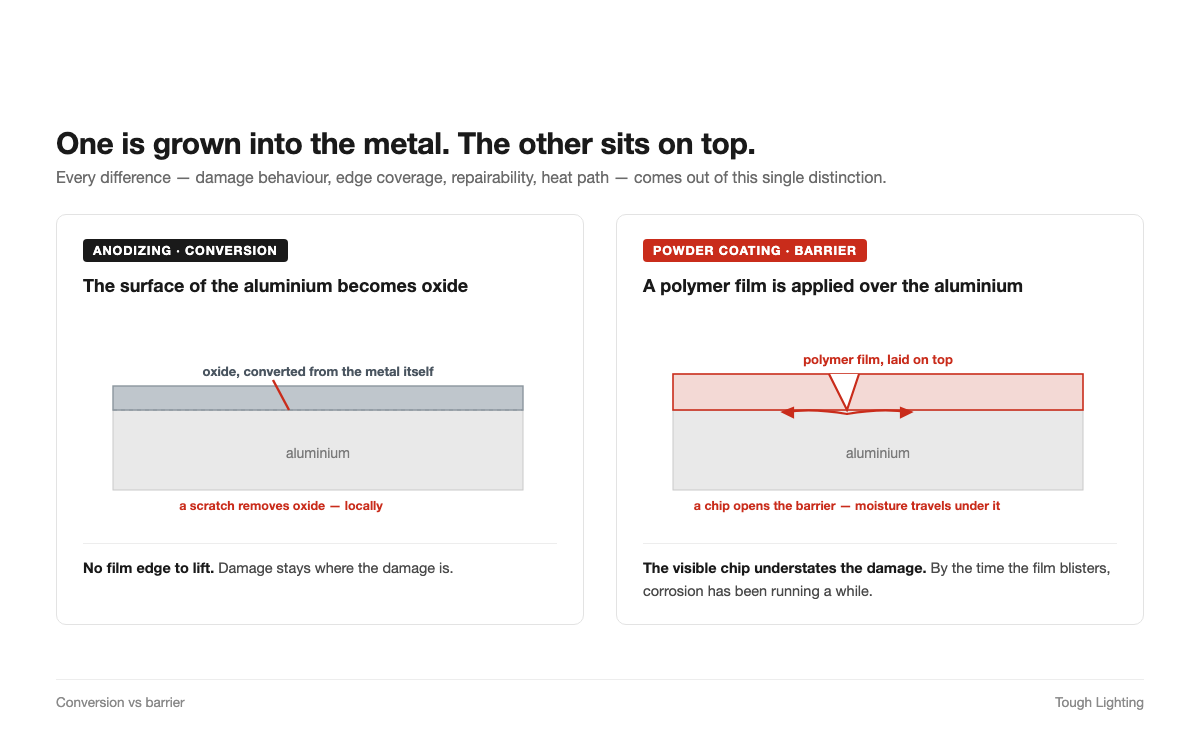
Anodizing is not a coating. It is an electrochemical conversion: the outer layer of the aluminium itself is turned into aluminium oxide, grown into the part rather than laid onto it. Nothing is added on top, so there is no film with an edge that can lift.
Powder coating is the opposite. A polymer powder is applied electrostatically and cured into a continuous film that sits on the surface. It is a barrier, and like every barrier it works until it is breached.
Almost every practical difference between the two follows from that single distinction. Keep it in mind and you can derive the rest of this article rather than memorise it.
The alloy decides first
Aluminium is not one material, and the two ways a lamp housing gets made call for very different alloys.
High-pressure die casting needs a melt that flows into thin sections and fills detail. That fluidity comes largely from silicon, which is why the common casting alloys carry a lot of it. Extrusion needs an alloy that pushes through a die and takes a straight profile, which is what the 6000 series is for, and it carries far less silicon.
Silicon does not convert to oxide. Anodize a high-silicon casting and the silicon particles stay as they are while the aluminium around them converts, so the finish comes out grey and patchy rather than clear, and the protective layer is less uniform than the same process gives on an extrusion. This is not a process fault that a better anodizer can fix; it is the alloy.
| How the housing is made | Typical alloy family | Realistic finish | Why |
|---|---|---|---|
| High-pressure die casting | High-silicon casting alloys | Powder coating | Silicon does not convert; anodizing gives a grey, patchy and less uniform layer |
| Extrusion | 6000 series | Anodizing or powder coating | Low silicon, converts cleanly; a genuine choice exists here |
| CNC from billet | 6000 / 7000 series | Anodizing or powder coating | Same as extrusion; surface finish before treatment is usually better |
| Steel bracket or hardware | Not aluminium | Powder coating, plating, or stainless instead | Anodizing is an aluminium process; it is not an option on steel |
Read that table the other way round and it becomes a design question rather than a finishing question. If an anodized finish matters to you, whether for hardness, for appearance, or because the part is a heat sink you would rather not insulate, that preference belongs in the decision about how the housing is made, not in a line item after it.
What happens when each one is damaged
A lamp on a machine gets hit. Branches, stone chips, a spanner, the loader bucket of the machine parked next to it. So the honest comparison is not how each finish looks new, but how each fails.
Scratch an anodized surface and you have removed oxide in the place you scratched it. The damage is where you can see it. Chip a powder film and you have opened an edge in a barrier: moisture can get under the film and travel, lifting it from the inside. The visible chip understates the damage, and by the time the film blisters the corrosion underneath has been running for a while.
| Anodizing | Powder coating | |
|---|---|---|
| Impact damage | Local; no film to lift | Chip opens the barrier; moisture can travel under the film |
| Abrasion | Hard oxide resists it well | Softer film wears through |
| UV exposure | Colour is in the pores; stable | Depends entirely on the powder chemistry |
| Repair in the field | Not practical; the part has to be re-processed | Can be touched up, though matching is imperfect |
| Thermal path | Oxide layer is thin | Film is an insulator and thicker, which matters on a heat sink |
That last row is easy to overlook on a lamp. A housing is often also the heat sink, and a thick insulating film on the fins is not free. It is rarely decisive on its own, but it belongs in the comparison rather than outside it.
Edges, holes and the places a coating does not reach
Powder is applied electrostatically, and that has two geometric consequences that matter more on a lamp than on a flat panel. Charge concentrates at sharp edges, so powder tends to pull back from them and the film is thinnest exactly where the part is most exposed. And inside recesses, deep fins and blind holes, the charge struggles to reach, the same effect that makes a Faraday cage.
Anodizing has no equivalent problem, because it is not deposited from outside: wherever the electrolyte reaches, the surface converts. On a finned housing with fixing holes and a recessed lens groove, that difference shows up as where corrosion starts, usually at an edge, a hole or a fin root rather than in the middle of a flat face.
So when you inspect a returned lamp, look at the edges and the fixing points first. They tell you more about the finish than the flat surfaces do.
What 240 hours of salt spray actually tells you
We run housings through ISO 9227 neutral salt spray for 240 hours. It is a useful number and it is routinely over-read, so it is worth being precise about what it is.
A salt-spray cabinet holds one accelerated condition: a constant salt fog, a constant temperature, no drying, no UV, no vibration, no impact. Real corrosion on a machine is cyclic, wet then dry, hot then cold, salted in February and not in July, and it is usually started by mechanical damage the cabinet never applies. The test is therefore excellent for ranking two finishes against each other and poor at predicting years in service.
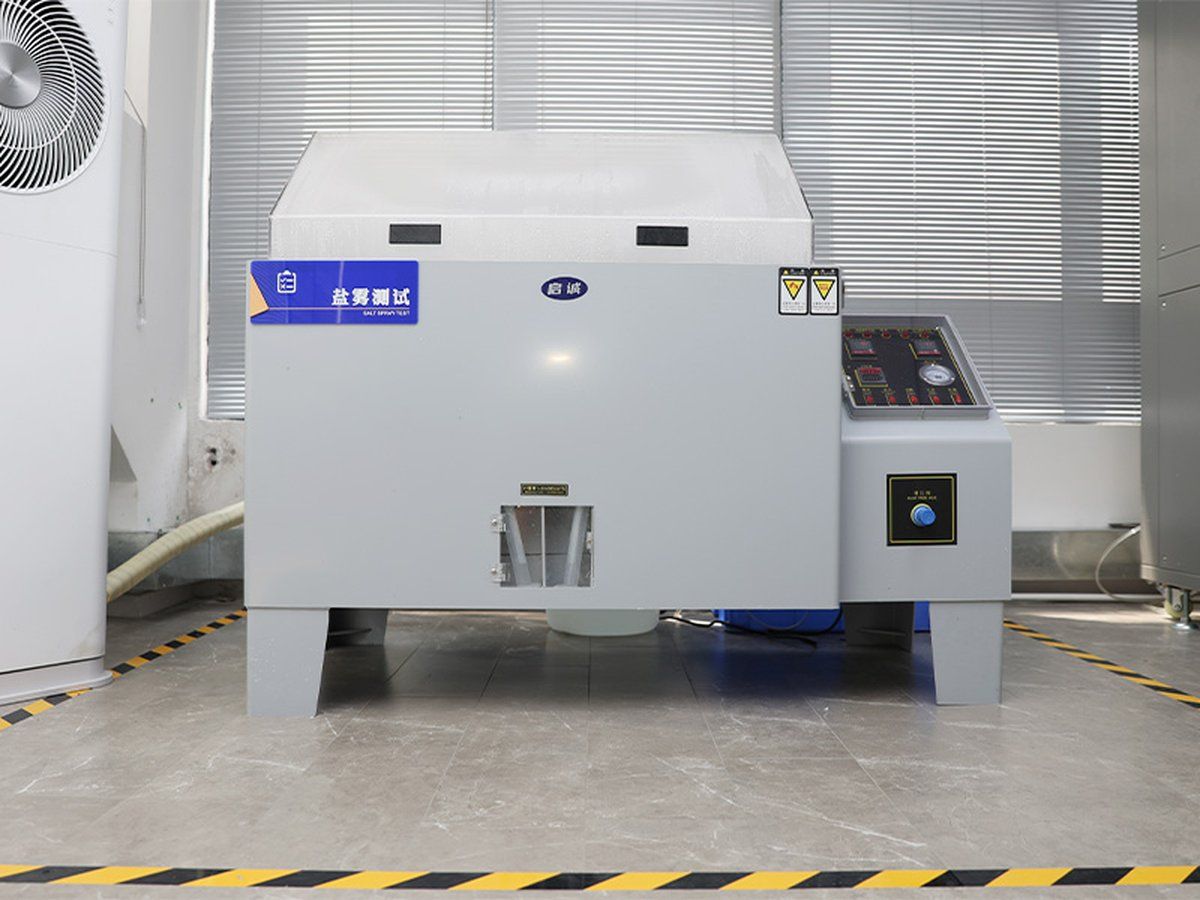
Two rules follow. Compare hour counts only when the test method and the rating criteria are the same, because an hour count with neither is not a number you can use. And treat the result as a ranking rather than a warranty: a finish that survives longer in the cabinet will usually survive longer on the machine, which is not the same as knowing how long.
| The lamp's duty | Lean towards | Because |
|---|---|---|
| Coastal, marine deck, road salt | Anodizing where the alloy allows | No film to lift when the surface is chipped; damage stays local |
| Abrasive dust, forestry, quarry | Anodizing | Hard oxide resists abrasion; a film wears through |
| Frequent high-pressure washdown | Either, but check the edges | Both survive the water; failure starts at edges and fixing points |
| Housing doubles as the heat sink | Anodizing | A thick insulating film on the fins costs thermal performance |
| Brand colour matters, or several colours | Powder coating | Far wider colour range; anodized colour is limited and less repeatable |
| Cast housing with visible surface texture | Powder coating | The film hides casting surface defects that a thin oxide layer reveals |
| Field repair has to be possible | Powder coating | Can be touched up; anodizing cannot be repaired in place |
Cost, and when "powder is cheaper" stops being true
Per part and at volume, powder coating is generally the cheaper process, and for a die-cast housing it is usually the only sensible one anyway. That is the answer most comparisons stop at.
Two things change it. The first is colour count: powder is cheap per part but each colour is a changeover, so a catalogue with several finishes carries a cost that a single anodized finish does not. The second is what happens after the sale. If the lamp lives somewhere a coating gets chipped and then creeps, such as coastal air, salted roads or abrasive dust, the cheaper finish can turn into the more expensive one through replacements, and none of that appears in the quotation.
This is why the question is worth asking at the design stage rather than at the quotation stage. By the time you are comparing finish prices, the housing process has usually already been fixed.
What we do, and why it is not a compromise
Our work lamp housings are high-pressure die castings, and they are powder coated. That is not a cost decision dressed up as an engineering one; it is the alloy. The silicon that lets the melt fill a finned housing with a moulded-in lens groove is the same silicon that would give a grey, patchy anodized layer. Choosing die casting for the shape means choosing powder coating for the finish, and the two decisions are really one.
What we then do about the known weakness of a coating is test it. Housings go through ISO 9227 neutral salt spray for 240 hours, and brackets are stainless steel rather than coated, because a coated steel bracket is the first part of an assembly to rust through. Test documentation is available on request.
One practical note for anyone comparing suppliers: most published specifications name the housing material and stop there. If the finish matters for your duty, whether coastal air, salted roads or abrasive dust, ask for it in writing along with the corrosion test behind it, because the material alone does not tell you what you are buying. For how sealing and ingress interact with all of this, see IP ratings, and why heated plow lights ice up covers the same housings under a harsher duty. The range itself is in LED work lights.
Frequently asked questions
Which is better, anodizing or powder coating?
Neither, as a general statement. Anodizing is harder, does not lift when damaged, and keeps the thermal path short. Powder coating covers a wider range of substrates and colours, hides casting surface defects, and can be repaired. On a die-cast housing the question mostly answers itself, because the alloy does not anodize well.
What are the disadvantages of anodizing?
It only works on aluminium, and not equally well on all aluminium: high-silicon casting alloys give a grey, patchy result. The colour range is narrower than powder. It cannot be repaired in the field; the part has to be stripped and re-processed. And because the layer is thin, it does not hide a poor surface underneath the way a coating does.
Which is better for aluminium specifically?
Ask which aluminium. On an extrusion or a machined billet part, both are genuinely available and the duty decides. On a high-pressure die casting, powder coating is the practical answer, and a supplier offering an anodized finish on a cast housing is worth a follow-up question about the alloy.
What is cheaper, anodizing or powder coating?
Powder coating, per part, at volume, most of the time. The comparison changes if you are running several colours, since each is a changeover, or if the lamp works somewhere that damages coatings and the cost moves into replacements.
Can a die-cast housing be anodized at all?
It can be put through the process, and it will come out with a layer. The point is that the result is not what you are picturing: grey rather than clear, uneven across the part, and less uniform in protection than the same process on an extrusion. If a cast part must have an anodized appearance, that is a conversation about changing the alloy or the housing process, not about the finishing line.
The question to ask before the finish question
Ask how the housing will be made. Die casting buys you complex shape, integral fins and low unit cost at volume, and it hands you powder coating. Extrusion buys you a cleaner anodizing option and a straight profile, and it constrains the shape. The finish is downstream of that decision, and the comparison table everyone publishes is only meaningful once it is made.