


IP68 is read as a threshold. Either a product clears it or it does not, and one IP68 lamp is taken to be much like another.
That reading is wrong in a way that matters most in exactly the application where people rely on it hardest. For immersion in sea water, the marking leaves out four things, and the first of them is written into the structure of the standard itself.
This is not an argument that IP ratings are useless. It is an argument about what question the rating answers, and what you have to ask separately.
The short answer: an IP marking records the outcome of one test under one set of conditions. For IP68 those conditions are agreed between the manufacturer and the user rather than fixed by the standard, so two IP68 claims can describe very different tests. Salinity is not among the conditions specified, the test lasts minutes rather than years, and an immersion result does not cover water jets unless a second code is present.
An IP rating is a result, not a property
It records what happened to a particular enclosure in a particular test, which means every part of its meaning travels with the test conditions.
The two digits grade different things. The first is dust, the second water, and each one corresponds to a defined procedure rather than to a general quality of being sealed. Read that way, the question stops being how high the number is and becomes what exactly was done to it.
For most of the scale that question has a single answer, because the procedures are prescribed. IPX7 is immersion under defined conditions of depth and time, with the water temperature held in a specified band. There is no ambiguity about what an IPX7 result represents.
IP68 is not one thing
Because unlike the ratings below it, IPX8 has no single prescribed test.
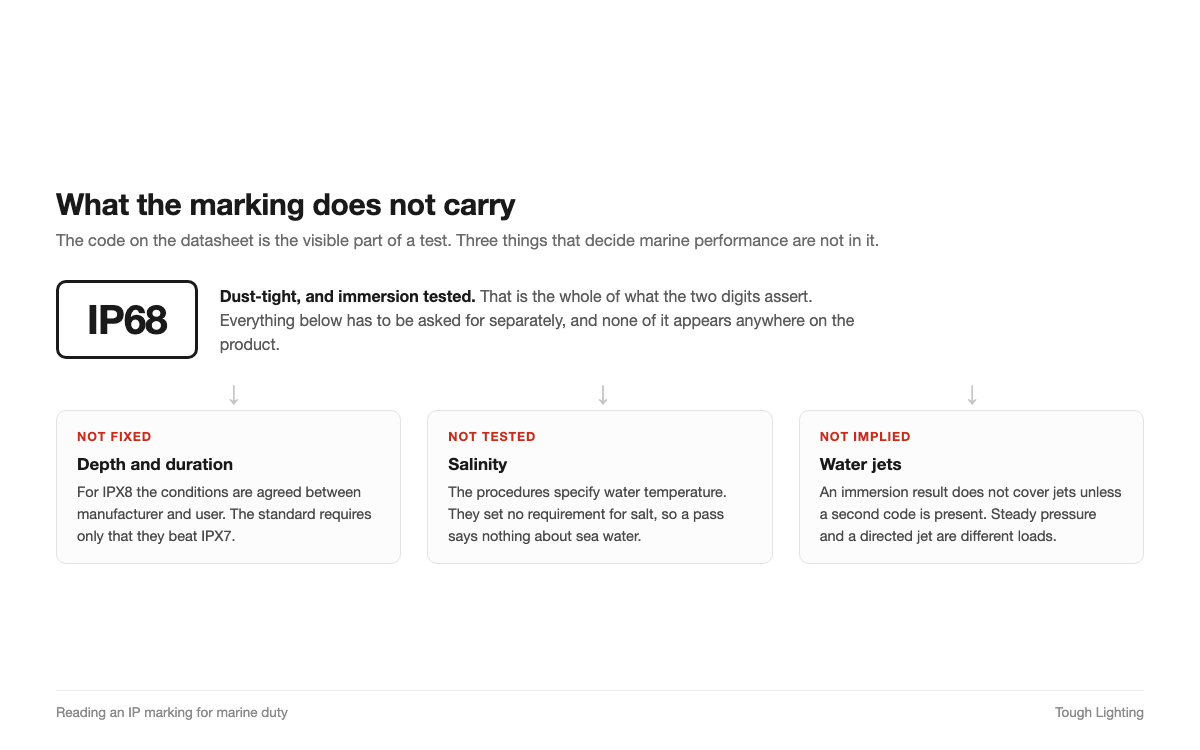
Where no relevant product standard applies, the IPX8 test conditions are subject to agreement between the manufacturer and the user. The standard requires only that they be more severe than those for IPX7, and that they reflect the enclosure being continuously immersed in actual service. Depth and duration are therefore set case by case.
This is a sensible piece of standards writing, because continuous immersion means something different for a bilge pump than for a deck light. It is also the reason two products can both be marked IP68 after tests that are not comparable. One may have been held at a shallow depth for half an hour. The other may have run for far longer, far deeper.
| Rating | Fixed by the standard | Left to be agreed or omitted |
|---|---|---|
| IPX7 | Immersion under defined depth and time, water temperature within a specified band | Salinity, repetition, ageing of the seal |
| IPX8 | Only that conditions be more severe than IPX7 and reflect continuous immersion | The actual depth and duration, plus everything omitted from IPX7 |
| IP69K | High-pressure, high-temperature jets from defined angles; the K-suffix test is defined in ISO 20653, not in IEC 60529 | Salinity, repetition, ageing of the seal |
So the useful question to a supplier is not whether a lamp is IP68. It is what depth, for how long, and on what sample. A supplier who ran the test can answer in one sentence.
The test says nothing about salt
The immersion procedures specify the temperature of the water. They set no requirement for its salinity.
That omission is not an oversight, because the test is measuring whether water gets in rather than what the water then does. But it does mean a passing result carries no information at all about sea water, and sea water differs in two ways that matter.
It is far more conductive, so any water that does find its way inside is much more damaging to electronics than the same volume of rain. And it leaves salt behind when it dries, which draws moisture back and keeps working on seals and surfaces between wettings. An enclosure can pass an immersion test cleanly and still be attacked by an environment the test never represented.
And nothing about elapsed time
The test is minutes long. Marine service is measured in seasons, and the failure mode that matters is a slow one.
A sealed housing is not a rigid box. Every time the lamp is switched on the air inside heats and expands, and every time it cools that air contracts and draws in whatever is against the seal. On a vessel that cycle happens daily, against a surface that is wet and salty rather than dry.
This is why temperature cycling and immersion are related tests rather than separate ones, and why an enclosure that passes immersion on day one can still accumulate moisture over a year without any single dramatic event.
Immersion does not imply jets
The second digit is not a ladder in which each step contains the ones below it.
An enclosure rated for immersion is not automatically suitable for exposure to water jets unless it is dual-coded. Immersion applies a steady pressure evenly over the whole enclosure. A jet applies a concentrated, directed force at one point, and a seal that holds comfortably against the first can be driven open by the second.
For a vessel that gets hosed down after every trip, that distinction is the practical one. A lamp marked only IP68 has not been shown to withstand the hose, whatever its depth rating says.
This is the same reason a pressure washer defeats seals that survive submersion, which is worth understanding separately if your equipment is cleaned rather than merely wetted.
What to ask instead
Four questions convert a marking into something comparable.
| Ask this | Why it matters | A usable answer |
|---|---|---|
| What depth and duration was IPX8 run at? | Those conditions are agreed, not fixed, so they are the claim | A specific depth and time, stated without hesitation |
| Is there a second code for jets? | Immersion does not imply jets unless dual-coded | A dual marking such as IP66 alongside IP68 |
| Was the sample a production lamp with its cable fitted? | The cable entry is the usual path, and it is easy to omit | A complete lamp, gland and cable in place |
| Has it been through temperature cycling as well? | Breathing past a seal needs repetition to show up | A separate cycling result, not the immersion one |
None of this makes IP ratings a poor tool. Used with the conditions attached they are the most practical sealing comparison available. Used as a bare number on a datasheet they are close to meaningless, and that is how they usually appear.
Frequently asked questions
Is IP68 waterproof in salt water?
The rating does not answer that question. It records an immersion test whose conditions specify temperature but not salinity, so a pass tells you the enclosure kept water out under those conditions and nothing more. Sea water is more conductive and leaves salt behind as it dries, and neither effect is represented in the test.
Which is better for a boat, IP67 or IP68?
For deck lighting the difference is usually less decisive than it appears, because neither is an immersion application. What matters more is whether a second code covers wash-down jets, and whether the cable entry was part of the tested sample. Ask about those before comparing the immersion digits.
Can a lamp be IP68 and IP69K at the same time?
Yes, and where both apply they should both be marked, because they describe different exposures rather than different amounts of the same one. A dual marking is the honest way to state that an enclosure was tested for immersion and for jets, since neither result implies the other.
What to do with this
Treat an IP marking as the start of a question rather than the end of one. Ask for the conditions, ask what the sample was, and ask whether jets were covered.
If the lamps are going afloat, the sealing rating is also not where most failures begin, so it is worth reading about what sea service actually attacks before spending the budget on a higher digit.