


You fitted a set of LED work lamps last month. Now the two-way radio hisses whenever they are on, or the guidance system wanders a few centimetres, or the AM band is unusable above idle. You check the paperwork and the lamps carry an E-mark.
Both of those facts can be true at the same time, and that is the part nobody explains. An approval is granted to one lamp under a defined test condition. Interference happens to a whole machine. This article is about the distance between those two sentences, and what to do inside it.
First, prove it is actually the lamps
Two minutes of switching saves an afternoon of theory. Start the machine with the lamps off and listen to the affected receiver. Switch the lamps on one at a time. Then run them with the engine off, on battery alone. If the noise follows the lamps and not the alternator, you have isolated it. If the noise is there with every lamp off, stop reading about lamps: an alternator, an inverter, a heater controller or a failing ignition component behaves the same way.
Note which lamp, and whether the noise changes with the beam being on rather than the lamp merely being powered. A lamp that is quiet at full output and noisy when dimmed is telling you the dimming method is the source, not the lamp.
Radiated or conducted: decide this before you buy anything
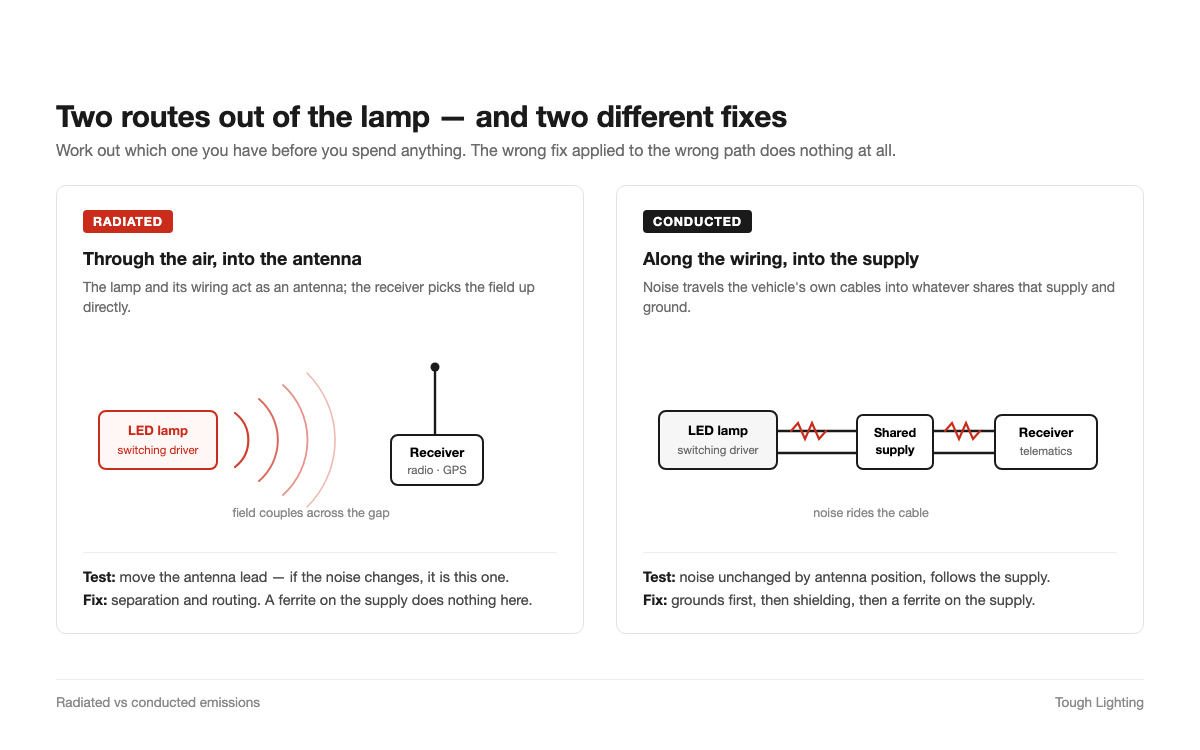
Every switching driver produces some electrical noise; that is how switching works. The question is how the noise reaches the receiver. It has two routes, and they need different fixes. Radiated noise leaves the lamp or its wiring as an electromagnetic field and is picked up by the antenna. Conducted noise travels along the vehicle's own wiring into whatever shares that supply.
The reason to separate them first is economic: a ferrite core on the supply lead does nothing at all about a radiated path, and shielding the lamp does nothing about noise already travelling down the harness. Most of the internet's advice is a single fix applied blindly to both.
| What you observe | Most likely path | Where to work |
|---|---|---|
| Noise changes when you move or reroute the antenna lead | Radiated | Separation and routing: lamp wiring away from antenna and its lead |
| Noise unchanged by antenna position, follows the supply | Conducted | The supply and ground: filtering, grounding, cable routing |
| Worse with more lamps on | Either, accumulating | Treat the worst lamp first, then re-test; do not fit filters to all of them |
| Only on AM, FM clean | Conducted, low frequency | Supply side; ferrite and filtering are most effective here |
| GPS or ISOBUS affected, audio clean | Radiated, higher frequency | Physical separation; filters on the supply rarely help |
| Present with lamps powered but not lit | Driver standby or dimming circuit | Lamp itself; the fix is a different lamp |
Approval is measured on one lamp; interference happens to a machine
This is the mechanism behind the contradiction in the opening paragraph, and it is not a loophole; it is how type approval has to work.
An emissions measurement to CISPR 25 is made under a specified condition: the lamp sits on a non-conductive bench in a shielded room, connected through a harness of defined length and layout, fed through a standard impedance network, with the antenna at a fixed distance. Every one of those conditions exists to make results repeatable between laboratories. None of them describes a tractor.
On the machine, the same lamp has a harness several metres long routed alongside other cables, a ground return shared with other loads, a mounting bracket that may or may not bond it to the chassis, and a receiving antenna within a metre or two. Fit eight of them and their emissions add. A lamp that measured comfortably inside the limit can still be part of an installation that misbehaves, and the approval was never a promise about your installation.
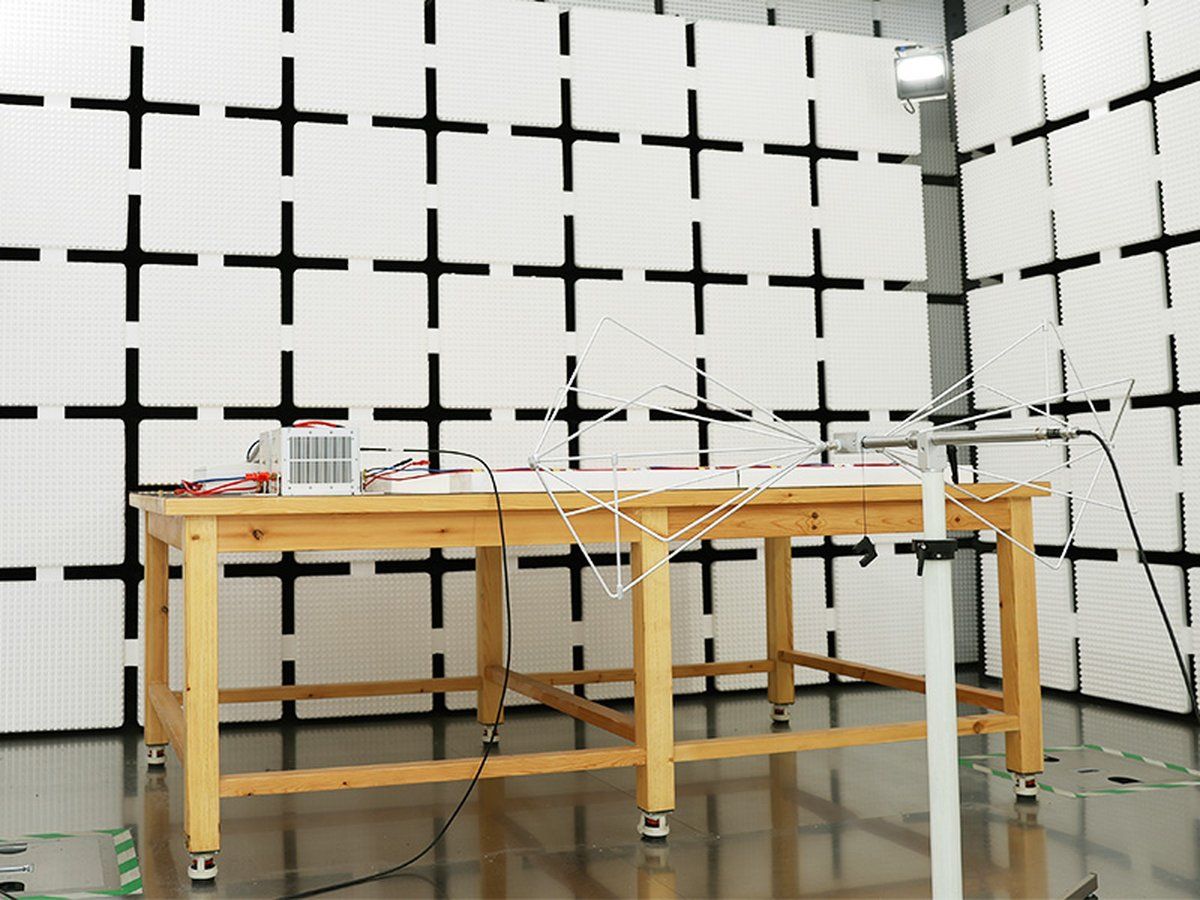
The practical consequence for a buyer: an approval tells you the lamp was engineered and verified to a limit. It does not tell you that any number of them, wired any way, will be quiet next to any receiver. Suppliers who promise the second thing are promising something no one can test.
R10 reaches agricultural tractors, and that is where it bites hardest
Most of what is written about this problem is written about cars, because that is where people notice a noisy radio. The harder version of the problem is on machinery. UN Regulation No. 10 applies to vehicle categories L, M, N, O, T, R and S, and category T is agricultural tractors, which is why the regulation reaches work lighting and not only road cars.
On a tractor the victim is usually not the cab radio. It is GPS guidance, an ISOBUS network, a telematics modem or an RTK correction link. Those fail differently from a radio: instead of audible hiss you get position drift, a dropped correction signal, or a section-control channel that switches late. Nobody hears anything, and the operator blames the receiver.
That changes the diagnosis. If you are chasing an intermittent guidance fault, put "switch the work lamps off and repeat the pass" near the top of the list, not at the bottom.
The other direction: when the radio interferes with the lamp
Everything above is about emissions, meaning noise leaving the lamp. R10 tests two directions, and the second one gets almost no attention: immunity. The lamp has to keep working when the vehicle passes through an external electromagnetic field, and a lamp can fail one direction while passing the other.
In the field this shows up as a complaint that sounds like nonsense until you have heard it a few times: the work lamps flicker, dim or cut out for exactly as long as the operator holds the transmit key on the two-way radio. Nothing is broken. A transmitter a metre from the lamp puts a far stronger field into it than anything the lamp will meet on a road, and a driver with poor immunity responds by resetting or by dropping out of regulation.
The same symptom appears near roadside transmitter masts, at weighbridges with RFID readers, and around induction heaters in a workshop. The diagnosis is easy once you know to look for it: the fault is perfectly correlated with somebody transmitting, and it stops the moment they release the key. No amount of grounding or ferrite on your side will fix it; immunity is designed into the lamp or it is not there, which makes it a purchasing question rather than an installation one.
It is worth asking about explicitly, because a supplier who only ever talks about emissions may only have tested one direction.
The fixes, in the order we would try them
Ordered by cost, and deliberately so. The first two are free and fix a large share of real cases; the last one is the only real cure when the lamp itself is the problem.
| Step | What to do | Why it is in this position |
|---|---|---|
| 1. Ground | Bare metal, dedicated bolt, star washer, short return. Check every lamp, not just the noisy one | A poor ground makes the harness a better antenna and raises conducted noise. Free, and often the whole answer |
| 2. Routing | Separate lamp wiring from antenna leads and sensitive signal cables. Cross at right angles, never run parallel | Coupling falls off fast with distance. Costs cable ties |
| 3. Shielded or twisted supply | Use shielded cable to the manufacturer's specification, bonded at one end only | Bonding both ends can create a loop that makes matters worse |
| 4. Ferrite core or filter | Fit on the supply close to the lamp, and re-test | Effective against conducted noise, useless against radiated. A symptom fix, not a cure |
| 5. Replace the lamp | If the noise persists with a single lamp on a clean ground and short lead, the driver is the source | Nothing downstream fixes a noisy driver |
One caution about step 4, because it is the internet's favourite answer: a ferrite core is cheap and sometimes transformative, but reaching for it first means you may spend money suppressing a symptom of a ground fault that would have cost nothing to repair.
"Complies with CISPR 25" is not the same sentence as "holds R10 approval"
This distinction decides what you are actually buying, and it is worth putting into the enquiry rather than discovering later.
| Ask for | What it proves | What it does not prove |
|---|---|---|
| ECE R10 approval number | A type-approval authority granted an approval against the regulation | That the installation on your machine will be quiet |
| CISPR 25 test report | The product was measured against the standard's method, and to what result | That an approval was issued, or which class was targeted |
| Which regulation the E-mark was granted under | Whether the mark covers EMC (R10) or a photometric function | That every function on the lamp is approved |
| Test condition used | Harness length, supply, and whether the lamp was tested alone | How several lamps behave together on your harness |
The asymmetry is worth stating plainly: an R10 approval implies the CISPR measurement methods were applied, because the regulation references them. A statement that a product "complies with CISPR 25" is a description of a test method, not of an approval. See vehicle lighting certifications for how the ECE, DOT and SAE frameworks divide up by market.
What we can put in front of you
We measure radiated emissions in our own EMC chamber, and CISPR 25 test reports are available on request for the models you are considering. Tell us the destination market and whether the function is road-facing and we will confirm which approvals apply; certification is something we handle rather than something we pass back to you.
Two design choices matter more than any filter added afterwards. A potted driver keeps the switching circuit mechanically and thermally stable, which keeps its behaviour stable. And a wide-input design that regulates across 9–32 V is not working near the edge of its range on a 12 V machine with a marginal supply, which is exactly when switching circuits get noisy. The lamps themselves sit in LED work lights.
If you are writing a specification rather than fixing a machine, the bulk order buyer's guide sets out the full list of documents worth naming in an RFQ.
Frequently asked questions
Do LED lights give off radio frequency energy?
Yes: every switching driver does. The diodes themselves are quiet; the circuit that regulates current to them switches many thousands of times per second, and switching edges generate energy across a wide band. The engineering question is never whether there is any emission, only whether it stays below the limit and away from the receivers around it.
Why do my LED headlights interfere with my radio when the old bulbs did not?
A filament bulb is a resistor with no electronics in it, so it emits essentially nothing. Replacing it with an LED assembly puts a switching converter where there was previously a piece of wire, usually inside the headlamp housing and connected to the same loom that runs near the antenna. Nothing about the vehicle changed; a new source was added in an unhelpful location.
How do I stop LED lights interfering with the radio?
In order: repair the lamp grounds, separate the lamp wiring from the antenna lead, use shielded cable bonded at one end, then fit a ferrite core on the supply close to the lamp. If a single lamp on a clean ground and a short lead still produces the noise, the lamp is the source and no external fix will cure it.
Will a ferrite core fix it?
Sometimes, and only against conducted noise. If the interference changes when you move the antenna lead, the path is radiated and a ferrite on the supply will do nothing. It is step four for a reason.
Does an E-mark mean the lamp cannot interfere with anything?
No, and no approval can mean that. It means an authority granted an approval against the regulation's limits under its test conditions. Interference is a property of an installation, of the number of lamps, the wiring, the grounds and what is receiving nearby, and no test on a single lamp can make a promise about all of those.
Can interference damage the electronics it disturbs?
Emissions at these levels disturb reception rather than damage hardware. The cost is operational, not physical: a guidance system that drifts, a radio that cannot be used, a telematics link that drops. On a machine doing section control or auto-steer, that is expensive enough without anything being broken.
If it only happens on one machine in the fleet
Then the lamp is almost certainly not the variable. Same lamps, same wiring specification, different behaviour means something about that machine differs: a ground that was never made properly, an antenna lead rerouted during a repair, an aftermarket accessory sharing a supply. Compare the quiet machine and the noisy one physically rather than reasoning about the lamps, and send us the photographs if the two look identical and behave differently.