
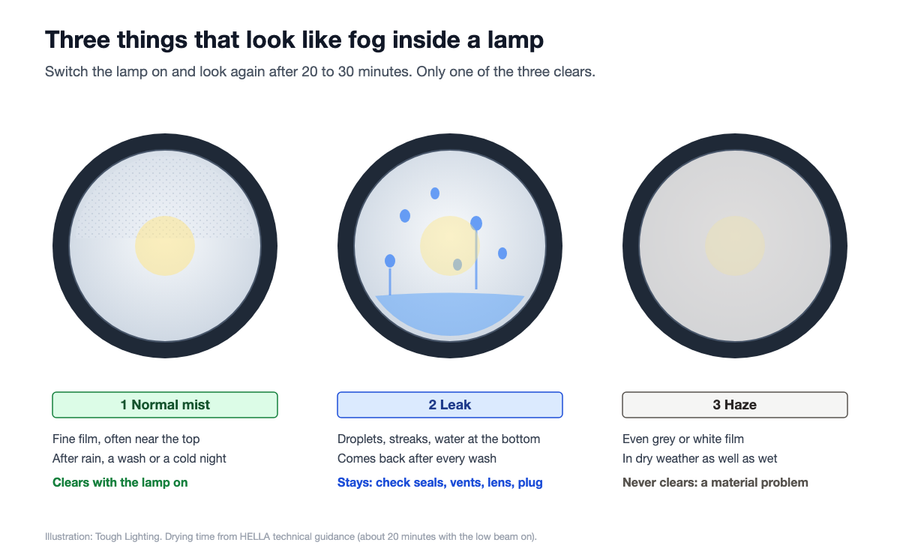
Three things that look like fog inside a lamp
| What you see | What it usually is | After 20 to 30 minutes with the lamp on | What to do |
|---|---|---|---|
| Fine mist on the inside of the lens, often near the top, after rain, washing or a cold night | Normal condensation | Clears | Nothing. Keep the vents clear |
| Droplets that stay, water running down the lens, or a pool at the bottom of the housing | Water getting in through a seal, a crack or a blocked vent | Stays or comes back after every wash | Inspect seals, vents, lens and plug; replace the lamp if the housing is cracked |
| A grey or white film evenly over the inside of the lens, in dry weather as well as wet | Haze from compounds given off by materials inside the lamp | Does not clear | A sealing or material problem; the lamp will not dry out |
The 30-minute test you can do without opening the lamp
Switch the lamp on, or drive with the low beam on, and look again after 20 to 30 minutes. HELLA's technical guidance is that the light-emitting area should be dry after about 20 minutes with the low beam on, a little longer or shorter depending on outside temperature and humidity. Parking in the sun also helps.
While you wait, look at three things:
- Where it is. Normal mist tends to sit as a fine film across the lens. Water from a leak collects low, because it runs down.
- What it looks like. Mist is a haze of tiny droplets. A leak shows larger drops, streaks or standing water.
- When it comes back. Mist that comes back after cold nights but clears each time the lamp warms up is the lamp breathing. Water that reappears after every pressure wash points to a seal.
If the lens clears, the lamp is working as designed. HELLA states that a lamp with no persistent moisture, no water build-up and no detectable fault is technically sound and can stay in use without restriction.
Why lamps are built to breathe
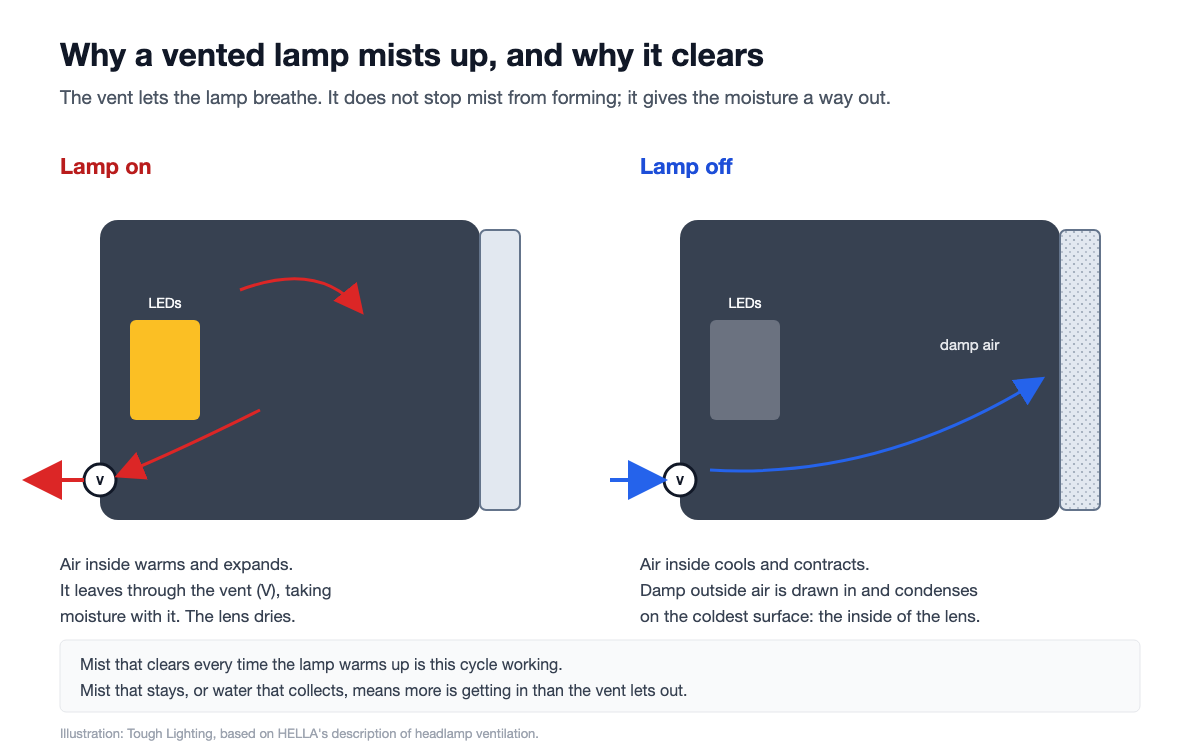
A lamp that heats up and cools down every time it is switched on cannot be sealed like a jar. When the lamp is on, the air inside warms and expands, and HELLA explains that it escapes through ventilation openings. When the lamp is switched off, the air cools and contracts, and damp outside air is drawn back in. That moisture then condenses on the coldest surface inside, which is the inner face of the lens.
HELLA lists three ways lamps are ventilated: small openings or slits in the housing, rubber or diaphragm valves that let air through while keeping water and dirt out, and on some modern LED and laser headlamps, small electric fans. Our own LED work lights use a breather valve.
The point worth taking from this is that a vent does not prevent condensation. HELLA notes that the same vents which let moisture out also make it easier for a lamp to mist up. What the vent guarantees is that the moisture has a way to leave once the lamp warms up. Without that way out, any moisture that gets in has nowhere to go.
When the mist is actually a leak
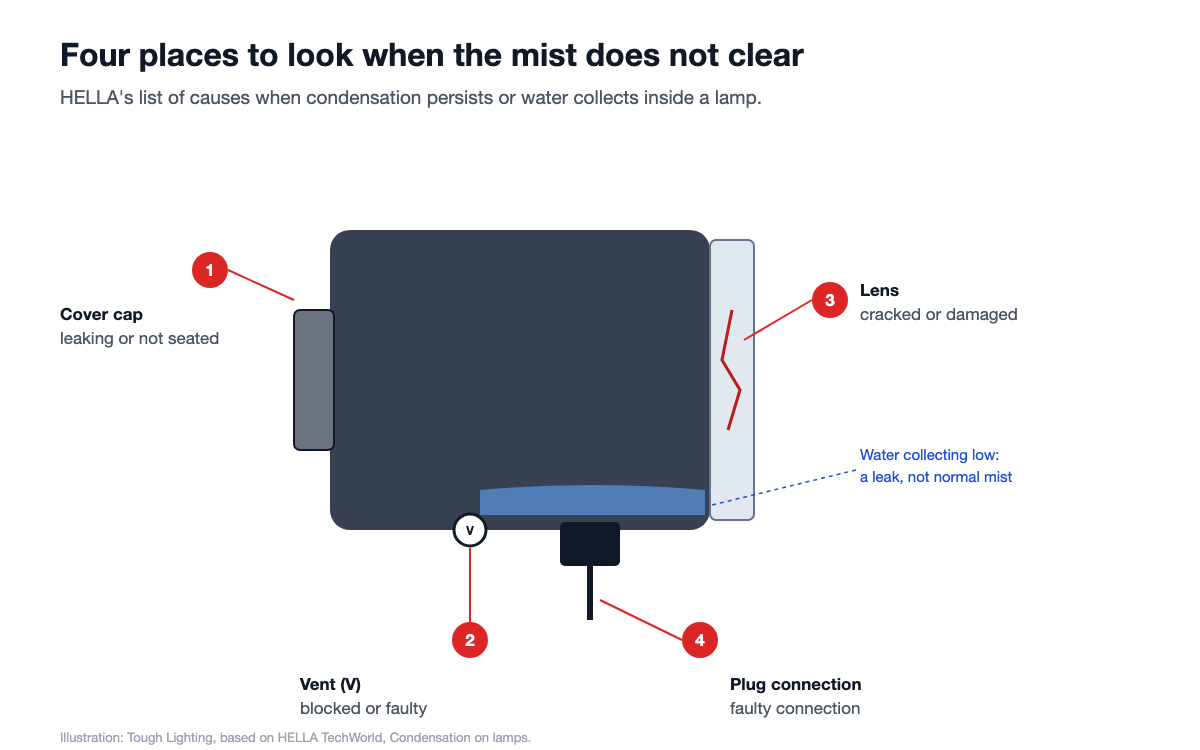
HELLA gives two signs that a lamp needs a closer look: condensation that persists over a longer period, and water you can see building up inside the lamp. It names four places to look:
- Cover caps on the back of the housing that are leaking or not seated properly
- Ventilation that is blocked or faulty
- Damage to the lens
- Faulty electrical plug connections on the lamp
Blocked vents are the easy one to miss. Mud, wax from a car wash or a cable tie pulled over a vent can close it, and then the lamp cannot breathe out what it breathed in. HELLA's advice is to check every seal and make sure the vent slots are open so air can dry the inside. On a machine that is pressure washed, look at the lamps again after washing. The IP ratings glossary and the IP69K vs IP68 guide explain what each rating is tested against.
If water has got in and you decide to take a headlamp out to dry it, HELLA gives two cautions. Do not remove the reflectors, because they are easily damaged, and re-aim the headlamps once they are back in, because taking them out can knock them out of alignment. A work light has no aim to keep, so the check is the same four places: the cover cap, the vent, the lens and the plug. A housing that keeps filling with water after those are put right is a lamp to replace.
When it is haze, not water
There is a third case that looks like mist and is not. Glues, gaskets, O-rings and potting compounds inside a lamp can release volatile compounds when they get hot. In a closed lamp these settle on the inside of the lens as a grey film, and they can also be absorbed by the LEDs' own silicone. Cree's chemical compatibility note describes a sealed test group that lost 90% of its light output after 450 hours, while a group whose enclosure was vented recovered almost all of it within 24 hours. The same note shows a nearly sealed fixture whose light had visibly yellowed after less than 100 hours.
The test for haze is simple. It does not clear when the lamp warms up, it is there in dry weather as well as wet, and it covers the lens evenly instead of collecting at the bottom. It will not dry out, because there is nothing to dry. We explain how this happens, and what to ask a supplier, in why LED work lights fail.
Will condensation fail an MOT?
The UK MOT inspection does not list condensation as a defect on its own. What it checks is the light. The government's headlamp aim guide for testers says that if the beam pattern is blurred and the examiner cannot see a distinct cut-off point, that is a reason for failure, and it suggests leaving the headlamps on for a short time to burn off the condensation before the test. So a lamp that clears in the 30-minute test should not be a problem. A lamp holding water that blurs the beam may be. Separately, the MOT inspection manual lists a headlamp reflector or lens that is slightly defective as a minor defect and one that is seriously defective as a major defect, so a reflector damaged by water that sat in the lamp for months can count against it too.
What to ask before you buy the next set
Most of what decides whether a lamp mists up, leaks or hazes is fixed when it is designed, not when it is fitted. Four questions to a supplier cover it, and each answer is something you can check against the product page or the test report.
| Ask | Why it matters | A useful answer |
|---|---|---|
| Is the lamp vented, and how? | A vented lamp can clear its own condensation; an unvented one keeps whatever gets in | Names the vent type, for example a breather valve or a membrane, and where it sits on the housing |
| What is the IP rating, and what was it tested against? | IP67 and IP68 are immersion tests. IP69K is a high-pressure, high-temperature spray test, which matters on a machine that is pressure washed | Gives the full rating and, on request, the test report |
| What is the lens made of? | Polycarbonate and glass behave differently with temperature, cleaning chemicals and stone strikes, and a cracked lens is one of the four leak points | States the material and any surface hardening |
| What does the warranty say about water ingress? | Terms differ between suppliers, and the time to read them is before you need them | Says in writing whether water ingress is covered and what is excluded |
The IP69K vs IP68 guide explains the spray and immersion tests in more detail. You can compare IP rating, lens material and warranty across our LED work lights.
Frequently asked questions
Will moisture in headlights go away on its own?
Usually, yes. Normal condensation clears once the lamp warms up. HELLA's guidance is about 20 minutes with the low beam on. If it is still there after that, or if you can see water collecting, the lamp has a leak or a blocked vent.
How do I get moisture out of my taillight?
Switch the lights on and leave the vehicle somewhere warm or in the sun. If the moisture does not clear, check the seals and the cover on the back of the lamp, make sure any vent is not blocked, and look for cracks in the lens.
Is water in a tail light covered under warranty?
That depends on the seller's terms, not on the lamp. Read what the terms say about water ingress and about damage to the lens or housing before you claim.
Does drilling a hole in a headlight stop condensation?
Most lamps already have vents. HELLA's advice is to check that the existing vents are open and the seals are intact, rather than to change the housing. A hole you add yourself changes a housing that was designed and tested without it.