


A tractor pulled over for a lighting violation usually has the triangle on the back. That is the point of confusion worth clearing up first: the triangle was never the thing that satisfied the lighting requirement.
We build amber warning beacons and tractor work lamps, so this question reaches us as a specification question: what do we actually have to fit. The answer is that three different devices are doing three different jobs, and in both states we looked at they are governed by separate statutes that do not reference each other.
This piece separates the three, works through what two states actually require, and sets out what to specify for the part we do supply.
The short answer: the slow-moving vehicle emblem tells following drivers that the machine is slow. The rear and front lamps tell them where it is and which way it faces. The flashing amber hazard lamps tell them it is there before they have worked out either. Fitting the triangle does not satisfy the lamp requirement, and fitting lamps does not satisfy the triangle requirement.
Three devices, three jobs
| Device | What it does | How it works | When it works |
|---|---|---|---|
| SMV emblem | Says "this vehicle is slow" | Passive: fluorescent and retroreflective | Daylight by fluorescence, night by headlamp return |
| Position lamps | Say "the vehicle is here, and this is its width and orientation" | Active, steady | Darkness and poor visibility |
| Hazard warning lamps | Say "notice this now" | Active, flashing | Daylight and darkness |
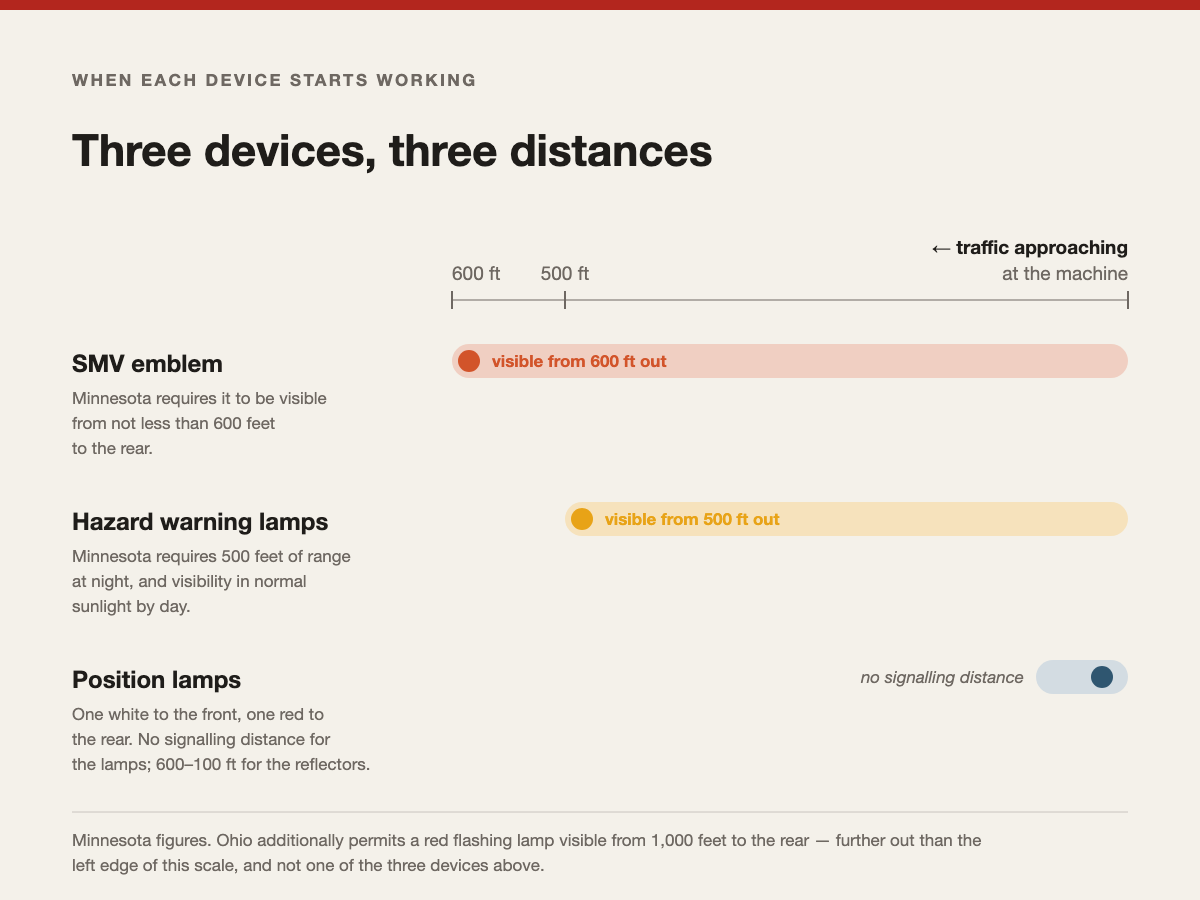
The distinction that matters commercially is the middle column. The emblem has no power supply and returns light only when something illuminates it. That is fine for a following driver with headlamps on. It does nothing for a driver approaching in daylight haze, in rain, or against a low sun, which is exactly when a slow machine on a road is most likely to be hit from behind.
That is the gap the flashing amber lamp exists to close, and it is why the statutes treat it as a separate requirement rather than an upgrade.
What one state actually requires
Minnesota is a useful starting point because the two requirements sit in different sections and neither one refers to the other.
The emblem: Minnesota Statutes 169.522, "Slow-Moving Vehicle, Sign Required." Subdivision 1(a) applies it to "animal-drawn vehicles, motorized golf carts when operated on designated roadways pursuant to section 169.045, implements of husbandry, and other machinery, including all road construction machinery, which are designed for operation at a speed of 35 miles per hour or less."
The emblem itself is specified as "a fluorescent or illuminated red-orange triangle with a dark red reflective border and be mounted so as to be visible from a distance of not less than 600 feet to the rear."
Note what the section does not say. It contains no language allowing the emblem to stand in for lighting, and none allowing lighting to stand in for the emblem. They are independent obligations.
The lamps: Minnesota Statutes 169.55, "Lights on All Vehicles." Subdivision 2 opens with a condition that matters: "(a) At the times when lighted lamps on vehicles are required." Within that window, a self-propelled implement requires "at least one lamp displaying a white light to the front, and at least one lamp displaying a red light to the rear," plus "two red reflectors visible to the rear." For combinations, one lamp must display "a white or amber light to the front and a red or amber light to the rear." The reflectors must be "visible at night from all distances within 600 feet to 100 feet when directly in front of lawful lower beams of headlamps."
The hazard warning lamps: Minnesota Statutes 169.55, subdivision 3. This one carries no time-of-day condition at all: "No person may operate a self-propelled implement of husbandry manufactured after January 1, 1970, on a highway unless the implement of husbandry displays vehicular hazard warning lights visible to the front and rear in normal sunlight."
That last phrase is the one to carry into a purchase order. Minnesota asks for daylight visibility here, and the colour section below adds a 500-foot night-time range test that applies to the lamps fitted under it, so a lamp fitted that way has to clear both. Daylight is the harder of the two: a lamp obvious at midnight can disappear against an overcast noon sky.
The same three jobs, drawn differently one state over
Ohio covers the same ground and reaches it by a different route, which is the clearest possible argument for reading your own state's code rather than a summary.
The threshold is different. Ohio Revised Code 4513.11 defines a slow-moving vehicle as "a boat trailer, unit of farm machinery, road construction machinery, or other machinery designed by the manufacturer to operate at a speed of twenty-five miles per hour or less." Minnesota's figure is 35 miles per hour. A machine rated at 30 mph is a slow-moving vehicle in Minnesota and is not one under Ohio's definition.
The dividing line is different. Minnesota splits on manufacture date, before or after 1 January 1970. Ohio Revised Code 4513.111, titled "Light and reflector requirements for older model farm machinery and agricultural tractors," splits on model year instead, and the same time condition governs four of its nine divisions: "At the times specified in section 4513.03 of the Revised Code." Multi-wheel agricultural tractors of model year 2001 or earlier must display "flashing lamps displaying amber light, visible to the front and the rear," together with amber reflectors visible to the front and red reflectors visible to the rear. Farm machinery of model year 2002 or later is handed instead to an industry standard, named in the statute as "American society of agricultural engineers standard ANSI/ASAE S279.10 OCT 98, lighting and marking of agricultural equipment on highways."
There is an option Minnesota's text does not describe. Ohio division (E) lets "any unit of farm machinery designed by its manufacturer to operate at a speed of twenty-five miles per hour or greater or any SMV" carry a red flashing light "visible from a distance of not less than one thousand feet to the rear at all times specified in section 4513.03 of the Revised Code," one of the four divisions that condition governs. If that lamp is double-faced, the statute adds, it "shall display amber light to the front and red light to the rear." Note the scope: it reaches farm machinery rated at 25 mph or above and any slow-moving vehicle, which between them cover most farm machinery. What it is not is a general permission for any vehicle to run a red flashing lamp.
And there is a stated consequence. Ohio division (I): "Whoever violates this section is guilty of a minor misdemeanor."
Two things are worth pulling out of that comparison, and the colour question is the more useful of them.
First, the colour. Ohio names it in the statute: "flashing lamps displaying amber light." Minnesota reaches the same place by a longer route. Its hazard warning lamp requirement, 169.55 subdivision 3, says only that the lamps be visible front and rear in normal sunlight. The colours live in a different section again, 169.59 subdivision 4, and that section is written as permission rather than command: it says a vehicle "may be equipped" with such lamps, and then sets what they have to look like if you fit them: "simultaneous flashing white or amber lights, or any shade of color between white and amber" to the front, and "simultaneously flashing amber or red lights, or any shade of color between amber and red" to the rear. Read the two sections together and the chain is: 169.55 subdivision 3 makes the lamps compulsory, 169.59 subdivision 4 governs what counts as one.
Read those two windows together and one colour sits inside both: amber.
Then the same subdivision addresses our form factor directly. "Instead of a pair of lamps that flash simultaneously, either one or two strobe lights or rotating beacon lights with an amber or yellow lens may be used both to the front and rear of the vehicle." So for a strobe or a rotating beacon, Minnesota does name the colour, and it names one band rather than a choice between two: amber and yellow here describe the same part of the spectrum. The subdivision then closes with a range test, and its subject is collective, covering every warning light the subdivision describes, not only the strobe option: "These warning lights shall be visible from a distance of not less than 500 feet under normal atmospheric conditions at night."
Specify amber and both states are satisfied, by two different routes. That is a firmer basis for a purchase order than either statute on its own.
Second, Ohio hands newer machinery to an industry standard rather than writing the requirement into the code. The statute names the document, so you know what to buy; you just cannot read the requirement without buying it.
⚠️ These are two states, quoted to show how the three requirements separate and how much the detail moves between jurisdictions. Other states word this differently again, apply different speed thresholds and different cut-off dates. Nothing above is a national requirement and nothing here is legal advice. Check your own state's code, or ask the dealer who registered the machine.
Why the triangle keeps getting treated as enough
Two reasons, both understandable.
The emblem is the most visible compliance item on the machine, so it reads as the compliance item. And it is the one that gets replaced most often, because fluorescent orange fades: an emblem that has spent five summers outdoors is no longer the colour the statute describes, and a faded triangle is a common inspection finding in its own right.
Neither of those makes it a lamp. If the machine is on a road in daylight and a following driver has no headlamps returning off the retroreflective border, the triangle is working on fluorescence alone, and fluorescence fades first.
Specifying the amber lamps
This is the part we supply, and the specification is short.
Amber, because it is the colour that satisfies both kinds of statute. Ohio requires it. Minnesota names "an amber or yellow lens" for strobes and rotating beacons specifically, and amber also sits inside both of its colour windows for paired flashing lamps. Specify amber and the question stops being state-specific.
Daylight visibility is the requirement, so it drives the choice. A lamp that meets a daylight-visible test needs real output and a beam that puts it where following traffic is, not a decorative flash. Our two amber strobe beacons are 5 W and 9 W respectively, a modest current draw, because the visibility comes from the flash and the optic rather than from raw power.
| Model | Power | Input voltage | Nominal diameter | Body (height × diameter) | Pattern |
|---|---|---|---|---|---|
| BE2010A | 5 W | 9–32 V DC base; 10–48, 10–60, 10–110 V DC optional | 3-3/4 in | 5 in × 3.7 in | Amber flashing |
| BE2010B | 9 W | 9–32 V DC base; 10–48, 10–60, 10–110 V DC optional | 5-1/4 in | 4 in × 5.2 in | Amber flashing |
Mount for the direction the risk comes from. The statute above asks for front and rear visibility. On a tractor with a cab, one roof-mounted beacon rarely achieves both, because the cab structure and any raised implement block the rear arc. Two positions is the normal answer.
Voltage. Both lamps list 9–32 V DC as their base range, which covers 12 V and 24 V machines, and both also list 10–48, 10–60 and 10–110 V DC as separate options for higher-voltage equipment. The table above lists the base range and the options together, so confirm with us which range the part number you actually order carries.
Do not accept a class claim without the paperwork. Warning lamp brightness classes exist, and suppliers quote them freely. We will supply test documentation on request rather than print a class on a page; our position on certification claims generally is set out in the vehicle lighting certifications entry.
Which colour you may use is set by the jurisdiction, not by preference. Amber is the colour associated with slow and hazard warning on civilian vehicles across most jurisdictions; red and blue are generally reserved for emergency and other specified vehicles. Which colour a given vehicle may use is a separate question with its own answer, covered in Beacon Light Colors: Who Can Use Amber, Red, Blue or Green.
Frequently asked questions
What does the orange triangle on a tractor mean?
It is the slow-moving vehicle emblem, and it means the machine is designed to travel at or below a low speed threshold, 35 miles per hour in Minnesota's statute. It is a passive marking that fluoresces in daylight and retroreflects at night. It is not a lamp and does not satisfy a lighting requirement.
Do tractors need flashing lights on the road?
In the two states quoted here, yes, though by different routes. Minnesota Statutes 169.55 subdivision 3 requires hazard warning lights visible to the front and rear in normal sunlight on implements manufactured after 1 January 1970. Ohio Revised Code 4513.111 requires multi-wheel agricultural tractors of model year 2001 or earlier to display flashing amber lamps visible to the front and the rear, and hands model year 2002 and later to one named industry standard, ANSI/ASAE S279.10 OCT 98. Both requirements sit separately from the steady lamps and separately again from the SMV emblem.
Is the SMV emblem enough on its own?
No. In the statutes quoted here the emblem and the lamps are independent requirements in different sections, and neither is written as an alternative to the other. A machine with a perfect triangle and no working rear lamp does not meet the lighting requirement. Ohio also attaches a stated consequence: division (I) of 4513.111 makes a violation a minor misdemeanour.
What colour should a tractor warning beacon be?
Amber, on the evidence of the two states quoted here, though they get there differently. Ohio Revised Code 4513.111 requires amber outright. Minnesota's hazard lamp requirement names no colour, but its colour rules in 169.59 subdivision 4 permit white through amber to the front and amber through red to the rear, and for a strobe or rotating beacon the same subdivision names "an amber or yellow lens" directly. Red and blue are generally restricted to emergency and other specified vehicles.
Check the machine against all three
Walk the machine and confirm three separate things: the emblem is present and has not faded out of specification, the steady front and rear lamps work, and the flashing amber lamps are visible from both ends in daylight. Each of those answers to a different requirement, and passing two of the three is not passing.
If the amber lamps are the part that needs sorting, send the machine type and the mounting positions with your enquiry and we will come back with a lamp and bracket combination. Start from the LED beacon and warning lamp range, or the tractor lighting range if the steady lamps need replacing at the same time.
Next: Beacon Light Colors: Who Can Use Amber, Red, Blue or Green covers which vehicles may use which colour, and how the brightness classes work.
---