


Every trailer wiring guide opens with a colour chart. Almost none of them says what that chart actually is.
We manufacture trailer lamps and sell into both North America and Europe, so the harness questions that reach us are usually the ones a colour chart caused. The most common has the same shape every time: someone matched brown to brown, and the tail lamps came on with the right indicator.
This piece sets out what is genuinely fixed in trailer wiring, what is only convention, and how to wire a trailer without relying on the part that is only convention.
The short answer: pin positions within a given connector type are fixed; wire colours are not. Colour conventions are real and widely followed, but they differ between connector types and between markets, and they differ inside the published diagrams of a single manufacturer. Identify the function at the connector pin, then follow the wire.
The proof is in one manufacturer's own diagrams
CURT publishes a comprehensive trailer wiring reference. Take two tables from the same page.
Their 4-pin flat:
| Colour | Function |
|---|---|
| Brown | Tail lamps |
| Yellow | Left turn / brake |
| Green | Right turn / brake |
| White | Ground |
Their 7-pin RV blade, traditional configuration:
| Colour | Function |
|---|---|
| Green | Tail lamps |
| Brown | Right turn / brake |
| Red | Left turn / brake |
| Yellow | Reverse |
| Blue | Electric brakes |
| Black | +12 V |
| White | Ground |
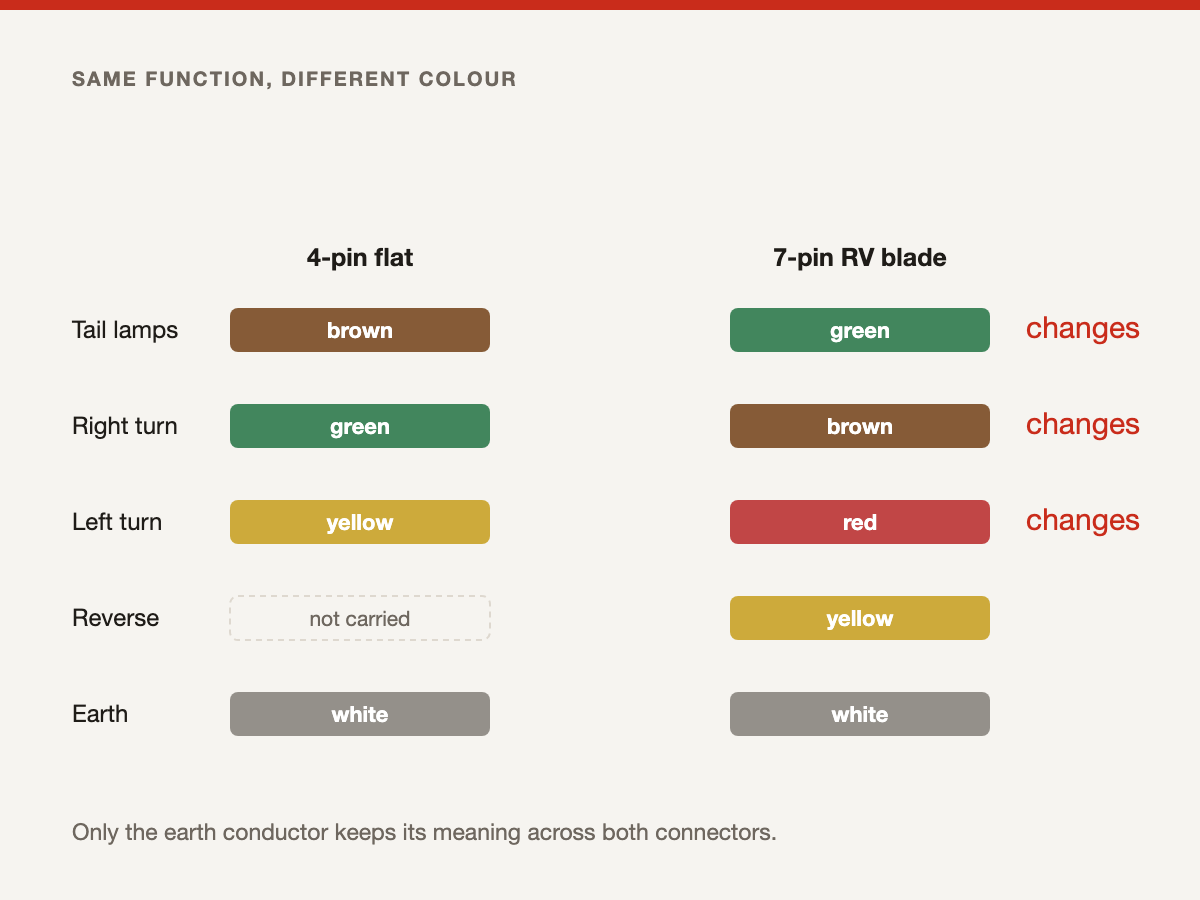
Three colours have moved. Brown goes from tail lamps to right turn. Green goes from right turn to tail lamps. Yellow goes from left turn to reverse. Only white is doing the same job in both.
The same page also carries a second 7-pin RV blade diagram, an "SAE" configuration distinct from the "traditional" one, which is a second convention for the same physical connector.
None of this is an error on their part. It is an accurate description of a market in which more than one convention is in live use. But it does mean that "brown is tail lamps" is true only until you change connector, and a person reading a 4-pin chart while wiring a 7-pin socket has been given exactly enough information to get it wrong.
What is actually fixed
Three things.
The connector's pin positions. A 7-way RV blade socket has a defined physical arrangement, and the tow vehicle side is wired to it. That geometry is what makes connectors interchangeable between vehicles and trailers at all.
The function set for that connector type. A 4-pin carries tail, left, right and earth. A 5-pin adds one circuit. A 7-pin carries those four plus a 12 V supply, electric brakes and reverse. Which connector you have determines which functions are available, regardless of what colours appear behind it.
That set is not arbitrary. It exists because specific lamp functions are required on the vehicle in the first place: 49 CFR 393.11, "Lamps and reflective devices," sets the requirements by vehicle type, and the functions it names include tail lamps, stop lamps, turn signals, clearance lamps, side marker lamps, identification lamps, licence plate lamps and several classes of reflex reflector. Read that section's own table by your own vehicle type before assuming a given lamp applies: the requirements differ between a truck, a truck tractor and a trailer, and reverse lamps in particular are not asked of every type. The connector has to carry circuits for the functions your vehicle actually has. Which of those apply to your trailer depends on its width and length, and we work that through in DOT trailer light requirements by trailer width and length.
Earth is earth. White as the earth conductor is the one convention that holds across every diagram above. It is also the conductor most often assumed rather than checked, which is why a bad earth is the leading cause of trailer lamp faults, covered in detail in why LED trailer lights fail on grounds that worked with bulbs.
What is not fixed is the colour of the wire attached to any of those pins by whoever built the harness. A replacement harness, a repair splice or an import can all arrive with a different colour scheme and be entirely serviceable.
⚠️ Trailer connectors are covered by published standards that the standards bodies sell rather than publish free. SAE maintains several for different connector families in North America, and ISO does the same in Europe. We have not reproduced the content of any of them here, and we are deliberately not mapping a particular standard number onto the connector shown above, because the seven-pin families are not interchangeable and it is easy to cite the wrong one. The colour tables are attributed to the manufacturer reference they come from, as a description of market practice.
Wire to the pin, not to the colour
The method that does not depend on convention:
Identify the connector type on both vehicle and trailer. Count the pins and note flat blade versus round.
Find each function at the vehicle socket with a test lamp or a multimeter while an assistant operates the lights. Tail, left, right, brake, reverse, earth. Write down which pin did what.
Wire the trailer to the pins you identified, using whatever colours the harness came with.
Test every function before the first road trip, including both indicators with the tail lamps on, which is the combination that exposes a shared-earth fault.
Step 2 is the one people skip because the colour chart made it look unnecessary. It takes about five minutes and it is the only step that is true regardless of who built either side.
What LED changes
A colour chart written for incandescent lamps is silent on all three of these.
Low current hides a marginal earth. An incandescent lamp draws enough current to force a poor earth connection to reveal itself as visible dimming. An LED draws so little that the same poor connection carries it without complaint, until the day it does not. The fault was always there; the LED just stopped reporting it.
The tow vehicle may object. Vehicles that monitor lamp current to detect a failed bulb can read the LED's low draw as a failure, producing a bulb-out warning or hyperflash. This is a tow-vehicle behaviour, not a trailer fault, and it is why load resistors exist.
Voltage drop bites sooner on long trailers. LED drivers have a minimum operating voltage, and below it they do not dim, they drop out. On a long trailer with a marginal earth return, the lamp furthest from the plug is the one that goes dark first. Our voltage drop entry covers sizing the run.
What changes at the border
This is the part that matters if the trailer, or the lamp, crosses a market boundary.
North American trailers use 4-pin, 5-pin, 6-pin and 7-pin systems, with 7-pin RV blade the common heavy configuration. European trailers use a 13-pin system, and previously a pair of 7-pin round connectors. These are not variants of each other. The function sets differ, the physical connectors differ, and the pin assignments differ.
The practical consequence for anyone buying lamps or harnesses for export: you cannot adapt a US harness to a European socket by matching wire colours, because there is no colour mapping that would be correct: the functions themselves are allocated differently. What you can do is specify the connector for the destination market at the point of order, which is how our own trailer lamps ship.
The lamps themselves are less market-specific than the connectors. Ours are listed at 9–32 V DC, so the same lamp serves 12 V and 24 V systems; it is the plug on the end that has to be right.
Frequently asked questions
What colour wires go where on trailer lights?
It depends on the connector. On a 4-pin flat the common convention is brown for tail lamps, yellow for left turn, green for right turn and white for earth. On a traditional 7-pin RV blade the same manufacturer publishes green for tail lamps, brown for right turn, red for left turn and yellow for reverse. Because the convention changes with connector type, identify each function at the connector pin rather than trusting the colour.
Is trailer wire colour a legal standard?
The connector specifications are published standards, but the colour of the wire crimped to a given pin is convention rather than a universally enforced requirement, and more than one convention is in active use. Treat the connector as the authority.
Why do my new LED trailer lights flicker or hyperflash?
Usually because the tow vehicle is monitoring lamp current and the LED draws too little for it. That produces hyperflash or a bulb-out warning. A marginal earth can produce similar symptoms for a different reason, so check the earth before adding load resistors; the diagnosis order is set out in why LED trailer lights fail on grounds that worked with bulbs.
Can I use a US trailer harness on a European trailer?
No. European trailers use a 13-pin system with a different function allocation, not a recoloured version of the North American 7-pin. Specify the connector for the destination market rather than adapting.
Five minutes with a test lamp
Before wiring anything, put a test lamp on the vehicle socket and have someone work through the lights. Write down what each pin does. That note is correct for that vehicle regardless of which convention the harness maker followed, and it is the only part of this job that does not expire when the connector changes.
If you are specifying lamps rather than fixing a harness, the connector for the destination market should be on the order. See the trailer and tail lamp range, and DOT trailer light requirements by trailer width and length for which lamps have to be on the trailer in the first place.
---