


Two questions keep arriving, and they are the same question wearing different clothes. The first is how wide a 6014 is. The second is whether sealed beam headlights have trade numbers at all.
Both come from the same place. There is a number stamped on the lamp, a bucket it has to go back into, and no obvious way to tell which part of that number is the size, which part is the beam, and which part is neither.
Sealed beams carry two numbering systems that look alike and answer different questions. A PAR number is arithmetic. A trade number is an interchangeable shape. Neither of them tells you what the beam does, and that is where most of the mis-orders start.
Two numbers, two different questions
The PAR number is the easy one, because it is a calculation rather than a code. PAR stands for Parabolic Aluminized Reflector, and the number after it is the front diameter counted in eighths of an inch. Divide by eight and you have inches, so a PAR 36 is 4.5 inches across the face, every time and without exception. The arithmetic and the mis-orders it prevents are set out in PAR 36 is 4.5 inches.
A trade number is not arithmetic. It is an index into a set of interchangeable outlines. 6014, 4411, H4656 and 6052 are not measurements and they are not model codes. Each one names a lamp whose mounting outline is held closely enough that any lamp carrying that number will seat in the bucket built for it.
Put plainly: a PAR number describes the lamp, and a trade number describes the hole.
| PAR number | Trade number | |
|---|---|---|
| What it encodes | Front diameter in eighths of an inch | An interchangeable mounting outline |
| Example | PAR 36 is 36 ÷ 8 = 4.5 in | 6014 is the 7 in round type 2D1 |
| Can you calculate it | Yes, by dividing by eight | No, it has to be looked up |
| Does it fix the beam | No | No |
| Does it fix the voltage | No | No |
| What it is good for | Checking a measurement you took yourself | Ordering a lamp that has to fit an existing bucket |
So how wide is a 6014
178 mm, or 7 inches. It belongs to the round family that SAE designates type 2D1, alongside 6015, 6016 and the halogen H6014.
But notice what the question assumed. It treated 6014 the way PAR 36 works, as a number you could decode into a size. You cannot. 6014 is a type designation that happens to have a diameter, in roughly the way a shoe size has a width without being a width measurement.
The three families you are most likely to meet on agricultural and construction machinery:
| Format | Dimensions | SAE type | Trade numbers you will see |
|---|---|---|---|
| 7 in round | 178 mm diameter | 2D1 | 6014, 6015, 6016, H6014 |
| 4 × 6-1/2 in rectangular | 100 × 165 mm | 2A1 | H4656, 4652, H4662 |
| 6052 | 142 × 200 mm | 2B1 | 6052 |
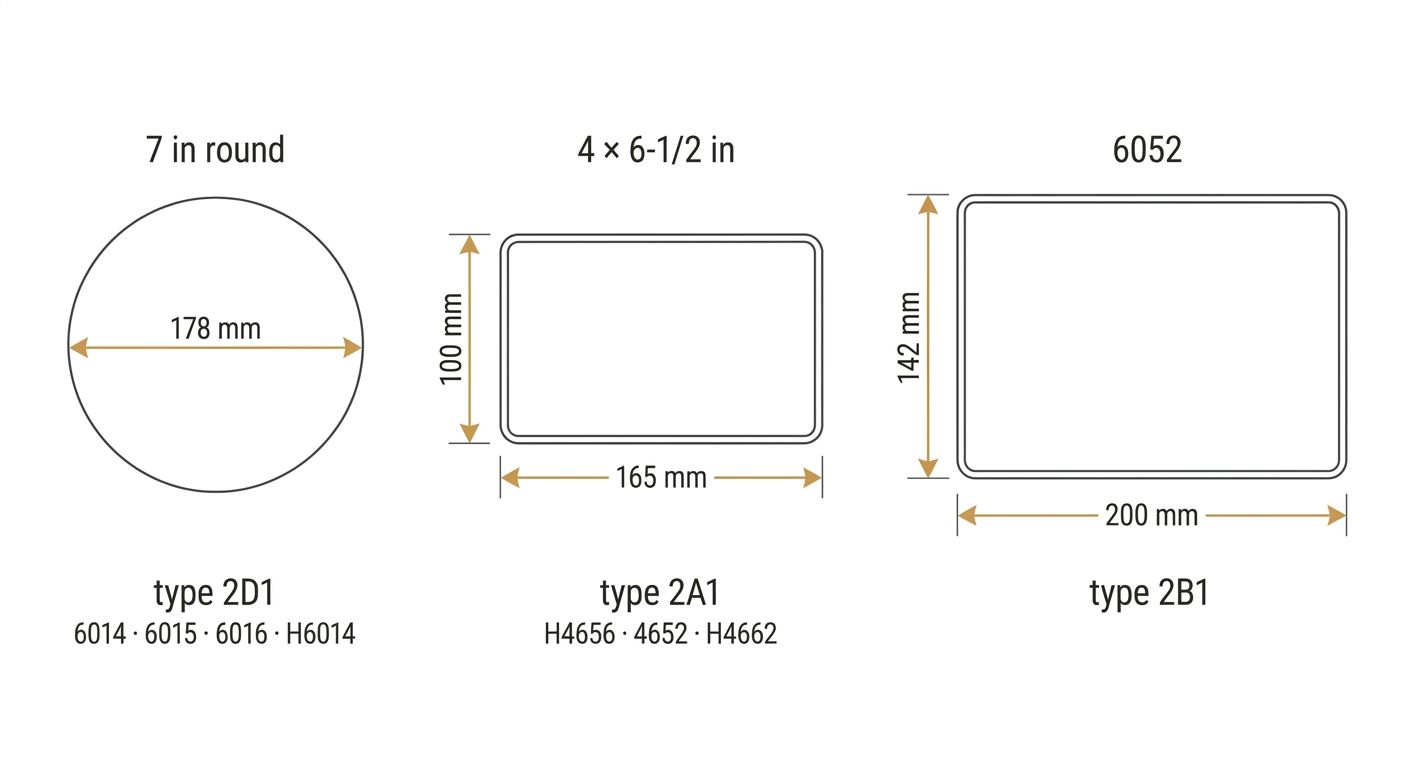
That third row is worth a second look. 6052 is a different family altogether and it is routinely mislabelled as a 4 × 6, which it is not. The dimensions are not close, and a bucket cut for one will not take the other.
The clause that makes any of this dependable is SAE J1383 5.3.1, which requires the dimensions marked "I" in the standard’s figures to be met so that lamps of the same type remain interchangeable. A lamp that misses those dimensions will not seat, whatever number is printed on the carton. Construction detail for both the sealed beam families and the modern module that replaces them is in sealed beam and 90 mm modules.
What the trade number does not fix
This is the part that costs people a return, and it is worth being blunt about.
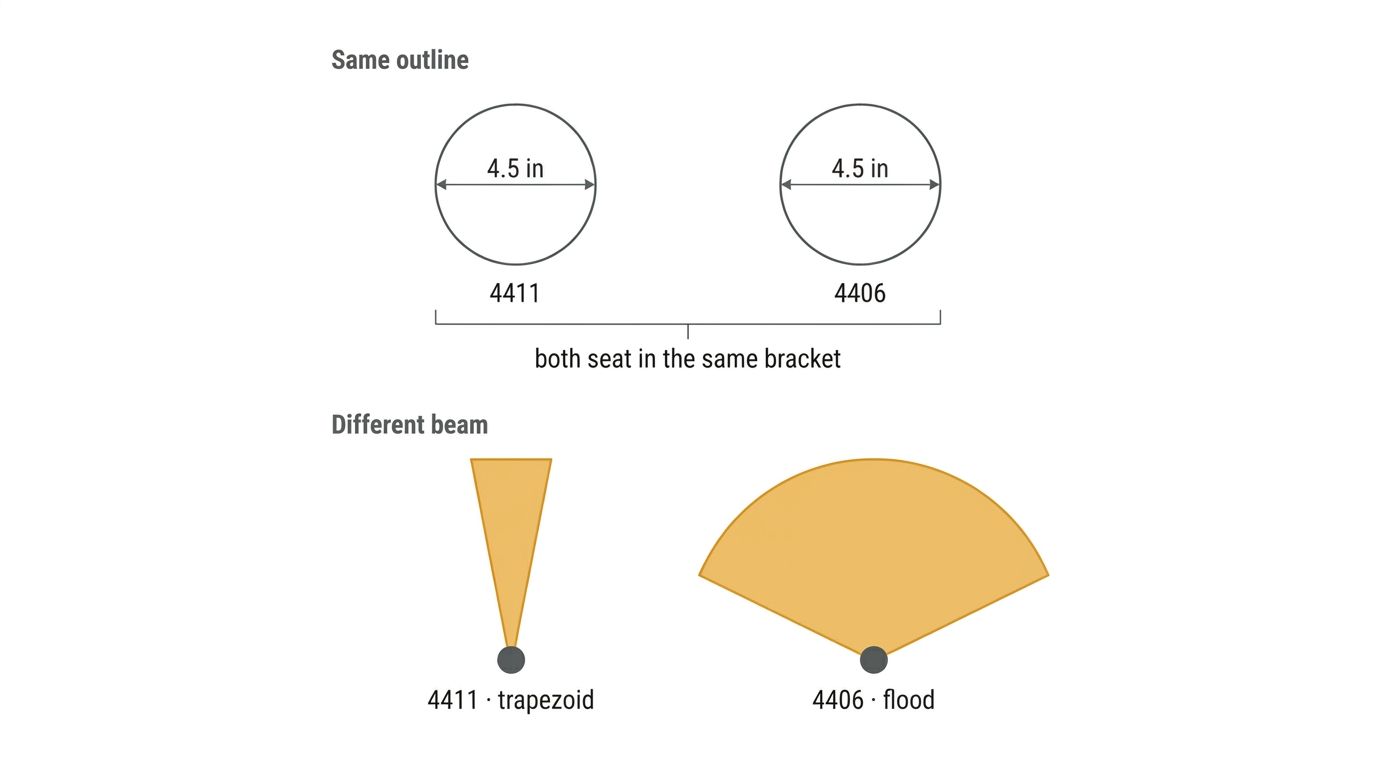
The beam is not in the number. 4411 and 4406 are both PAR 36, both 4.5 inches, and both drop into the same bracket. One is a trapezoidal pattern and the other is a flood. Ordering "a 4411" settles the fit and leaves the beam to whatever the supplier happens to stock, unless you say which pattern you want. What the patterns actually do on a machine is covered in beam patterns.
The voltage is not in the number either. The same outline has been built for 6 V, 12 V and 24 V systems over the decades, and the number does not distinguish them. On older machines this matters more than it sounds: a good many tractors people want to modernise are still 6 V, often with positive earth, and no lamp in a 9 to 32 V range will run on them.
Nor is the function. A single filament lamp, a high and low beam lamp, and a work lamp with a red tail lamp built into the same body can share an outline. Fitting a single function lamp where the machine expected two loses the second function silently, and on a road-registered machine the rear lamp is usually a legal requirement rather than a convenience.
| Fixed by the trade number | Not fixed by it |
|---|---|
| Front outline and mounting dimensions | Beam pattern (flood, trapezoid, spot) |
| Seating in the original bucket | System voltage |
| Terminal position, within the type | Wattage and output |
| Number of functions in one body | |
| Depth behind the mounting face |
Reading it off the lamp you already have
If the old lamp is in your hand, four measurements turn it into an order, and only the first one is guaranteed by the number.
Measure the face across the glass. This is the figure that decides which family you are in. If it comes out at 4.5 inches you are in PAR 36 territory; at 7 inches you are in the 2D1 round family; if it is rectangular, measure both axes before assuming it is a 4 × 6.
Measure the depth behind the mounting face. Sealed beams are shallow. An LED replacement carries a heat sink, and a recess that swallowed the original may not clear a finned housing.
Look at the terminals. Screw terminals, spade terminals and pigtails are not interchangeable without an adapter, and the trade number does not always settle which one you have.
Count the functions. If the lamp you are replacing was carrying a tail lamp or a high and low beam as well as the work light, the replacement has to carry them too, or the machine quietly loses one.
With those four answers, the number on the old lamp becomes useful rather than ambiguous: it narrows the family, and the measurements settle the rest.
The approval layer, if the function faces the road
None of the above is about legality. Once a lamp points at the road rather than at the work, a second question opens, and the two main frameworks are not interchangeable.
ECE approval is granted by a third party and marked with an E-mark, with photometry measured in lux on a screen at 25 m. FMVSS 108 works by manufacturer self-certification, marked DOT on the lens. The beam patterns are shaped differently, with ECE enforcing a sharp cut-off to limit glare and FMVSS allowing more upward light for sign illumination, so a single optic cannot satisfy both. A lamp offered with both marks is normally two variants sharing a housing.
One date matters if you are reading older documentation: for new type approvals, UN Regulation 149 has replaced R112, R113 and the related road illumination regulations since 14 November 2021. An existing approval under the older regulations does not stop being valid, which is why both numbers still circulate. How the ECE, DOT and SAE frameworks divide by market is set out in vehicle lighting certifications.
Frequently asked questions
How wide is a 6014 sealed beam?
178 mm, or 7 inches, measured across the face. It is the SAE type 2D1 round format, and 6015, 6016 and H6014 share the same outline. The diameter is a property of the type rather than something encoded in the digits, so it has to be looked up rather than calculated.
Do sealed beam headlights have trade numbers?
Yes, and they are the numbers most often stamped on the lens: 4411, 4406, 6014, H4656, 6052 and their relatives. A trade number identifies an interchangeable outline rather than a manufacturer’s model, which is why lamps from different makers carrying the same number will seat in the same bucket.
Is 4411 the same thing as PAR 36?
They overlap but they are not the same kind of statement. PAR 36 is the format, 4.5 inches across the face. 4411 is a trade number within that format, and 4406 is another one with a different beam. Every 4411 is a PAR 36; not every PAR 36 is a 4411.
Can I put an LED lamp in a 6014 housing?
If the replacement is built to the same outline, it seats. What changes is everything the number never covered: current draw falls, which can read as a failed lamp on a machine with a load-sensing circuit; the lens now runs close to ambient instead of being kept clear by radiated heat; and the beam becomes a choice rather than a consequence of the reflector. Those are specification decisions, not fitment ones.
What to send us
The fastest enquiry is the number off the old lamp plus the two measurements: face diameter and depth available behind the bracket. Add the terminal type and whether the original carried a second function, and the part is usually settled in one exchange rather than three.
We manufacture PAR 36 LED replacements for agricultural machinery and cross-reference them to original equipment numbers. If your measurement comes out at something other than 4.5 inches, tell us the number and the dimensions anyway: knowing which formats buyers are actually asking for is how we decide what to tool next.